

Why A $2,000 Fat-Tire E-Bike With Full Suspension Might Be Smarter Than A Car For Short Trips
I'm a car guy first and foremost, so believe me when I tell you that the idea of swapping a car for a bicycle in any scenario aside from exercise would normally elicit a strong "No Thanks." But cars are expensive these days, running an average $49,000 for new gas models and $57,000 for an EV. Then there's the cost to fill up that block of ICE (internal combustion engine) fitted to my car with the nationwide average price of gasoline currently running upwards of $4.00 per gallon.
Factor in maintenance and parking, and suddenly I'm finding a case to be made for using something besides my beloved car in certain situations. Like, say, all the short trips I take on a regular basis around town. A sudden need for a gallon of milk at the supermarket or dropping off an art project at school forgotten by a child. Sure, I have a regular bike, but I'm lazy and don't really want to pedal myself to death running these errands.
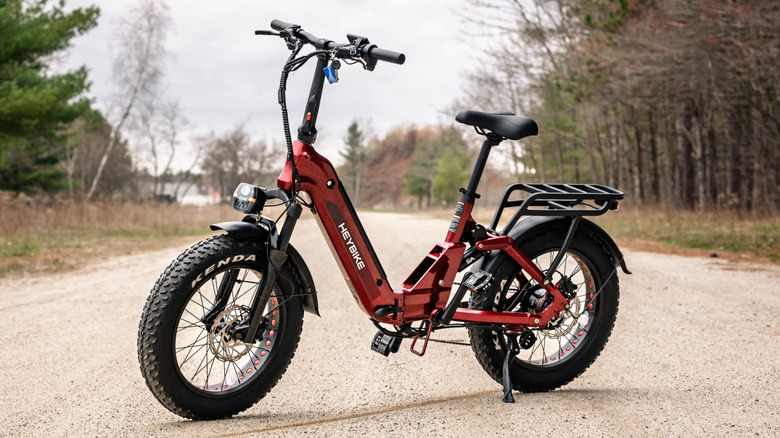
Enter the e-bike, specifically the HeyBike Ranger 3.0 Pro. This battery-powered gizmo is part of a segment that has exploded in popularity, with experts suggesting it's the new form of mass transit. The U.S. Department of Energy says that e-bike sales quadrupled between 2019 and 2022, and a report from Global Market Insights indicates close to 1.5 million e-bikes were sold in the U.S. last year. After spending time cruising around on this HeyBike, it's easy to see why. Low running costs, a smooth ride, and road-ready design are highlights, but the $2,000 price point is also pretty compelling compared to buying a car. Plus, it's just plain fun.
Cheaper to run
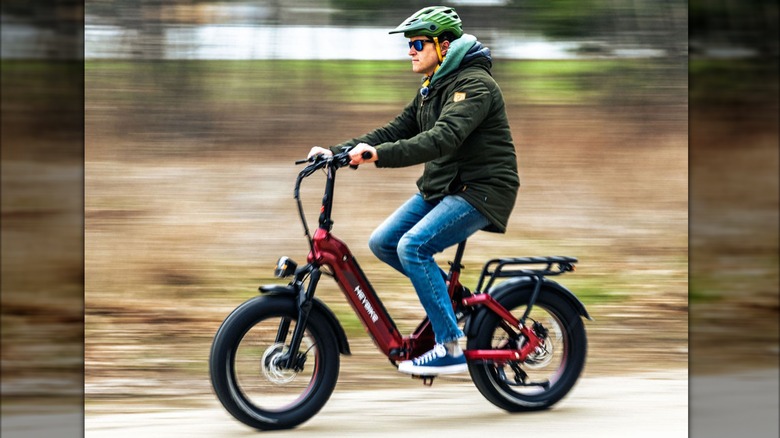
You'll have to take this math with a grain of salt. Obviously, an e-bike can't replace a car for all purposes. But the value proposition is hard to ignore. One of the most popular vehicles in the U.S. is the Toyota RAV4. For 2026, it comes with a 42 mpg combined rating and a 14.5-gallon gas tank. At the national average of $4.22 per gallon of gas, the RAV4 costs about $61 to fill and 10 cents per mile to run.
Going with an EV like the new Subaru Solterra and its improved reputation, it'll cost about $14 to fully charge based on the current national average electricity cost ($0.194/kWh) and a 74.7-kWh battery pack. With a max range of 288 miles, you're looking at about 5 cents per mile to use. Then there's this HeyBike Ranger. Helped by its relatively minuscule power output of just a single horsepower and featherweight of 75 pounds, it is shockingly efficient in this context.
The 0.72-kWh battery pack costs about 14 cents to fill up and two-tenths of a cent per mile to run based on its 90-mile range. That's 50 times less than our Toyota example and 25 times cheaper than the Solterra. E-bikes are by no means maintenance-free, but they're certainly less intensive to keep on the road than an ICE-powered car. Of course, these costs are estimates that will vary based on how often you use the pedals on your e-bike versus all-electric power. From just a running cost perspective, the e-bike wins, hands down.
Smoother ride
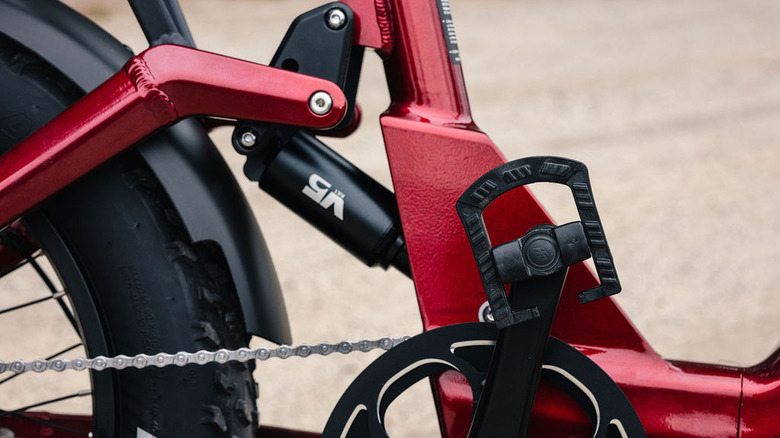
I recently drove a new $85,000 Ford Expedition King Ranch with trick adaptive dampers. The ride from this $2,000 e-bike is arguably better, at least going 20 mph over pockmarked pavement. In fairness, the Ford uses body-on-frame construction, which I find can deliver a more jarring ride than your average unibody crossover, or fat tire e-bike, at low speeds with a choppy road surface. HeyBike stacks the Ranger 3.0 Pro with equipment to make this possible, namely the full suspension setup.
Up front, it's a pair of adjustable hydraulic dampers that can be locked out, but the ride is so much cushier when they're set at the full 2.5 inches of travel. In the back, a Horst-link subframe links with an adjustable air shock rated for 174 psi. This design means the rider is far more isolated from road impacts than they would be on a bike without suspension. As a member of the so-called "fat tire" e-bike segment, the Ranger 3.0 Pro gets a set of 20" x 4" tires with beefy sidewalls as another element of keeping the ride smooth.
What about that bike seat, you may be wondering? Well, HeyBike says the "cushioned saddle offers plush support and ergonomic comfort for a more enjoyable ride." Clearly, the heated and cooled thrones in the Expedition King Ranch, which can be optioned with massaging cushions, take the cake on keister comfort. However, compared to the rigid arrow-shaped object that calls itself a seat on my road bike, the Ranger 3.0 Pro is indeed cushioned.
Usable cargo hauling
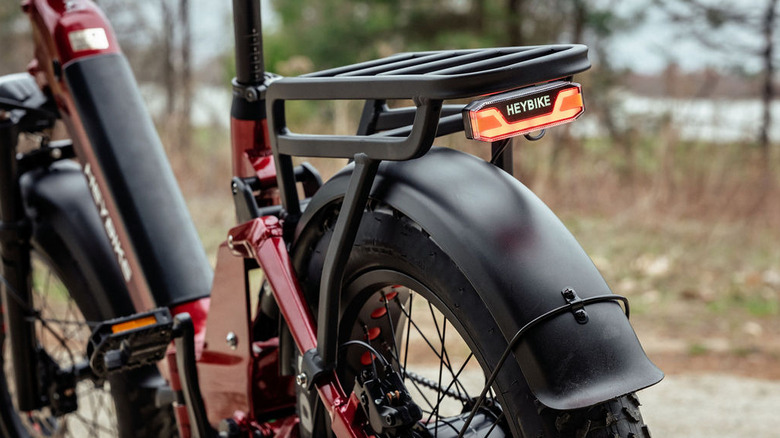
Making the aforementioned milk and art project runs on this e-bike are genuinely doable thanks to a robust rear cargo shelf. This shelf is rated for 100 pounds, while the overall load rating for the e-bike is 440 pounds, including the rider and cargo. This e-bike is remarkably flexible on the cargo front, making it an ideal option for skipping the car for quick trips.
Along with the integrated rear rack, HeyBike offers a handlebar bag, front and rear baskets, and pannier bags. That latter accessory would make a good fit for going beyond short trips and swapping your car for an e-bike to commute to work. Plus, the Ranger 3.0 Pro can be folded, something the highly rated Velotric Nomad 2 e-bike cannot do. Which means, should you prefer to treat it as cargo rather than haul cargo with it, just unlock the frame mechanism and fold this e-bike neatly in half.
It requires a bit of muscle and at 75 pounds, the HeyBike is heavy, but I can confirm that it will fit in the back of a compact crossover with the rear seats upright. Sure, a car is easier to move cargo with, but an e-bike pinch hits better than you might expect. And with this kind of cargo capability, I'd argue the Ranger is a candidate for Consumer Reports' list of the best e-bikes you can buy.
Road-friendly specs
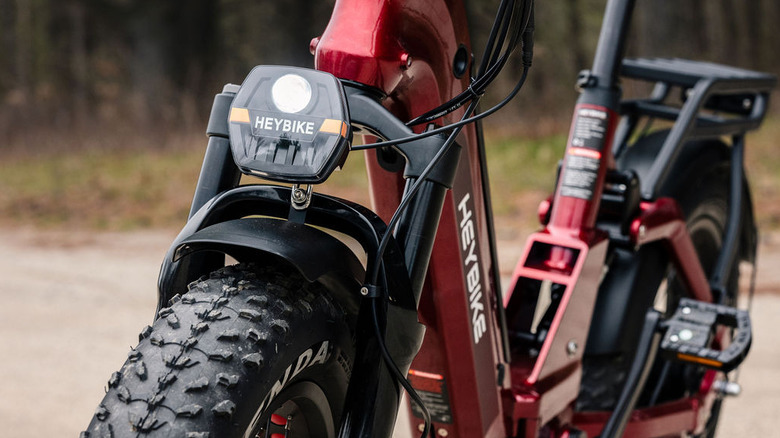
Riding any bike on the road is risky compared to being cocooned in a car. That said, HeyBike has done an admirable job of baking in a host of features on the Ranger 3.0 Pro that add rider confidence. Safety wise, there's a headlight and taillight that rapidly blinks when the brakes are activated. Also part of the deal are disc brakes, which grab strongly, turn signals, and a horn — really more of a beep.
Integrated front and rear fenders work to keep you free from debris, and the IP65 water-resistance rating means you can run errands in the rain. Perhaps the most important spec for riding your e-bike on the road is speed. Out of the box, the Ranger 3.0 Pro will hit 20 mph. I was a little surprised at how fast that feels, but really, for errands that are further out, you'll want to open up the HeyBike app and unlock the 28-mph top speed. Going this fast makes it easier to keep up with the kind of stop-and-go traffic experienced where I live.
When it comes to e-bike pedal assist — it is a bicycle after all — HeyBike touts the use of a torque sensor on this particular model, as opposed to a cadence sensor. Cadence versions work from pedal movement while torque sensors keep track of how much pressure is put to the pedals. I haven't ridden an e-bike that uses a cadence sensor, but I would agree with the general sentiment that torque sensors deliver a smooth, natural assisted pedal feel.
The case for an e-bike
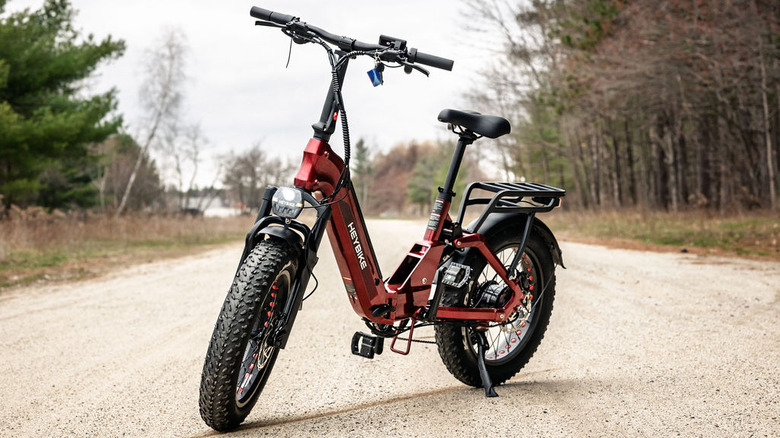
At the end of the day, a car is naturally more capable than any e-bike. More space inside, a higher level of occupant safety, protection from the elements, and so on. However, I regularly find myself in scenarios where a fat-tire e-bike would be a better choice, with its cushy ride and easier maneuverability. For reference, I work from home and have three teenagers with active extracurricular lives, which generally takes place all within a few miles of where we live.
That means the mundane tasks that fill out a typical day usually fall to me. Firing up my gas-powered car to go a couple miles every time duty calls feels unnecessary when so many of these trips could be handled with an e-bike. It's not perfect, but this approach is definitely a lot cheaper and can be quite a bit of fun in the process.