

A Cray Supercomputer Created The 'Realistic' Special Effects In A Classic '80s Sci-Fi Movie
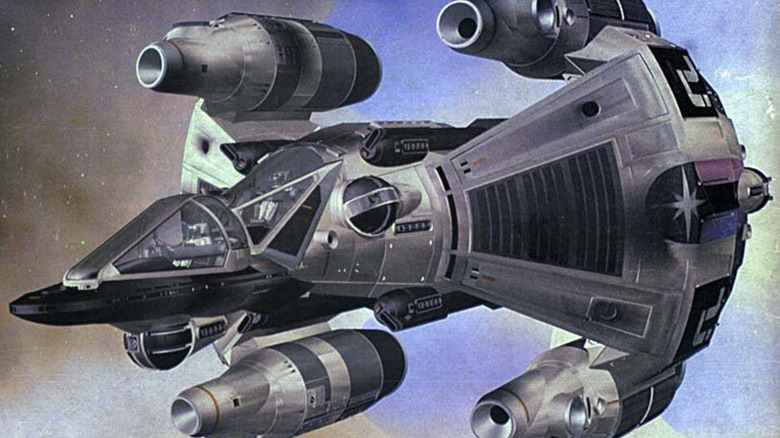
One of those '80s sci-fi movies you've probably never watched, Disney's "The Last Starfighter" is perhaps not best known for the storyline. One of the first movies to use computer generated imagery (CGI) extensively, "The Last Starfighter's" history with period technology is arguably more interesting than the movie itself. Using multiple machines, including an IMI-500 workstation, "The Last Starfighter's" 3D effects were mostly rendered on the Cray X-MP supercomputer by a company called Digital Productions.
This was a $15 million machine that launched in 1982 as an iteration over the Cray-1. It came in a variety of specs, and was the world's fastest computer in the early '80s. During the shooting of the movie, which only lasted 38 days, 27 minutes of effects were conceived for the computers to craft via Fortran — a significant amount at the time. It's estimated that some 400,000 polygons — the shapes used to build the digital images — were required to build just a single spacecraft, the Gun Star.
The Last Starfighter kicked off CGI as we know it
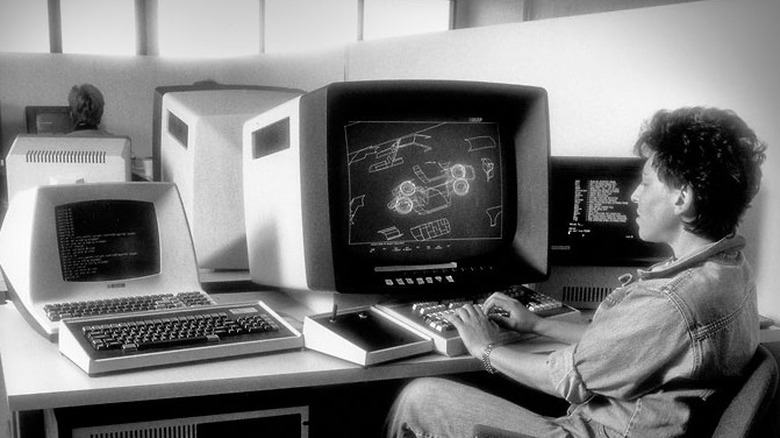
Due to these effects, the budget on the movie ballooned, including a $3 million contract with Digital Productions alone. At the time, Digital Productions and the studio claimed that the effects would be realistic. Today, the look has been called cheesy, but is remembered for being impressive at the time, considering the technology.
While "The Last Starfighter" may not be part of the best sci-fi movies of the era, it is often praised as kickstarting the visual effects revolution. A year later, a Sherlock Holmes movie would feature the first fully CGI character "Young Sherlock Holmes" would feature a fully 3D animated knight. Then, 15 years after "The Last Starfighter", Jar Jar Binks, the most hated character in "Star Wars" would take CGI characters to a new level.
The movie went on to make $28.7 million, and has a cult following. Its director, Nick Castle, directed several other films, including "Major Payne" and "Dennis the Menace" in the '90s. Digital Productions would go on to work on films like "Labyrinth" with Jim Henson, but after being purchased by Omnibus Computer Graphics, it would disappear when the company went bust in 1987.