

Severance's Adam Scott Stars In A New Irish Folk-Horror Movie You Shouldn't Miss
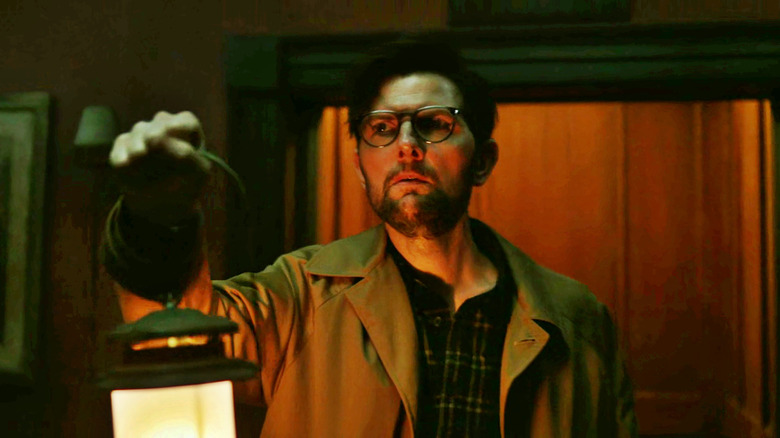
Damian McCarthy's latest film, "Hokum" — the follow-up to his similarly strange and frightening "Oddity" from 2024 — never makes the impression that it wants to be an outlier among those thematic horrors (like the most disturbing sci-fi horrors you'll only watch once) that are primarily built on trauma. It's clear from the get-go, as we watch Adam Scott's American author, Ohm Bauman, type his latest novel away on his laptop in the dark while sipping whiskey, that he's a man burdened by some formidable demons from his past. He looks at the ghost that appears in his sterile, lifeless flat with a calm familiarity. It's evident that whoever the spirit may be, it's not the first time visiting him.
But before he could further investigate, Ohm is already on his way to The Bilberry Woods Hotel in rural Ireland, where his parents went on their honeymoon decades ago. They are both dead now; his mother was shot when she was young, while his father drank himself to death, consumed by grief. Ohm arrives with a plan. He's there to scatter his folks' ashes in the woods, check out the honeymoon suite they stayed at, and then kill himself.
But apart from spreading the remains, nothing goes according to plan; he can't enter the honeymoon suite since it's closed due to the owner's belief that it's haunted by the Cailleach witch, and when Ohm hangs himself in his room, the hotel's bartender saves him. After waking up in the hospital, he returns to the hotel for his belongings and finds that his savior has gone missing. So he decides to find the girl before leaving the island, and every clue points to the honeymoon suite. With nothing left to lose, Ohm goes up there to face whatever awaits.
Damian McCarthy has slowly become a master of atmospheric horror

"Hokum" doesn't reinvent the genre (nor does it have any intention to do so) but maximizes every tool and trope it has to offer. After cutting his teeth on a series of award-winning short films and two low-budget horror features, McCarthy has become a master at building atmosphere. His latest is another slow-burning creep-fest, where he meticulously carves out a haunting mood that gradually overtakes the viewer's mind. In "Hokum," the use of light and darkness is his most immersive and ominous yet, permeating a rising tension and overflowing fear that builds to a crescendo at the midpoint, whetting every diehard horror fan's appetite — as one of the scariest horror movies of the past decade did.
The story (also penned by McCarthy) might be another customary folk tale turned into a traditional scary movie narrative, but the director makes sure the dread and viscera that constantly linger in the air as the plot unfolds go straight to your nerves. Naturally, the immaculate production design (from old and rugged furniture to carefully picked wardrobe choices) and Joseph Bishara's ambient score as the eerie underpinning of the picture serve as the bedrock and core foundation in which nightmares can grow. And achieving all that with carefully restrained gore in favor of a more impalpable macabre is truly a rare accomplishment.
But that's not to say that "Hokum's" script is nothing to write home about. Fusing complex trauma with folk phantasmagoria is never an easy task, yet McCarthy makes it seem so. The characters are grounded, self-aware, flesh-and-blood human beings with relatable everyday problems into which the paranormal has to force itself in — especially when it comes to the viciously cynical, extremely rational, and insufferably misanthropic protagonist that Ohm is.
The poignant symbiosis of grief and guilt is Hokum's best feat
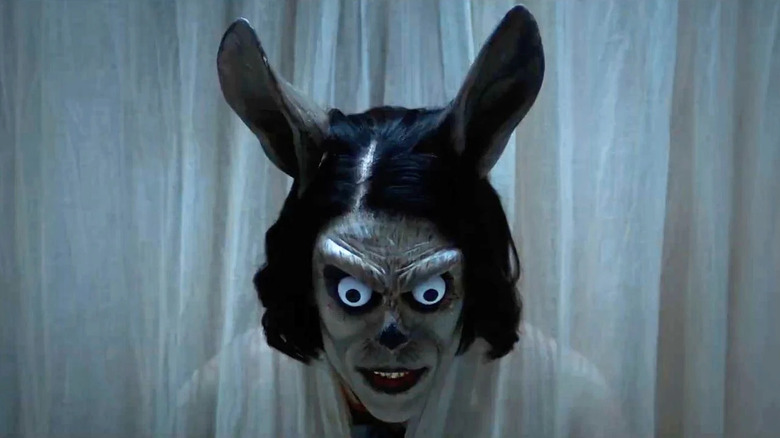
As a successful yet deeply depressed author, Ohm isn't the kind of hero who's easy to like. He's a cynic undone by his somber past, and Scott channels that ugly and hostile energy remarkably well (as he did in Apple TV+'s "Severance"). There's a reason behind his behavior, and McCarthy subtly places every puzzle piece for us to pick up and place in the big picture when the key revelation of his past sins arrives. Without giving anything away, I can say with confidence that the symbiosis of grief and guilt that eats away inside Ohm is a pinpoint accurate depiction that culminates poignantly in the last stretch of the movie without interfering with any of the scares throughout.
Because "Hokum" isn't just about witches, murders, and goats jumping on cars (you'll see), but the acceptance of our past (regardless of how dark it is) and finding redemption for any sins (and the overwhelming guilt that stems from them) that we never thought of as a possibility. Going hand in hand until the very end, the scares and vast array of emotions create a potent cocktail in "Hokum," reaching its climax in one of the most harrowing scenes of the film. But that's exactly why it'll stay with you well after the credits roll.
There might not be an outstanding amount of originality here, but "Hokum" is a great example of how to excel using everything the genre provides to make a movie that delivers exactly what it promises. Frankly, from a $5 million budget, that's not short of extraordinary these days. Thus, it's no surprise that McCarthy's third feature stole the heart of critics as much as it has the moviegoers, making nearly $24 million worldwide.