

Why Do TV Remotes Still Use Infrared Instead Of Bluetooth?
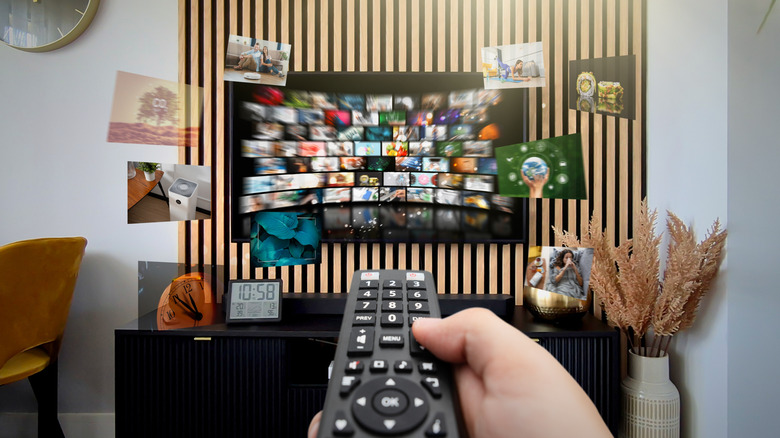
Say it out loud, and you feel like the hero in an old spy thriller: infrared. Or maybe it's just us. Either way, infrared (IR) now feels like a quaint technology, a relic from a bygone era. In the age of high-bandwidth Bluetooth and Wi-Fi, it feels as though infrared should've long since been phased out, yet a number of manufacturers still use it in their brand-new, high-resolution televisions — and remotes.
Infrared remotes started seeing wide adoption all the way back in the late 70s and early 80s, when they appeared on the scene to dethrone ultrasonic clickers (the very first wireless TV remotes, introduced in 1956 by Zenith Electronics). Infrared quickly became ubiquitous, appearing in controllers for everything from multidisc CD changers to slide projectors and air conditioners.
So, why is a technology that appeared in the 70s still so widely used today? You likely won't be surprised to learn that a large part of the reason is cost. That said, infrared is also a leader in simplicity, reliability, and power efficiency when compared to more modern wireless technologies.
The advantage of infrared

Infrared works by transmitting codes in the form of infrared radiation (it's also how your Oura Ring reads your blood oxygen level, though without the codes). A microprocessor creates binary code and instructs an emitter in the remote to encode it as pulses of light, which it flashes towards the device. A detector in the target device picks up the binary and translates it into commands, like Channel Down or Change Input.
IR is extremely cheap. All you need to build it into a remote is a cheap LED emitter and receiver. Manufacturers also don't have to worry about paying dues and fees, as they do with Bluetooth, which is controlled by a consortium (the Bluetooth Special Interest Group). There's that old saying, "If it ain't broke, don't fix it," and infrared has been working, and working well, for more than 40 years now. It's straightforward: the remote flashes, the detector counts the flashes. It also relies on line of sight, which cuts down on interference.
Then there's the matter of efficiency, a major consideration in the era of spiking utility fees. IR uses less power than Bluetooth, and because the emitter only activates for very brief intervals, batteries tend to last for a very long time.
Where Bluetooth has the upper hand
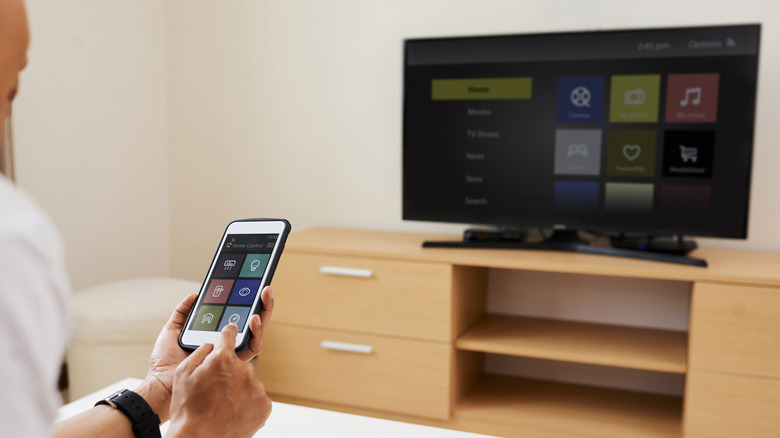
All of that said, Bluetooth has become a dominant standard for a reason. While it suffers from some common issues, it also has some common fixes. Also, it's everywhere, in nearly every smartphone, and you can buy a dongle to add it to a PC for just $10. It allows a huge range of devices to convert data into radio signals and exchange them over the air. Though you typically find Bluetooth in things like smartphones or wireless speakers, it's increasingly appearing in remotes as well, and with good reason.
For one, Bluetooth doesn't require line of sight. Left the living room TV on and it's blaring while you're getting in bed? Bluetooth's got your back. It can go right through the wall between the two rooms and switch off the TV without requiring you to so much as ruffle your covers. It also has a much longer range. While infrared tends to top out around 10 meters, Bluetooth can reach up to ten times that distance. Bluetooth also lets you link up to multiple devices at the same time, while infrared is strictly one-to-one with the single device the remote is programmed to control and be pointed at.
Finally, there's the broad compatibility angle. Some device manufacturers are eschewing dedicated remotes entirely because they know most consumers have a smartphone or tablet, which can control a device without a specialized emitter; you just need your device to work with Bluetooth.