

Tesla Faces A Potential Challenge From A Robotaxi Manufacturer In China
Electric vehicle (EV) automaker Tesla might be best known for its line of EVs, but it also has a growing autonomous taxi program, the Tesla Cybercab. Currently, Tesla's robotaxis are operating in the Texas cities of Austin, Dallas, and Houston, and this program is part of Tesla's mission to innovate the vehicles of the future. Tesla isn't the only company developing a fleet of self-driving taxis, though, as the Chinese company Xpeng could become a competitor very soon.
Like Tesla, Xpeng produces various EVs, and it, too, has an eye on building its own robotaxis. And soon. In January 2026, Xpeng began testing autonomous vehicles, and by March, it expanded business operations to produce driverless taxis on a large scale. By May, just three months after the initial tests, Xpeng marked the official rollout of these vehicles. Now, it looks ahead to an aggressive 2026 where it goes all-in on robotaxi technology and expansion, which could soon see it being a direct competitor for everyday travel with Tesla.
How Xpeng can challenge Tesla
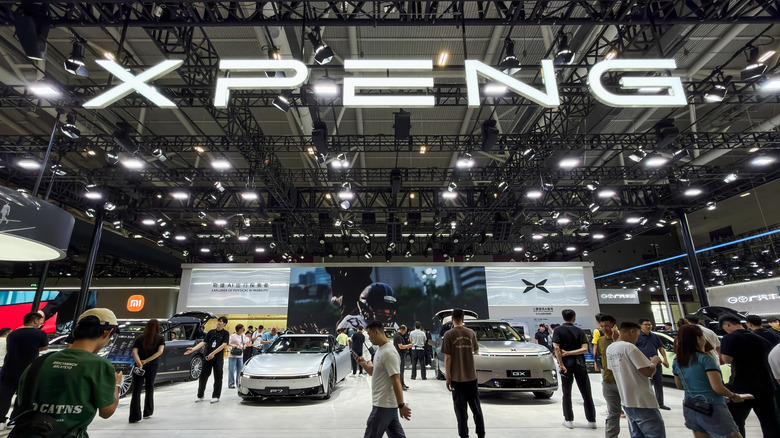
Xpeng has been around since 2014, and while it was founded in China, the company also has locations in Europe and U.S., including a research and development center in California's Silicon Valley. In 2024, Xpeng and Volkswagen formed an EV-related joint venture, and it hopes to partner with more large-scale automakers to offer EVs worldwide. Xpeng already sells its vehicles on an international scale and foresees that only increasing in the future.
And Xpeng isn't looking just to challenge Tesla in EV production either as it has an ambitious goal of having its driverless taxi program fully operational next year. Like Tesla, Xpeng's robotaxi program is still in its infancy as neither company has yet to produce robotaxis and operate them outside of their own countries, and it was only this year that Tesla's robotaxis were fully driverless, with no safety driver behind the wheel. Robotaxis can be a controversial topic as some fear them being dangerous, and that fear was realized in 2024, which led to GM cancelling its robotaxi program. In markets, such as China, where both manufacturers are sold, consumers have to decide which EV is a better purchase, a Tesla or an Xpeng, and soon, they'll have to decide which robotaxi to hail on a city street.
Xpeng is also looking to the skies
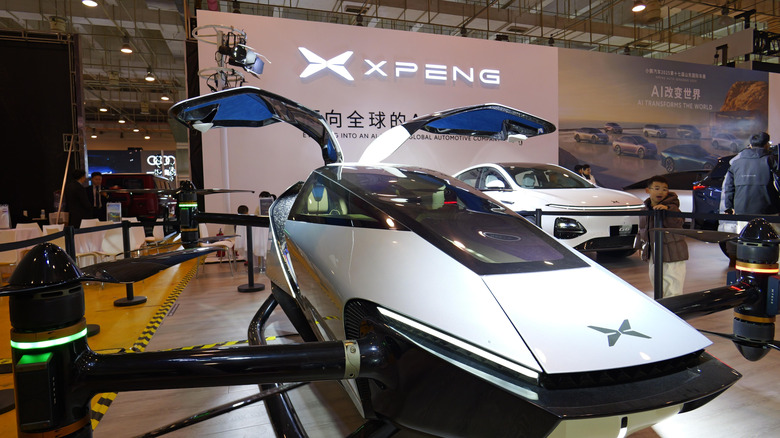
Xpeng isn't just going to settle for innovative EVs and robotaxis, though, as it has plans to produce flying cars for the everyday person to buy and use. Xpeng wants to have its flying cars in production by next year, and it's already getting plenty of attention with thousands of preorders received so far. Even though Elon Musk has promised Tesla is working on something cool, a flying car is certainly steep competition.
If the roads and the skies aren't enough, Xpeng also is applying its artificial intelligence (AI) technology to humanoid robots – Tesla ended production of two of its models to focus on producing robots. It wants to put these robots in customer service-oriented jobs by early 2027 in China, and Xpeng's strategy is to move on to a global expansion. If it is successful in its goals, it could certainly become an interesting player able to challenge Tesla from multiple angles.