

Why Old-School CRT TV Screens Had That Weird Fuzzy Feel To The Touch
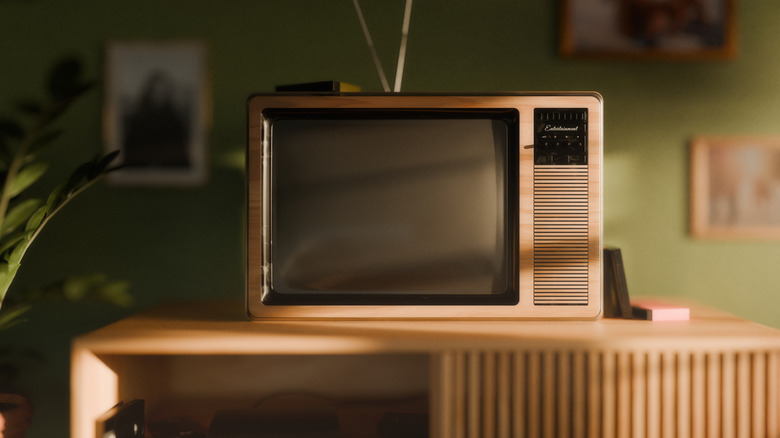
It's not a surprise that retro enthusiasts are in love with CRT TVs. Sure, a brand-new 4K LCD screen will give you a sharp and clean image, but many people still claim that a CRT simply looks better and provides a richer experience. In fact, CRTs can be put to use in a variety of ways, from retro gaming monitors to digital photo frames. Everything about them screams "vibe," after all, from that iconic high-pitched "whine" to the static feeling you get when you put your hand close to the screen. Gen Z may not remember this, but old-school CRT screens would give your hand a fuzzy feeling by discharging enough static electricity that you could hear audible crackling.
Why did this happen? Well, it's all down to the underlying tech. Because they used cathode ray tubes, older TVs operated at much higher internal voltages than modern televisions (a CRT TV can hold as much as 25,000 volts). As a result of the storm of electrons brewing inside, a massive charge would build up on the outside of the screen. So, once you put your hand close to the screen, the static charge would start pulling on your skin, and if you touched it, the screen would give you a tiny jolt of electricity.
Why did old-school TVs give off so much static?
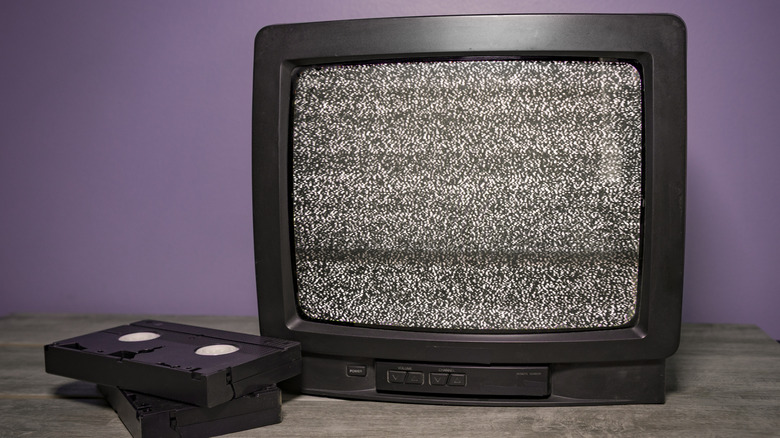
CRT TVs may be one of the best thrift store tech finds, but they're primitive compared to modern displays. A cathode ray tube is essentially a sealed glass vacuum chamber that consists of an electron gun on one end, a deflection system in the middle, and a screen coated in phosphor on the other. The electron gun consists of a cathode (negative charge) and an anode (positive charge). The cathode releases electrons that the anode accelerates (and the deflection system aims) into the phosphor-coated screen, projecting an image in the process.
As the back of the screen was bombarded by electrons, the front of the glass would build up quite a lot of static charge. Touch or come close to the screen, and your skin would feel fuzzy from that static buildup. Such a sensation given by those old-school CRT screens is a unique experience. Modern televisions still generate some static, but the underlying tech is much more efficient. For instance, LCDs use liquid crystals and polarized lights, so there simply isn't as much charge at the surface of the screen to give off that "fuzz".