

This Is What Aircraft Carrier Radar Systems Actually Look Like Up Close
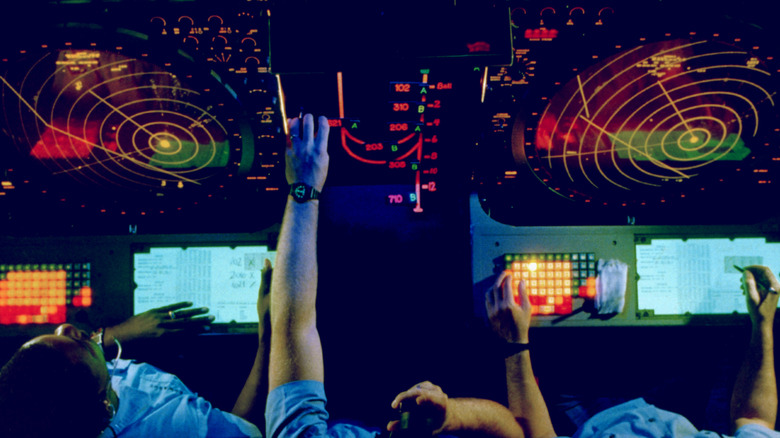
Radar technology on board nuclear-powered aircraft carriers like the USS Gerald R. Ford (CVN-78) are one of the most critical situational awareness tools used in carrier-based combat today. Crew members sit inside a dark room called the Combat Information Center (CIC), using radar screens to identify and track potential threats or targets. A video from The Navy Channel gives a unique look inside the CIC of the USS Gerald R Ford, showing technology that is far more advanced than carriers of the past.
Carrier-based radars were first introduced as far back as the 1930s, featuring rudimentary aircraft or ship detection at ranges up to about 100 nautical miles, and interfaces that were highly manual to operate. Radar scopes featured circular guidelines showing target bearing relative to the ship, and this information was used to pinpoint a target's location. Today, radar returns are no longer viewed as single-information-sources, but, instead, they rely on aggregated views of multiple sensors both on and off the ship, to form a real-time picture of threats and enemy movements. Radar interfaces started out as basic radar scopes displayed on cathode-ray tubes, and they have developed over time where they are now shown on large desktop monitors.
The early days
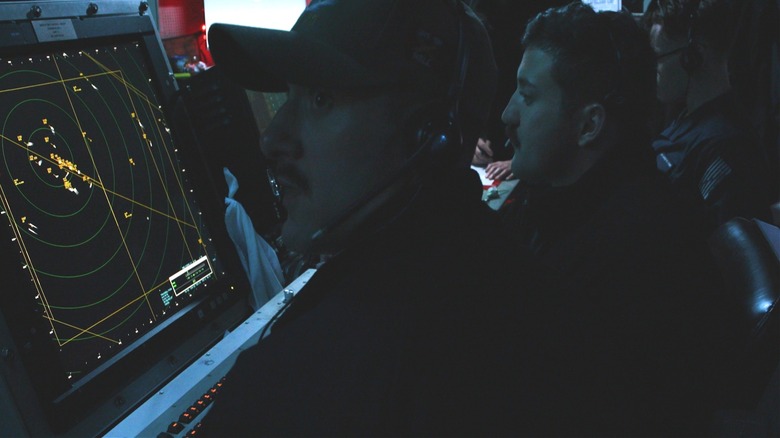
Radars on aircraft carriers entered operational use in 1940, when the first CXAM radar was installed on the USS Yorktown. The CXAM radar consisted only of the most basic interfaces, with sailors manually plotting aircraft or ship positions based on A-scan returns. Blips on the screen would indicate a target, and operators would be able to plot the target's range. The CXAM radar was able to identify and distinguish two ships 400 yards apart, and it was able to detect fighter aircraft from 50 nautical miles away, giving the Navy a distinct early warning advantage over its enemies.
These early radars relied on a mechanically rotating antenna, but as jet planes and missiles got faster, the technology had to evolve. A new kind of radar technology — phased-array radars — were introduced on carriers during World War II, and they brought the ability to scan targets more quickly and more accurately, with mechanical scanning replaced by stationary, electronic scanning. In 1962, the USS Enterprise was equipped with the next-gen frequency scan radars, which were as big as billboards and could track targets more than 200 nautical miles away. Radar operators at the time viewed target returns on a circular display console with green radar lines and dots showing basic information on a target, including range and bearing.
The future of carrier radars
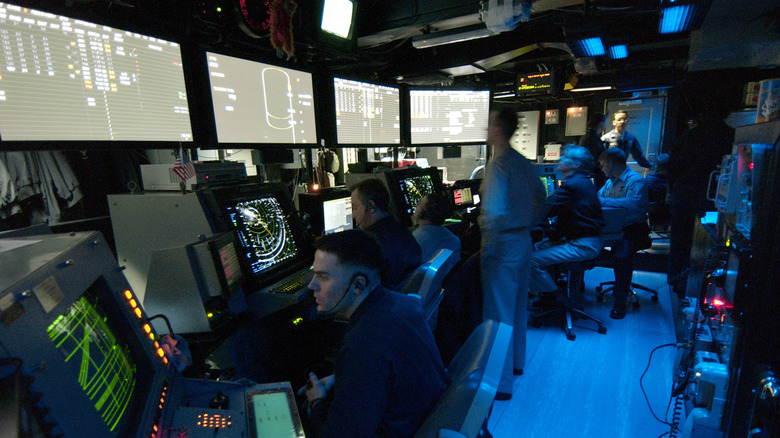
The most recent aircraft carrier, the USS Gerald R. Ford, entered operational service in 2022 a more advanced radar technology, using a SPY-4 volume search radar and the SPY-3 multi-function radar, integrated to form its dual-band radar system. The SPY-3 and SPY-4 radars can track targets 250 nautical miles away, and forms part of the Ford's modern-day combat information center. These radars will soon be replaced by the SPY-6 radar, which features improved range and tracking capabilities. While older radar systems were primary sources of target and traffic data, modern day interfaces don't just include single visual displays, but they also show aggregated data from multiple sources to form a holistic view of a combat scenario.
The radar images are displayed on modern computer LCD monitors instead of legacy radar scopes, and they are shown as part of software called the Ship Self-Defense System (SSDS). The radars on the Ford class of carriers are being used as part of the navy's Project Overmatch, which aims to aggregate data using ship censors like the SPY-4 radars and sending them to central Navy sources where they will be combined with censor data from other ships, aircraft, and satellites to enable strategic decision making at a high level. Expect the USS John F. Kennedy, the U.S. Navy's upcoming nuclear supercarrier, to have even more radar tech when it enters service in 2027.