

The Largest Solar Farm In America Has Almost 2 Million Panels - Here's Where It Is
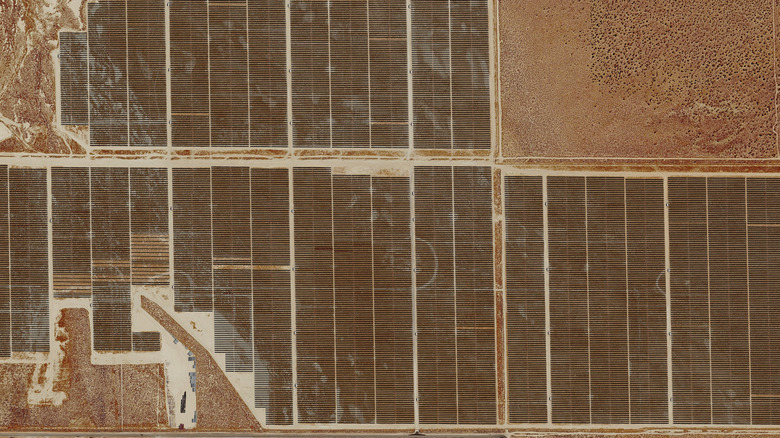
While it still makes up a relatively small part of U.S. electricity production, solar power has overtaken coal for the first time, thanks to massive investment in new facilities and despite the fact that solar power is being weakened by air pollution from fossil fuels. According to a June 2026 report from the Solar Energy Industries Association, solar made up 60% of all new electricity-generating capacity added in the first quarter of this year. Currently, the largest solar farm in the U.S. is Edwards & Sanborn Solar + Energy Storage, located in Kern County, California, within the Mojave Desert.
Built between 2021 and 2024, the massive solar farm is made up of over 1.9 million panels and extends over 4,660 acres of land, including parts of Edwards Air Force Base, and has a capacity of 864 MWdc (megawatts direct current), plus 3,287 MWh (megawatt hours) of battery storage. That makes Edwards & Sanborn the country's largest solar-plus-storage farm in terms of overall capacity, even if it's physically smaller than Orion Solar Belt in Texas, which mostly produces power for Google data centers rather than American homes.
According to NASA, Edwards & Sanborn Solar + Energy Storage has the largest battery storage system in the world. That's particularly important for a solar farm, allowing it to reliably supply banked energy at night or in bad weather. Battery capacity also prevents waste. After all, being able to produce a lot of electricity doesn't mean much if that power isn't going anywhere. Edwards & Sanborn has a maximum interconnection capacity of 1,300 MW (or 1.3 GW), with energy going to the California Independent System Operator (CAISO) grid to power homes and businesses, including Starbucks.
How the largest solar farm in the U.S. compares to the rest of the world
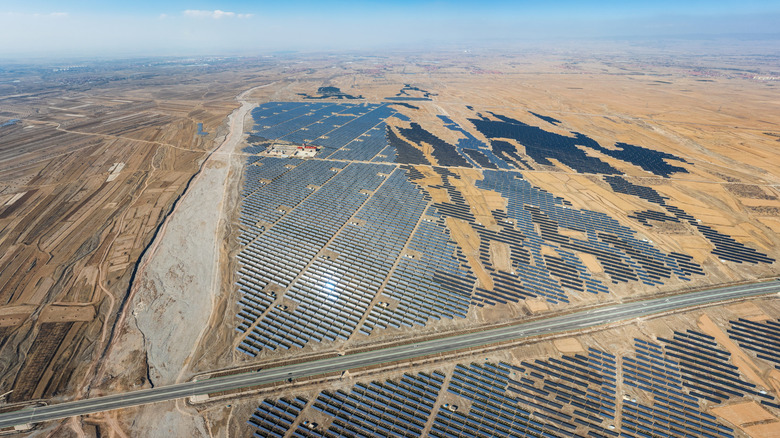
While Edwards & Sanborn Solar + Energy Storage is impressive, it's pretty small compared to the facilities you'll find across Asia and the Middle East. China's largest solar farm, which has quietly been changing the desert around it, is Gonghe Photovoltaic Park (also known as Talatan Solar Park). The massive installation covers 162 square miles of what was sparsely populated desert atop the world's highest plateau and has a capacity of up to 16.9 GW — not megawatts — which is enough to power every home in Chicago.
Other impressive solar farms that take advantage of vast sunny deserts include India's Bhadla Solar Park, which has a capacity of 2.2 GW and stretches across over 21.6 square miles, making it the country's largest. There's also the United Arab Emirates' Mohammed Bin Rashid Al Maktoum Solar Park, located just outside Dubai and covering about 30 square miles. That facility has 3.7 GW capacity, with a goal of reaching 5 GW by 2030.
Edwards & Sanborn Solar + Energy Storage's battery capacity leaves room for expansion, but it may not be the largest solar farm in the U.S. for long. Mammoth Solar Farm in northwest Indiana has a planned capacity of 1.3 GW across its three installations, two of which are already operational, producing a combined 700 MW. The final and largest piece, Mammoth Central, began construction last year and is expected to begin operating in 2027. American projects like this may seem minuscule compared to many international ones, but getting developers to compete for the title of largest solar farm in the U.S. can only be a boon to clean energy overall.