

No, Solar Panels Don't Work Well During A Heatwave - Here's Why
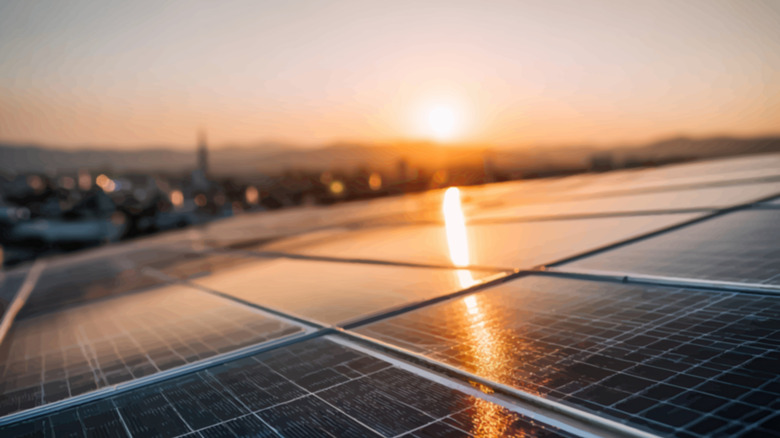
2025 was one of the warmest years on record, and each subsequent year will threaten to break that record. If you want to stay cool without worsening the situation, you might be tempted to use solar-powered cooling systems, but that implies solar panels work when you need air conditioning the most: during heatwaves. Unfortunately, they are subject to the rule of "too much of a good thing."
While solar panels generally work best in direct sunlight, they ironically don't do well in high temperatures — when the sun is at its strongest — due to how they generate electricity. Basically, the sun (and to a lesser extent artificial sources of light) generate particles known as photons, and when they reach solar panels, they create electric fields that make electrons start moving, creating a current that eventually produces the electricity we rely on. However, the hotter a material gets, the more its molecules move, electrons included. Above a certain temperature, electrons move around a little too much, making it harder to move through the solar panel to where they need to be, reducing voltage (the pressure of electric flow) and, in turn, efficiency.
As a general rule, solar panels work best at a temperature of 25 degrees Celsius (77 degrees Fahrenheit), and every degree Celsius above that hamstrings efficiency by 0.5%. Heatwaves can heat solar panels up to 65 degrees Celsius or more, reducing efficiency by as much as 25%. While direct heat/sunlight can impact a solar panel's performance, a lack of cooling solutions can make their temperatures soar even hotter.
Keep solar panels cool to keep yourself cool
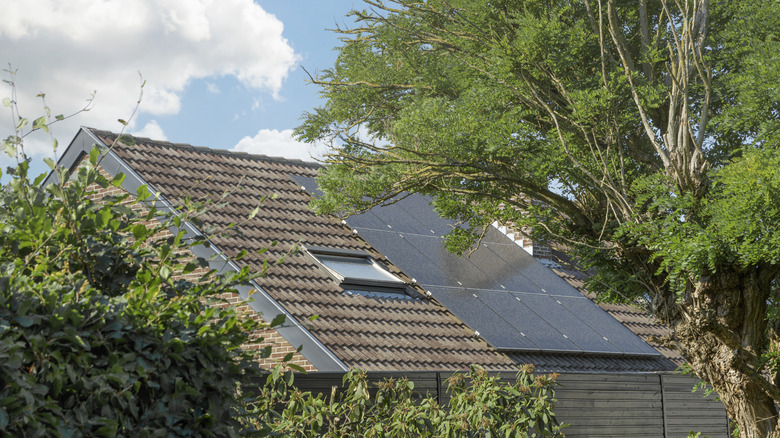
You might wonder why solar panel efficiency caps out at 77 degrees. That's because these systems are tested around that temperature. While we have little control over the day-to-day temperatures (humanity's influence on climate change notwithstanding), we can customize our solar panel installations so they don't heat up too much.
Since heat rises, not only do solar panels have to contend with the ambient outdoor temperature but also any heat that escapes from house roofs. However, installing anchors that provide a few inches of breathing room between the roof and the solar panel gives heat enough space to dissipate while also providing a passive convective air flow cooling solution. Furthermore, while traditional logic says you want to use solar panels with dark colors that absorb as much light as possible, solar cells made out of reflective, light-colored materials stay cooler and thus maintain efficiency more readily during heatwaves,
Even if you can't keep solar panels themselves cool, you can mitigate some efficiency degradation by cooling the inverter (the component that turns the electrical current into usable electricity). Installing inverters in shaded areas — e.g., behind the solar panel — gives them a break from the heat and maintains somewhat optimal temperatures. If only you could keep solar panels cool by setting them up in shaded areas, but that would defeat the purpose.