

How To Get The Best Audio Out Of Your Subwoofer
Are you all about that bass? If so, a subwoofer belongs in your home audio setup. Despite the jargony name, a subwoofer is really just a speaker designed specifically for bass frequencies. However, merely installing a subwoofer doesn't guarantee the low end of your favorite songs (and movies, and TV shows, and games, etc.) will shine to its full potential. A few key steps to optimize your subwoofer will help you take true advantage of this component of your audio system.
One of the easiest ways to begin adjusting your subwoofer with the goal of improving bass levels is to move the subwoofer to different spaces around the room. With each adjustment, you should aim to move the subwoofer about five feet. Ideally, every time you move the subwoofer to a new location, you should leave it there for a few days. You need some time to get a thorough and accurate sense of how the new location influences the subwoofer's sound. Take notes, and eventually you should find a spot that delivers the strongest results, where the bass is powerful without overwhelming everything else.
If you haven't even purchased a subwoofer yet, it's also wise to discuss your current setup with a professional before investing in a unit. Choosing the right size subwoofer requires accounting for such factors as the size of the space you'll install it in, as well as the size and power of the existing speakers in your audio setup. Even an otherwise impressive subwoofer may not offer the sound you want if it's too small for the space and system it occupies.
Tips for optimizing your audio system's subwoofer
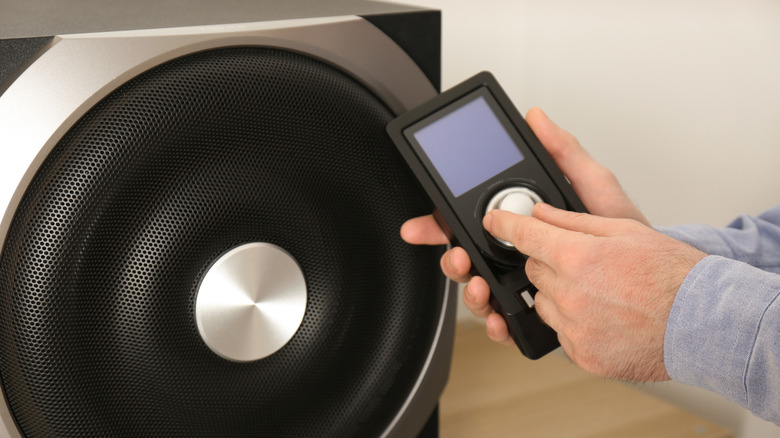
The above suggestions offer a few basic ways to improve your subwoofer's performance. If you want to get more technical, check the back of the subwoofer to see what types of inputs it supports. If your subwoofer has an input called sub in, direct, bypass, or LFE (Low-Frequency Effects), use this as the input instead of the traditional RCA inputs. These jacks are made specifically for lower frequencies and will give you the best bass results. You'll typically need a long interconnect cable to facilitate this connection, but you'll be happy with how the results outshine what you'd get from the usual input options.
It's also likely your subwoofer is part of a larger setup consisting of other speakers. You want to confirm that the settings of your subwoofer account for those of the speakers already in your system. Although this might require some technical know-how, you can manually check the levels of the main speakers and those of the subwoofer to see if they match. If they don't, make adjustments accordingly. For example, if the trim setting (used for fine volume adjustments) of your primary speakers is set somewhere around zero or plus one, the subwoofer trim should also be as close to zero as possible.
Of course, applying all the tips in the world won't help much if you don't have the right subwoofer. That's why, if you're in the market for a new unit, it's important to do your research. By reviewing the best subwoofers on Amazon or the subwoofers most beloved by audiophiles, you'll be more likely to purchase something that ensures the bass always slaps.