

4 Cheaper Soundbars You Should Try Instead Of A Sonos
We may receive a commission on purchases made from links.
We're not going to stand here and deny that Sonos makes incredible soundbars. Performance and versatility are hugely important to the company, with popular products like the Sonos Arc Ultra and Sonos Beam (Gen 2) delivering one heck of an audio experience. Whether you're watching a movie or listening to a podcast, you can count on a Sonos soundbar to deliver exceptional sound quality. Unfortunately, most of the Sonos lineup is expensively priced, too, and soundbars aren't an exception.
While Sonos isn't the only soundbar maker on the scene, the company does make some of the most feature-packed systems. Once connected to the internet, Sonos gear can be controlled and customized using the Sonos app. The software even lets you stream music and podcasts directly from supported platforms like Spotify and Apple Music, as well as remotely from an external device using Apple AirPlay. Don't feel like picking up your phone to adjust a setting or change the song? No problem, as most Sonos hardware supports voice commands, too.
A Sonos soundbar leaves big shoes to fill, but there are a handful of cheaper audio systems that check a lot of the same boxes as products like the $499 Sonos Beam (Gen 2). We found four options worth discussing, so let's get things started by taking a look at a cool JBL soundbar combo.
JBL Bar 300MK2
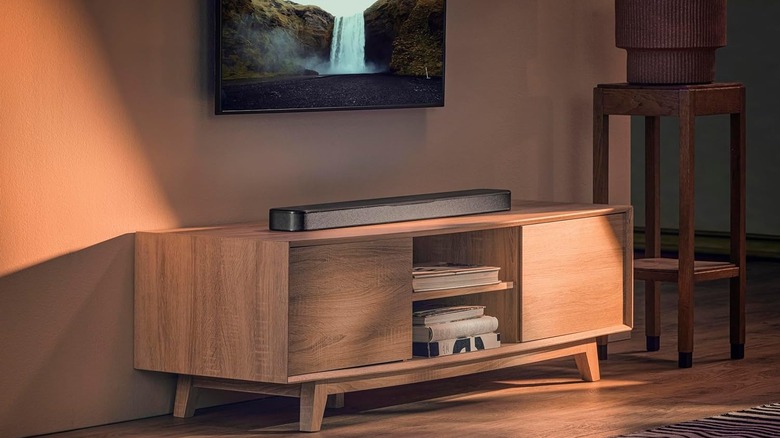
JBL may best be known for its Bluetooth speakers and headphones, but the company's home theater tech packs a serious punch, too. The $450 JBL Bar 300MK2 delivers up to 450 watts of power, making it perfect for small to medium-sized listening spaces. While it doesn't include a wireless subwoofer, the bar's two bass ports do a nice job of bringing the low end to your favorite movies, shows, and music genres.
For what it's worth, the Sonos Beam (Gen 2) doesn't come with a sub either, and it's $50 more than the JBL 300MK2 when neither is on sale. And like the Beam, the JBL system can be connected to Wi-Fi (via the JBL One app) for access to platforms like Spotify Connect, Tidal Connect, and Roon, as well as audio casting via AirPlay 2 and Google Cast. It also supports Bluetooth if you don't feel like using the internet — another leg up over the Beam (Gen 2).
The 300MK2 doesn't contain up-firing speakers, but its front channels and side-firing drivers do a decent job of emulating Dolby Atmos and DTS:X configurations. JBL isn't one to disappoint when it comes to audio deliverables, so swapping Sonos for the JBL Bar 300MK2 gets two thumbs up from us.
Bose Smart Soundbar 600
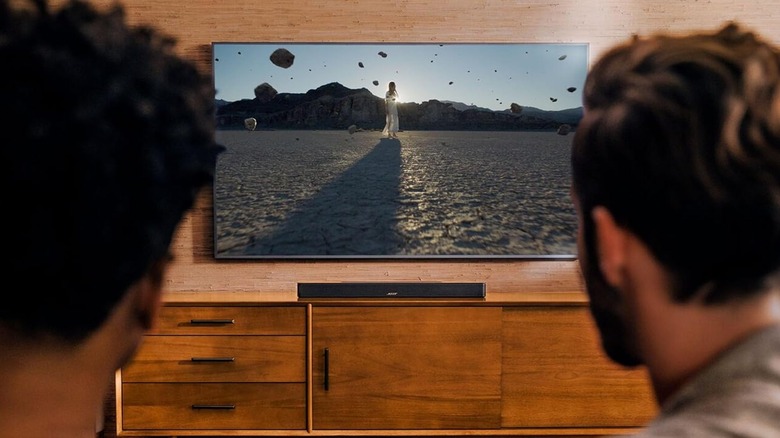
It would feel strange for a Sonos alternatives article not to feature a Bose product. The audio stalwart has been delivering the decibels for decades, and products like the $550 Bose Smart Soundbar 600 are proof that the brand has still got it. While the sticker price is about $50 higher than the Sonos Beam (Gen 2), according to Amazon's price history tool, the Bose 600 has spent more time priced at $399 than the full $550 over the past year.
So let's examine the soundbar itself. First and foremost, there's no acoustic calibration to speak of on this model, but Bose's TrueSpace technology is always optimizing the soundstage. That's really not a huge detractor, though, especially when you consider that the Bose 600 has a dedicated center speaker and two up-firing drivers.
It's built to convince you it can be a surround sound setup, and we're pretty dang convinced. So were our pals at TechRadar, who praised the Bose 600's Dolby Atmos capabilities, but also reminded us that the Bose bar doesn't support DTS (a lot of soundbars don't). The publication claimed "it's a budget soundbar to be reckoned with," and we agree, especially if you love streaming music. The Bose 600 features native support for Spotify Connect, AirPlay 2, Google Cast, and Alexa, on top of Bluetooth connectivity if you want to skirt around Wi-Fi.
The Bose Music app may not be as robust as Sonos' software, but the latter requires your speakers and soundbars to always be online. Plus, the former still gives you plenty of ways to customize your Bose audio, and you can even link it up with another Bose speaker or the Bose Ultra Open Earbuds.
Samsung HW-S60D
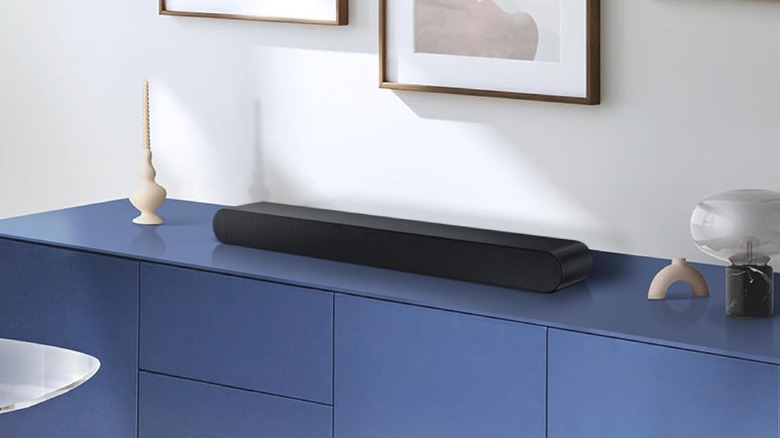
Samsung's soundbar lineup is constantly evolving, and if you're looking for a way to enhance your TV audio that won't set you back $500 or more, you should consider the $400 Samsung HW-S60D. This is a 5.0 system that does a great job of homing in on dialogue and vocals, thanks in part to its dedicated center speaker. Another reason we wanted to feature this Samsung model is its SpaceFit Sound technology, which calibrates the soundbar to best match your room acoustics.
Arguably, we'd say that the Samsung S60D is actually more customizable than the Sonos Beam (Gen 2). There are several audio settings you'll be able to play with to fine-tune the system, and there's even a seven-band EQ for creating your own sound profile. Available connections include HDMI eARC and digital optical, but you'll also be able to connect the S60D to Wi-Fi, which gives you access to AirPlay 2, Google Cast, Spotify Connect, and built-in Alexa capabilities.
The S60D supports Bluetooth as well, putting it ahead of the Beam (Gen 2) as far as wireless support is concerned. While the bar's Dolby Atmos delivery isn't all that convincing, it's hard to say no to a system that costs at least $100 less and delivers a pretty convincing soundstage, even without side-firing speakers or a wireless subwoofer.
Yamaha True X Bar 40A
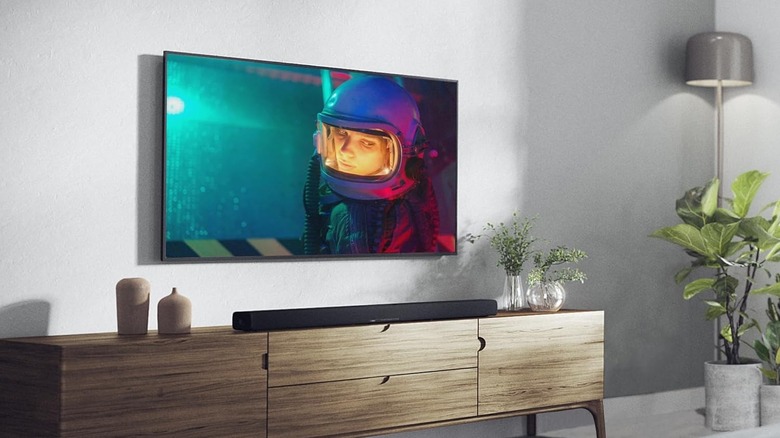
Yamaha doesn't mess around when it comes to soundbars, and the Yamaha True X Bar 40A is proof that you don't always need a subwoofer. While it launched with a $500 MSRP, the X Bar 40A's asking price has not eclipsed $400 in the past year, according to Amazon's price history feature. The bar actually has twin woofers built into the chassis, and you can add the Yamaha NS-SW100BL Subwoofer ($250) for even more low end. The X Bar 40A also contains two up-firing speakers for height effects when watching Dolby Atmos movies and shows.
The Yamaha bar has four audio presets to choose from, including a Clear Voice mode for boosted dialogue. Once connected to Wi-Fi, you'll be able to stream music via AirPlay 2, as well as Spotify Connect and Tidal Connect. The Yamaha companion app isn't exactly intuitive, though, so we were relieved to learn that all in-app controls are also on the soundbar remote.
The most direct Sonos comparison is the $500 Sonos Beam (Gen 2), which doesn't support Bluetooth (but the X Bar 40A does!). The X Bar 40A comes with everything you need in the box to get your new bar up and running in just a few minutes. While it's not the cheapest Sonos competitor on the market, it may be a compelling option for someone who doesn't want to spend the extra $100 for the newest Beam while also giving up Bluetooth connectivity.
How we chose these Sonos substitutes
When selecting our Sonos substitutes, we stuck to noteworthy brands like JBL and Bose, and we attempted to match up as many features as possible with comparable Sonos tech. We used the Sonos Beam (Gen 2) as the measuring stick for pricing since it's the Sonos soundbar with the most mass appeal. Considering the Sonos Beam (Gen 2) retails for $499, we only included soundbars that either had a lower MSRP or spent a majority of the past year being sold at a lower actual price.
When possible, we leaned on both professional, hands-on reviews and user feedback to help guide our selections. Lastly, we didn't pick any soundbars that aren't readily available, even if stock is temporarily low on sites like Amazon.