

SpaceX Wants To Keep Important Supplies Floating In Space - Here's Why
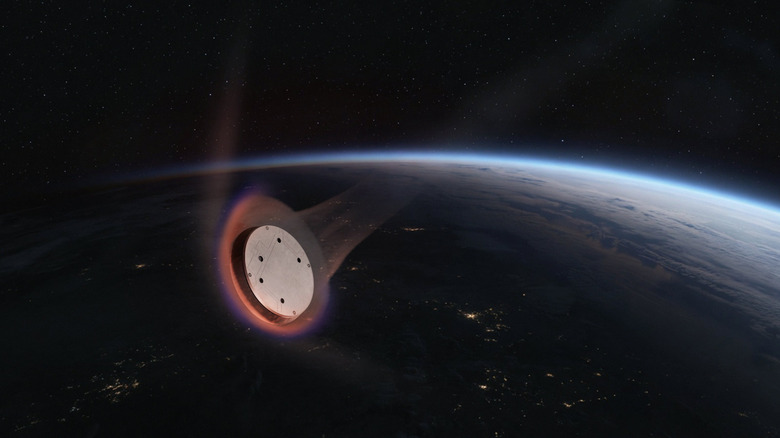
On June 23, 2026, SpaceX launched a test flight of a new vehicle known as Starfall. The company streamed the launch on X, but provided little detail on what Starfall was. The broadcast cut away just as the Falcon 9's first stage separated and landed back on Earth, which is a practice usually only seen during classified government missions. On the day of the launch, SpaceX posted a short summary of the spacecraft on X, explaining, "Today's mission includes a demo of a new vehicle that will enable affordable, routine access to the microgravity environment for scientific research and in-space manufacturing. After demonstrating controlled flight, the spacecraft will splash down in the Pacific Ocean."
SpaceX disclosed some information about the spacecraft as part of an environmental impact assessment organized by the Federal Aviation Administration (FAA) before the launch could take place. The assessment detailed two Starfall launches and reentries into the Pacific Ocean, and revealed the nature of the craft, its size, and basic information about what it does. The puck-shaped vehicle measures 2.4 feet in height and has a diameter of 10.1 feet. The report stated, "SpaceX seeks to perform two Starfall reentries to demonstrate capabilities for future transport and delivery of goods through space."
The Starfall capsule will drop supplies from space
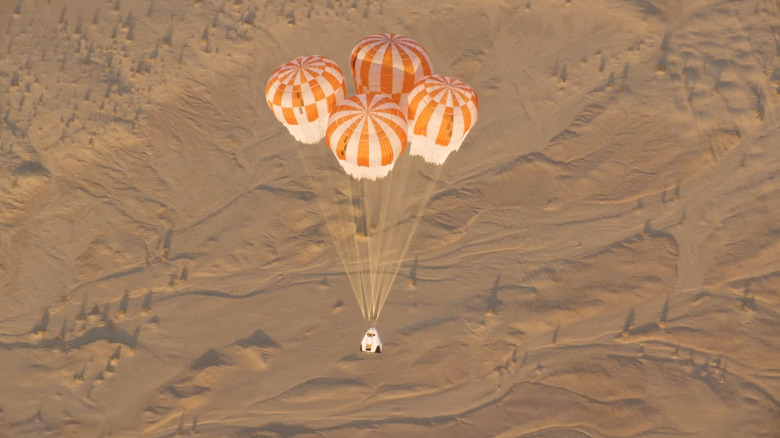
In the environmental impact assessment released by the FAA, SpaceX detailed that the capsule weighs about 4,600 pounds and is capable of carrying about 2,200 pounds of cargo. Within those constraints, the capsule should be able to carry a wide variety of civilian and military supplies to almost any remote destination on Earth in less than an hour. SpaceX's Falcon 9 rocket is known for being able to relaunch quickly, and short-term cargo flights should be possible.
This can provide strategic advantages for pre-planned military operations in remote areas of the planet. If a high-profile mission required equipment or supplies to be dropped at a specific time, a pre-launched Starfall capsule could, in theory, loiter in low-Earth orbit until called upon to reenter the Earth's atmosphere and land covertly from a vertical position without enemy detection. The fact that SpaceX has clearly been developing this new spacecraft under a veil of secrecy is likely because the U.S. government sees it as providing a strategic advantage over its adversaries.
Civilian business customers may also be able to make use of Starfall, with the small capsule presenting a wealth of opportunities for specialized cargo deliveries. One of the most important of these will be its potential in humanitarian aid, and it would be able to deliver emergency supplies like food, water, and rescue equipment to disaster-hit regions anywhere on the planet at short notice.
Autonomous research and manufacturing in space
SpaceX's statement on the day of the launch revealed that the company was aiming to provide a platform for in-space research and manufacturing, which could include a number of applications such as the manufacturing of pharmaceuticals and microgravity research experiments. Both manufacturing and research are regularly conducted on the International Space Station (ISS), and Starfall would open up that opportunity to a much wider customer base.
The ISS conducts physical science experiments on a regular basis, all of which utilize the unique microgravity environment of space. Starfall will open up access to space to more universities and science institutions that conduct some of these experiments. Some of the experiments already conducted in microgravity feature research into fuel combustion, the behavior of various types of crystals, and even research into dark matter.
When it comes to in-space manufacturing, companies such as Varda Space Industries are already manufacturing pharmaceuticals in microgravity. By processing materials autonomously in microgravity, convective currents, buoyancy, and sedimentation are suppressed, resulting in crystals that are more uniform in size and structure. This can improve intravenous drug delivery to patients back on Earth.
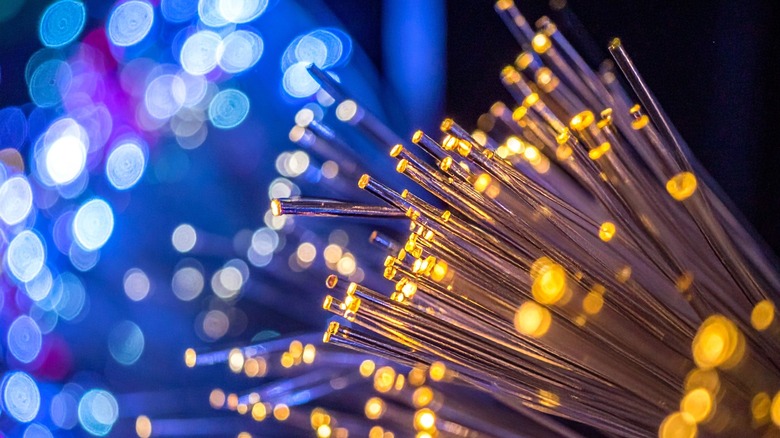
The manufacturing of Zirconium, Barium, Lanthanum, Aluminum, and Sodium (ZBLAN) optical fibers in space has also proved to be successful. This glass alloy possesses unique properties that allow light to travel through fiber optic cables at up to ten times the capacity of traditional silica-based fibers. If SpaceX can upscale the Starfall concept, it may very soon become the norm to have ZBLAN fiber optics delivered from space.