

Why Your Retro Light Gun Games Won't Really Work Anymore
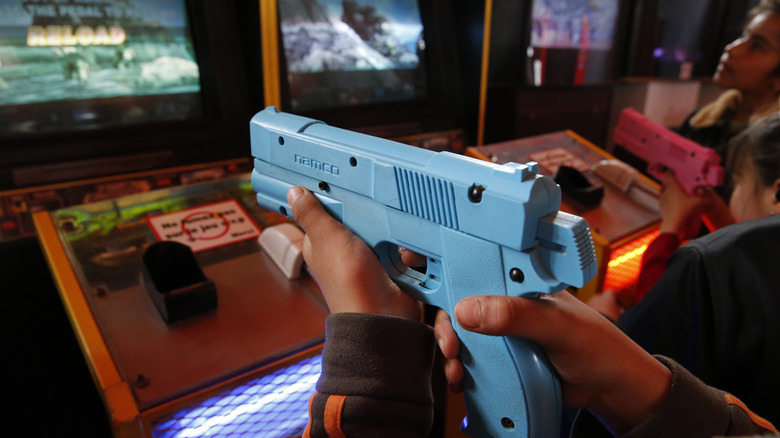
If you grew up with the original NES console, odds are it came bundled with two controllers, a special combo cartridge that included "Super Mario Bros." and "Duck Hunt," and the NES Zapper. If you try digging out your NES and plugging it into a modern TV, you can get "Super Mario Bros." to work, but not "Duck Hunt." That's because the magic that made the game function makes it incompatible with modern technology.
"Duck Hunt" was a special game because it brought the light gun experience into your home — you pointed the Zapper at a TV, and it responded like the light gun cabinets in arcades. The game works by turning every target into a white square for a fraction of a second whenever you press the trigger. If the Zapper detects the square, you hit your target, and if it doesn't, you miss. Any potential disruption in the process prevents the Zapper from communicating with the game and registering a hit, which is why "Duck Hunt" and all retro light gun games don't work on modern displays.
Even though flat screen TVs have numerous advantages over the bulky CRT monitors of yesteryear, they fall behind in one department: processing lag. While modern screens can have refresh rates that reach into the triple digits, they are all subject to input latency. One reason why retro enthusiasts love CRTs is that they lack this latency; games just feel snappier when playing on them. More importantly, the NES Zapper can only register the white rectangles of compatible games due to the latency-less nature of CRTs. Without this CRT consistency, retro light-gun games don't feel consistent either.
Light gun games at home aren't dead, just different
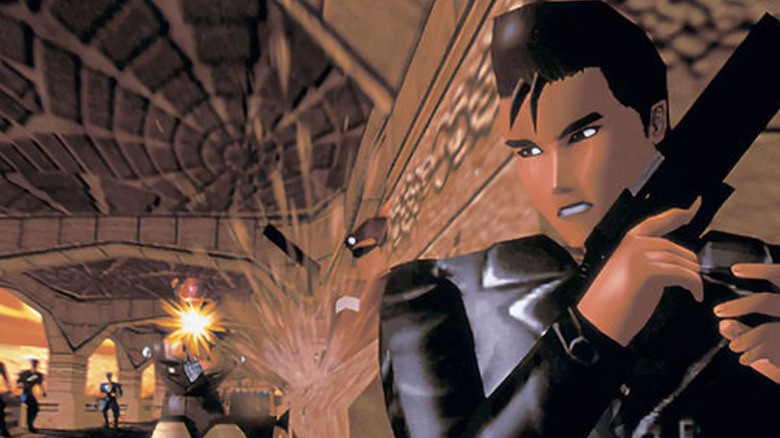
In the spirit of fairness, you can still play plenty of light gun games at home. For instance, the "House of the Dead" remakes are available on the Switch; whether or not they are good games is an entirely different matter, though. Plus, the company G'AIM'E ported titles such as "Time Crisis" to a plug-and-play console that is compatible with modern devices.
The Zapper was a true light-gun device: a toy gun that detected light to register hits and misses. By comparison, modern equivalents are basically posers. Instead of using CRT screen timing to calculate accuracy, these games rely on infrared emitters and motion controls. They're not as accurate as the OG light gun games, especially because these newer titles need their aiming reticles recentered every so often. Today, the most popular "light gun" games are those on VR headsets such as the Meta Quest 3, but these are just self-contained virtual environments that use motion controls to move digital reticles.
For a time, light gun games seemed dead, but it turns out they just needed the right technology to revive them. G'AIM'E, for instance, uses its own custom AI synthesis and a high-resolution camera, while another company, Sinden, uses a built-in camera. However, the different integrations produce different work environments: Sinden requires a computer (or a TV screen that mirrors a computer screen) and emulated software, whereas G'AIM'E is self-contained enough to run custom-licensed ROMs, but you can only use their games. Such is the nature of plug-and-play devices.