

Why Do Some Laptops Have Two Charging Ports?
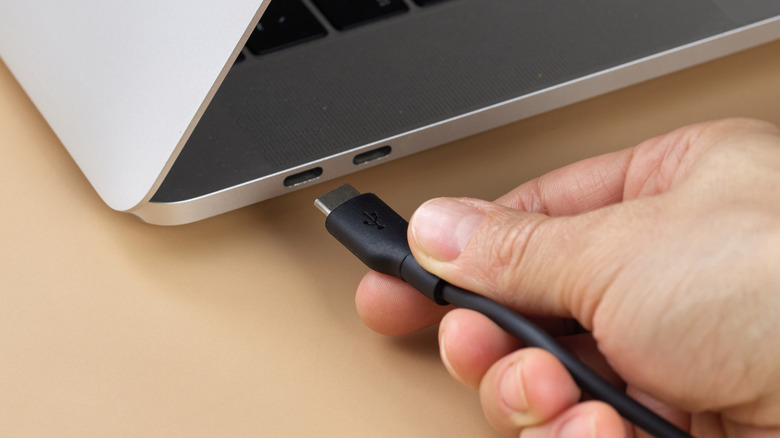
If you recently purchased a laptop or are in the market for one, it's likely that you have seen options with two USB-C charging ports. This is often a sought-after laptop feature, but keep in mind that while both ports can support charging, that's not their only purpose. The ports are also designed to improve connectivity, allowing you to hook up a wide array of everyday USB-C gadgets with your laptop.
Over the past few years, USB-C has witnessed increased adoption due to faster transfer speeds and higher power delivery, replacing older barrel-style connectors on laptops. That's why most modern models now feature at least one USB-C port for charging, data transfer, and connecting devices. But as USB-C continues to gain prominence, the single port might feel like a limiting factor. As a result, manufacturers now tend to include two or more USB-C ports, which is great for users. But those dual connections shouldn't be mistaken for just charging ports, as they can do a lot more.
Two USB-C ports streamline charging and connectivity
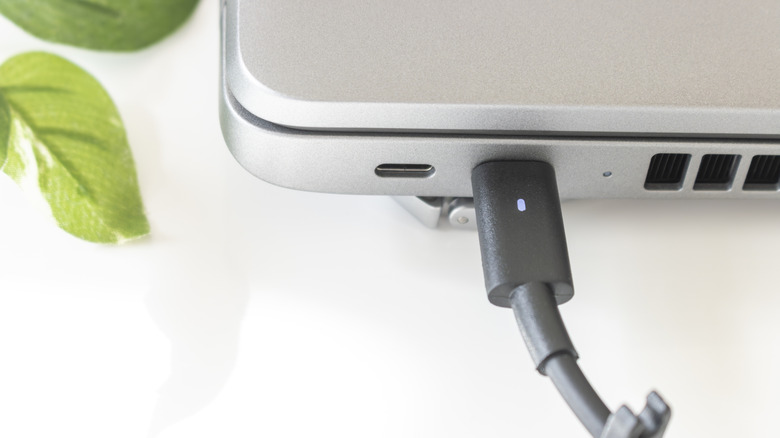
Having two USB-C ports is also about flexibility. That's the reason you'll find them on opposite sides of many laptops. This allows for charging from either side, depending on which is closest to the power outlet — helping minimize cable runs and keeping your setup clean. Even if both ports are on the same side, improved connectivity remains a key benefit.
With laptop manufacturers cutting back on ports and ditching USB-A connections in a bid to achieve slimmer designs, an extra USB-C port lets you plug in a USB hub or docking station for connecting additional devices. Plus, we can't ignore the fact that USB-C ports do have a limited lifespan. Although generally rated to withstand over 10,000 insertion cycles, there are no guarantees. Other factors, including physical damage and improper use, can lead to premature failure. If that happens, a laptop with a pair of USB-C ports can still be charged, which is a major benefit over a single port.
That said, it's important to remember that not all USB-C laptop ports work the same. Some support Power Delivery (PD), while others are limited to basic charging and data transfer. And PD is undoubtedly the better choice when it comes to charging laptops because they can deliver up to 240W of power, although most models require far less.