

Ronald Reagan's Landmark Cybersecurity Policies Were Influenced By A Classic '80s Techno-Thriller
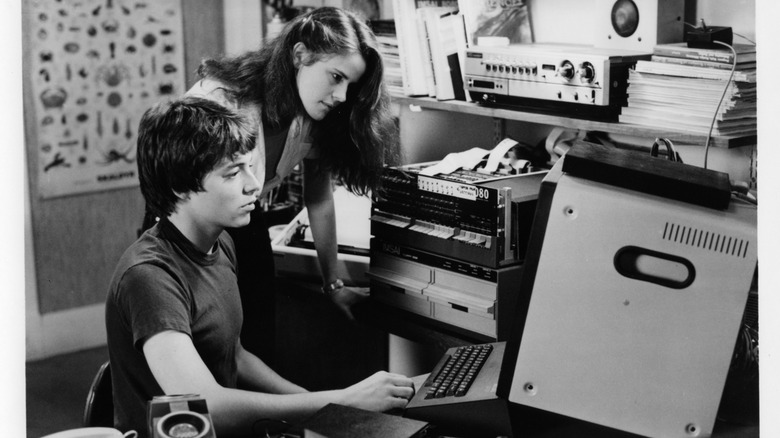
It's no secret that science-fiction has influenced the trajectory of technological development for decades, with classics like "Star Trek" and concepts like the Warp Drive giving researchers goals to shoot for. However, science isn't the only thing fiction can influence in real life; the right movie, seen by the right person at the right time, can also have surprisingly big impacts on governmental processes, as was the case when Ronald Reagan saw the film "WarGames" in 1983.
"WarGames," which was one of the landmark early roles of actor Matthew Broderick, follows David Lightman, a teenage hacking enthusiast who chances upon a backdoor into a covert military computer housing an advanced weapons-control AI. Thinking the AI's training modules are just video games, he runs a simulation of a thermonuclear war, only for the AI to mistake the simulation as the real deal and begin prepping actual missile launches targeted at the Soviet Union. If David can't find the AI's creator and correct his mistake, World War III will begin.
Technology wasn't nearly as much of a societal concern in the early '80s, with laptops and computers being prohibitively expensive during the Reagan years. The depiction of military AI in "WarGames" in particular was deliberately exaggerated, as at least at the time, AI couldn't have such control over the levers of war. Said depiction, however, frightened President Ronald Reagan enough to prompt relatively swift legislation to ensure the safety of the American people in the digital age.
After seeing WarGames, Reagan called for cybersecurity research
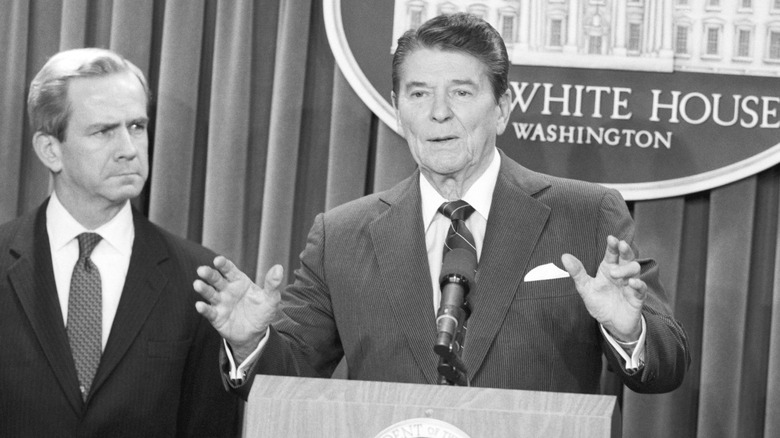
Former Hollywood star that he was, Ronald Reagan was personal friends with the writer of "WarGames," and the weekend it released in theaters in 1983, the president had a private screening of the film at Camp David. According to the book "Dark Territory: The Secret of Cyber War" by Fred Kaplan, Reagan experienced a notable fear reaction to the film, specifically its depiction of vulnerable government computer networks. In the film, Broderick's character is able to hack into the government network fairly easily with nothing but a dial-up modem, an acoustic coupler, and an ordinary cradle phone.
At a White House meeting the following week, Reagan asked his cabinet: "Could something like this really happen?" His staff informed him that not only could such a hack happen, but the current state of the U.S. government's cybersecurity was even worse than depicted in the film. This led to a whirlwind of legislation, including congressional hearings on the matter of cybersecurity where clips of "WarGames" were shown to gathered legislators. After a little over a year of deliberation, the Reagan administration passed the very first Presidential directive on cybersecurity, NSDD-145. About a year later, this would evolve further into the Computer Fraud and Abuse Act (CFAA), the first official U.S. federal internet policy, which directly prohibits intentionally accessing any computer system without direct authorization and serves as the bedrock for most cyber-crime laws.