

Here's Why QR Codes Have 3 Squares Instead Of 4

The humble QR code, with its matrix of black and white squares, has become an instantly recognizable symbol of the digital age. A quick scan lets you pay for products, board a train, open a door, pull up a menu, and a myriad of other things. While each one encodes unique data, all QR codes share an identical feature — large squares in the corners. These squares, called finder patterns, only appear in three of the four corners, and there's a good reason for that.
Positioned top-left, top-right, and bottom-left, this pattern tells the device reading the QR code which way is "up", enabling an accurate scan. So when using your smartphone camera to read a QR code, you don't have to worry about orienting your phone because the reader knows that the corner without a large square is the bottom-right of the code. Test it out the next time you hold your phone up to a QR code by framing it sideways.
You'll discover that the handset's code reader has no trouble recognizing and scanning it. Once you know what those three squares do, the rest of the QR code should begin to look less like random noise and more like a carefully structured system, because that's exactly what it is. The clever design allows for a huge amount of information to be packed into a tiny pattern, which is why we haven't run out of QR codes yet even though they're everywhere.
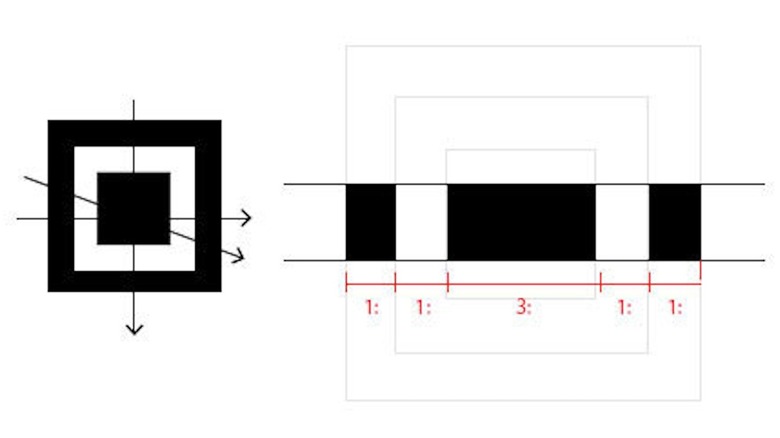
The all-important 1:1:3:1:1 ratio
The QR code first appeared in 1994, but back then it wasn't seen in public spaces. It was created by a small team led by Masahiro Hara – an engineer at vehicle components maker Denso Wave — to track car parts. The idea for QR codes came from the popular board game Go. Hara designed them as a more robust, higher‑capacity alternative to traditional barcodes. In the late 1990s, QR codes began to spread, though mainly within industrial settings.
As mobile phones with cameras became popular in the early 2000s, the codes saw more use by the general public to access information. Smartphone proliferation drove further adoption of the distinctive square-shaped QR code, and today it's almost impossible to go through an entire day without coming across at least one — though you should think twice before scanning some QR codes. Creating the finder pattern was a challenge, as it had to be unique enough to avoid being confused with ordinary printed content.
After analyzing a wide array of printed materials like magazines, the development team realized that a specific ratio of white to black areas – 1:1:3:1:1 – almost never occurred. So, the ratio was incorporated into the QR code's finder pattern, allowing scanners to lock onto it regardless of surrounding text and images, or scanning angle. The 1:1:3:1:1 ratio became the framework of the QR code design, and by using a pattern that rarely occurs in printed materials, the QR code has gone on to become a global standard for rapid and dependable scanning.