

This New Biotech Might Have Solved The Problem With Long-Term Space Missions
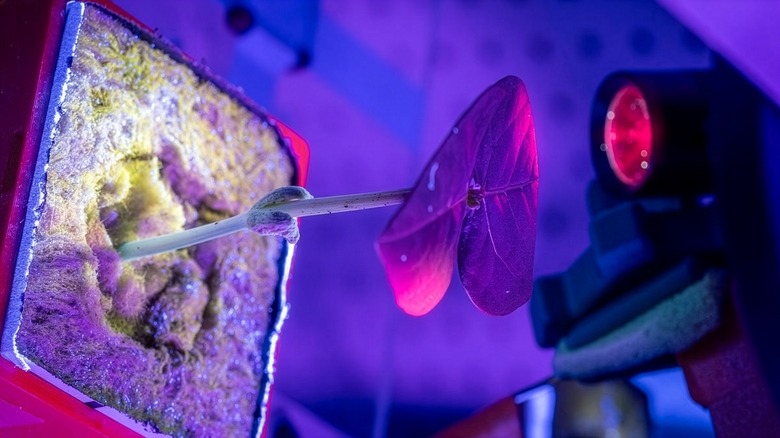
NASA has been testing plant growth in the microgravity environment of the International Space Station (ISS) for years. The ISS has plant growth science stations that provide enough LED light and moisture to allow plants to grow in space, and the same technology can be deployed on spaceships going to Mars. Astronauts have to keep fit, healthy, and happy for the 400-day round trip to Mars that could include an exciting and ambitious 30-day surface mission. Studies on the ISS have shown that the consumption of freshly grown produce can have a positive impact on the wellbeing of astronauts, which will be essential on missions that include long-term isolation. But while fresh food can be sent up to the ISS as part of about 14 cargo resupply missions per year, the same cannot be said for Mars missions, where astronauts will only have access to what they bring with them, and presupply cargo sent to Mars before their mission starts.
While solving the fresh food problem has been a key focus, another potentially more serious problem has to be solved, and that is what to do about medication that expires before a typical Mars mission can be completed. More than half of the pharmaceuticals on the ISS have been shown to expire within three years, and that would mean that these would expire before a mission could be completed. A new study has demonstrated advancements in this area, with a plant virus with favorable therapeutic properties having been grown in a space-like environment at the University of California San Diego. If this biotech can be further explored and tested in a real microgravity environment like the ISS, it could mean that astronauts will have the ability to grow their own medicine on Mars missions.
How pharmaceuticals are grown in space
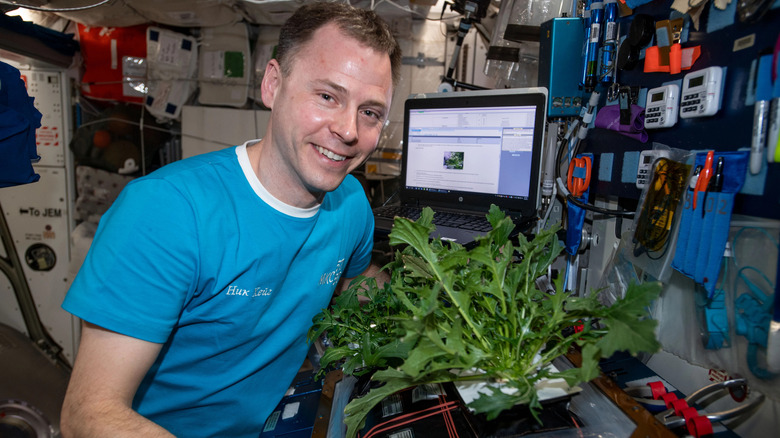
The study conducted at UC San Diego featured a plant virus called cowpea mosaic virus (CPMV), which has been known for boosting the human immune system to fight cancer cells. The virus was grown on Nicotiana benthamiana (a relative of tobacco plants) and Vigna unguiculata no. 5 (black-eyed pea plants). The resulting viral yield from the two plants were compared, with the black-eyed pea plant acting as a dual-purpose example, being able to grow the plant virus as well as producing edible produce for astronauts.
The plants were grown on a random positioning machine (RPM) that simulated the effects of microgravity in space, by rotating in three dimensions completely randomly using a custom Python script running on a Raspberry Pi. Once the plant had reached the point where it could be harvested, the engineers tested an advanced method of extracting it from within the plant leaves without destroying the plant itself. This involved extracting apoplastic fluid from plant leaves by placing the leaves in a vacuum, and then spinning it in a centrifuge to separate out the viral extract. The ISS already has a laboratory-grade centrifuge, and applying this method of extraction on a spacecraft is not only practical, but preserves the plant to maximize yield.
How astronauts get sick in space
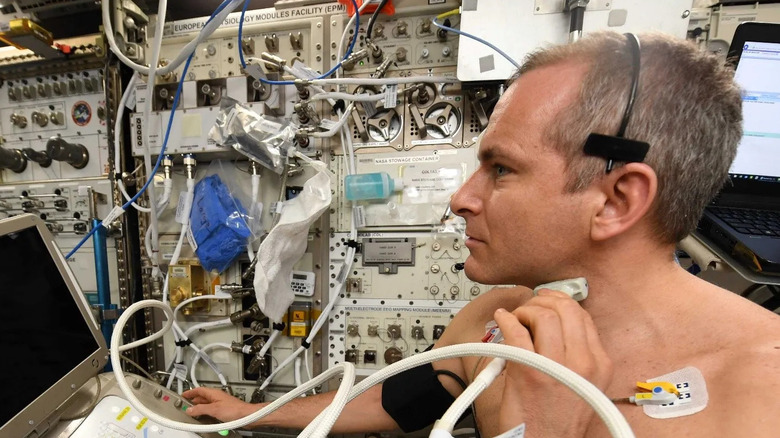
While astronauts are given a clean bill of health before launching to space, medical emergencies can occur in space for a variety of reasons. The ISS is equipped with an arsenal of pharmaceuticals that can be used in the event of a health-related emergency; however, if these were to expire, they could not be consumed due to degraded effects and possible toxicity. Producing pharmaceuticals while in space becomes very important in the context of long-duration missions to deep space. Astronauts have been documented to regularly suffer from motion sickness, headaches, and urinary tract infections while in space. NASA has even gone as far as investigating the possibility of sending an AI doctor on missions to Mars and elsewhere.
An unidentified NASA astronaut was observed to have a blood clot during a routine ultrasound examination during a 2018 mission to the ISS. The ultrasound was done for a vascular research study on the ISS to investigate the effects of long-term space flight on the human body. The astronaut was immediately started on a dose of enoxaparin to treat the clot and prevent secondary medical emergencies such as a pulmonary embolism or heart attack.
In a more recent incident, astronaut Mike Fincke had a medical emergency, which only further highlighted the potential risks of a Mars mission, eventually forcing his mission's early return to Earth from the ISS. While he didn't elaborate on the nature of the incident, Fincke made it clear that it was something that required immediate medical intervention. These incidents underscore the need to have alternative sources of critical pharmaceuticals on long-duration missions to Mars. More research on alternative, plant-based pharmaceuticals has to be conducted to develop this concept. It will ensure that astronauts have readily available medication on hand in cases of emergency.