

Switzerland's Solar Railway Breakthrough Might Be Coming To Several New Countries
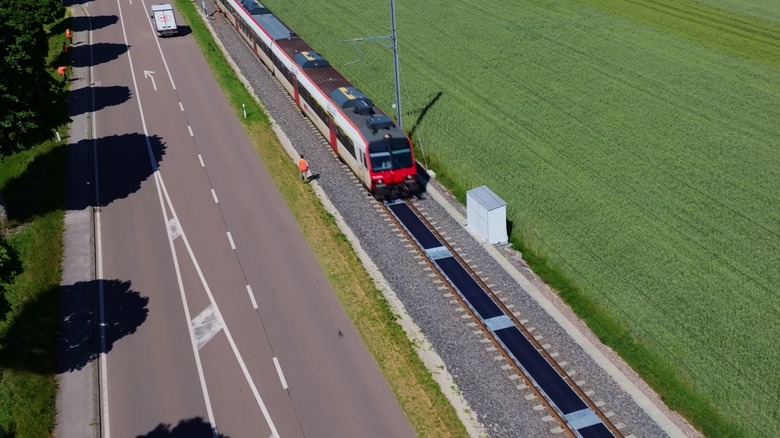
A Swiss startup may have found a way to expand the country's solar power capacity without converting additional farmland into solar panel farms. Instead of clearing land for new solar panel installations, Sun-Ways has been running a pilot that uses land already developed for another purpose: railway tracks. The company's removable solar panels fit in the unused space between the rails, turning train tracks into energy-harvesting infrastructure without affecting train operations or schedules. The Sun-Ways pilot program has been running for more than a year, covering only 100 meters (328 feet) of track in Neuchâtel, Switzerland. Early results appear promising, and other countries, including Italy and South Korea, are considering similar tests.
France's SNCF announced in February 2026 that it will partner with Sun-Ways to study the startup's pilot, which is scheduled to run in Switzerland until April 2028. An Italian company signed a deal with Sun-Ways to start a similar pilot in Italy, according to Euronews. The report also says that Sun-Ways plans to install similar solar panels in South Korea, and names China, India, Singapore, and the Netherlands as other interested parties. Belgium, Canada, Mexico, and the U.S. are among other interested parties, per Sun-Ways.
The solar panels placed between the rails would not power the trains themselves, though that could be a future use of the electricity. The Swiss national railway operator, SBB, already runs on 100% renewable energy, a target achieved on January 1, 2025. The energy comes from several sources, including hydro, solar, and wind power. SBB didn't partner with Sun-Ways in this initial pilot.
How the Sun-Ways solar panels work
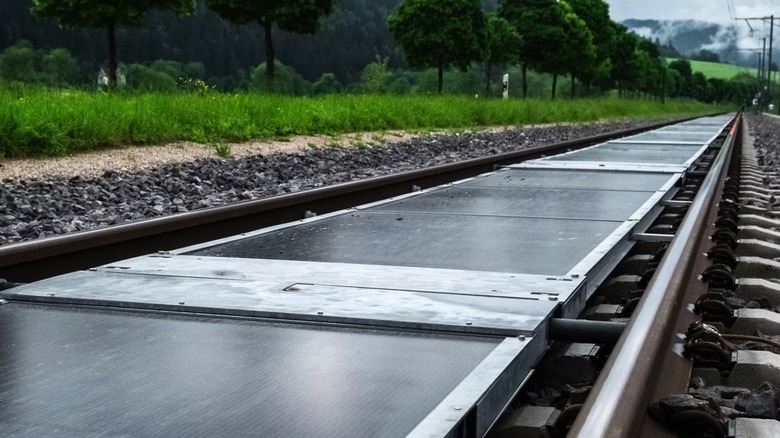
The panels were installed near the village of Buttes in the canton of Neuchâtel in April 2025. The pilot includes 48 photovoltaic modules spread across 100 meters of railway track. Each panel measures about 2 meters (6.55 feet) long and is rated at 380 watts peak (Wp), which represents the maximum output under peak conditions. The entire system can generate a theoretical maximum of 18 kWp. Sun-Ways estimates the installation can generate 16,000 kilowatt-hours, or 16 megawatt-hours, of electricity per year.
Unlike other photovoltaic panels installed at an angle, the Sun-Ways solar panels lie flat between tracks so trains can safely pass overhead. A special Scheuchzer railway machine transports and deploys the panels, which are then connected to a system attached to the sleepers. Sun-Ways says the installation system could eventually deploy about 300 meters (985 feet) of solar panels per hour, although this estimate has not yet been demonstrated beyond the 100-meter pilot. The panels may need to be removed for railway maintenance, but the system is designed to accommodate this. A three-panel assembly measuring about 6 meters (19.7 feet) can be detached in about 10 minutes.
Solar panels also have to be clean to generate electricity efficiently. While initial plans called for brushes mounted beneath the trains, testing showed that airflow generated by passing trains was enough to prevent dust from accumulating. After over a year of operation, the pilot has also provided data on seasonal debris buildup. The panels also come with an anti-reflective coating to reduce glare that could affect train drivers.
How much energy could solar railways generate?
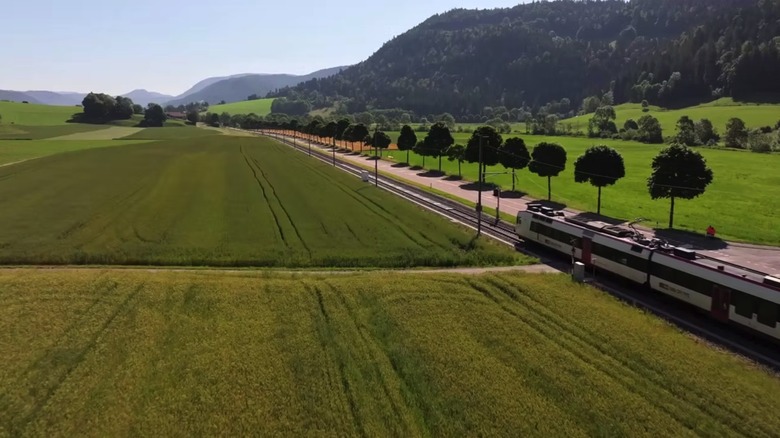
Sun-Ways estimates that 100 meters of solar panels can generate about 16,000 kilowatt-hours of electricity annually, enough to power roughly three to four Swiss households. If the technology were deployed across Switzerland's 5,320-kilometer (3,306-mile) rail network, it could produce about 1 TWh of electricity a year, or roughly 2% of the country's annual electricity consumption. That would be enough to supply about 300,000 households, although it remains unclear whether Switzerland will expand the technology after the pilot concludes.
According to Sun-Ways, the pilot program produced over 16,000 kilowatt-hours of electricity between May 2025 and June 2026, matching the company's estimates despite being offline for about a month during that period. More than 11,000 trains have crossed the installation, traveling at speeds of around 70 kilometers per hour (43 mph). The system is currently designed to support trains traveling up to 150 kilometers per hour (93 mph), which could limit its use in countries where high-speed trains exceed that maximum, including France, Italy, and South Korea.
Switzerland's climate may also limit energy production compared with sunnier regions. If the technology proves commercially viable, countries with higher solar irradiance, like Italy and southern France, could potentially produce even more electricity from similar installations.