

Wind Or Solar: Which Energy Source Is More Efficient?
We may receive a commission on purchases made from links.
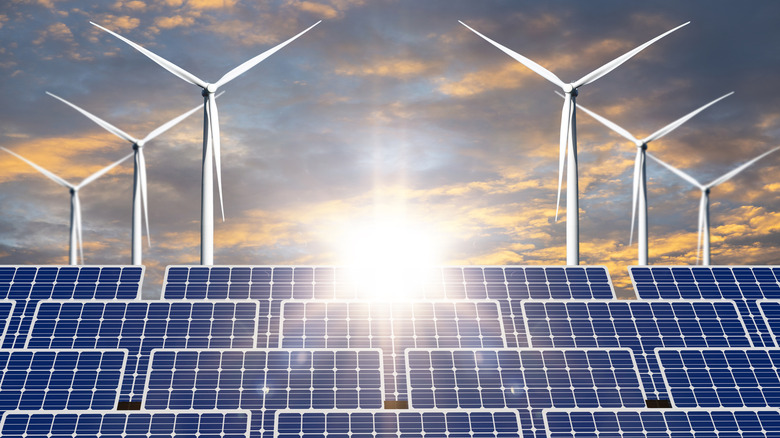
Wind energy and solar energy are the twin standard bearers of the renewable energy movement. They are both in abundant supply and produce no greenhouse gases once installed, leading to better air quality and paving the way to curbing global warming. They are also more affordable now in most places than fossil fuels, which are subject to highly volatile price shifts. Wind and solar are superior to oil and coal in almost every single way, but how do they stack up to each other? While both are productive in their own right, wind holds the edge for a very simple reason.
Turbines convert roughly half of the wind energy passing through them into electricity, but solar panels only convert around a fifth of the solar energy that hits them into electricity. As it stands, wind turbine technology is simply more efficient than solar array technology. However, it could be argued that energy efficiency is only one part of the overall efficiency of these two technologies. Truthfully, wind and solar are hard to compare because they are each suited to totally different needs.
Pros and cons of wind power
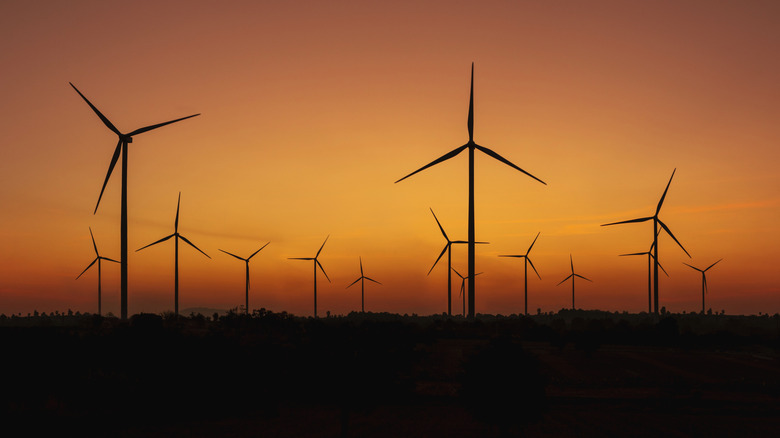
Aside from the efficiency of turbines over solar arrays, the next biggest advantage that wind energy has is availability. Modern turbines can generate electricity from wind speeds as low as 6 mph, which is classified by the National Weather Service as a "light breeze". Electricity production scales up with wind speed and only cuts off if winds become dangerously strong. Changes in wind speed are typically gradual and predictable, unlike shut downs at power plants.
Wind turbine technology has been steadily advancing to harness even greater amounts of power. In the past two decades, wind turbines have grown 59% taller on average, according to the World Economic Forum. This number is significant because wind speeds are stronger higher above ground. Objects on the ground, like buildings and trees, impede the flow of wind, slowing it down and offering less power for turbines to harness. For that same reason, offshore wind farms (in particular the big ones going up in China) are going to be a key part of the energy sector going forward.
The big drawback to wind energy is that you can't put a wind turbine just anywhere. They need to be clear of obstacles and they generate too much noise to be close to communities. Although they are more efficient than solar panels, they aren't as versatile or easy to install. For these reasons, wind power is almost exclusively used on the industrial scale, and not for home installation (although some small home turbines do exist).
Pros and cons of solar power
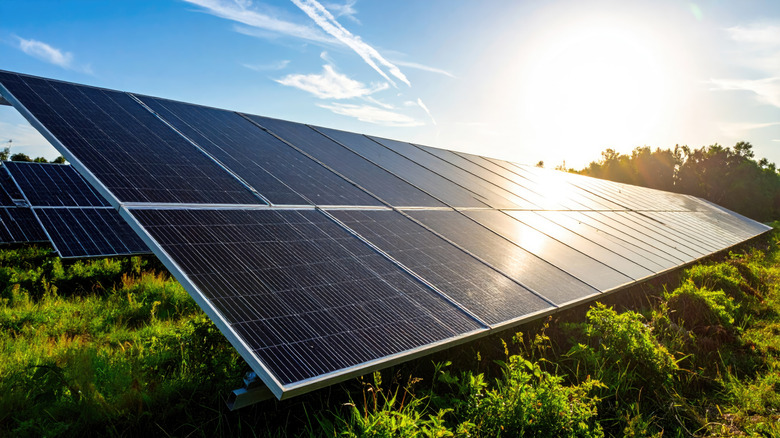
Solar energy is not only less efficient than wind energy, but it's also less available. While it only takes a light breeze for a wind turbine to start producing electricity, solar arrays can only gather power when they receive direct sunlight. This means they have to be oriented very particularly to face the sun, and they won't work at night or in heavily overcast weather conditions. This, coupled with the far lower efficiency, might have you thinking that solar is a total waste, but it has some sneaky advantages over wind power as well.
Solar panel arrays are much easier to install and maintain than wind turbines, making them more accessible for home use (you might even be able to install them on your windows soon). Installing solar panels for an entire home typically costs somewhere between $10,000 and $30,000, but a single wind turbine costs between 2 and 4 million dollars. The ease and cost-effective nature of solar arrays is arguably the main reason solar energy has now overtaken coal in the United States for the very first time.
On the other hand, another downside to solar energy is the fact that solar panels are made with silicon and various rare metals that are obtained by mining. The mining industry is a major contributor to climate change, so manufacturing solar panels does come at a notable cost. With this in mind, on top of all else we've covered here, it's clear that wind is the king of clean energy.