

Is Liquid Cooling Quieter Than Air Cooling?
We may receive a commission on purchases made from links.
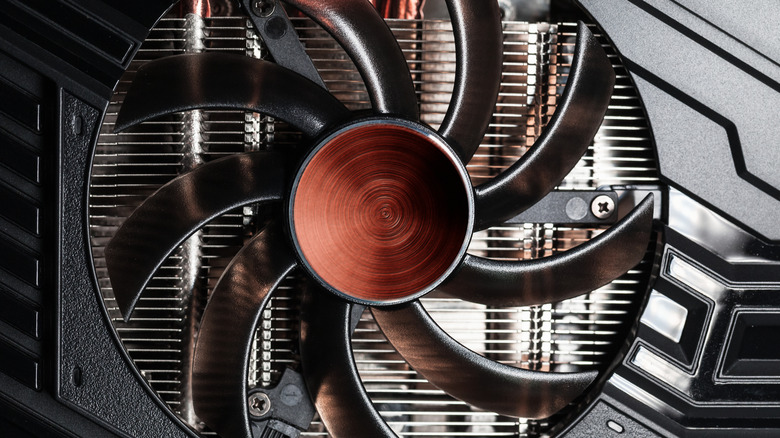
Say you're in the middle of a gaming session, and you enter a graphically demanding area (Saint Denis in RDR2 is infamous for this). After a minute, boom: the fans in your PC ramp up to uncomfortable speeds in a desperate effort to dissipate the heat. Every gamer with an air-cooled machine has been there, and those moments when the PC gets so loud that you could swear it will wake up the next-door neighbors are frustrating. Sadly, there isn't much you can do at the moment to resolve the issue, as this is an inherent flaw with air cooling. And water cooling is not without its faults.
A system like this is much more expensive and complex than a series of spinning fans. But in the majority of cases, liquid cooling is quieter than air. Air coolers aren't generally famous for their cooling efficiency. It's pure physics: air isn't as dense as water (or other liquids), so it simply can't move as much energy. As a result, when your GPU or CPU starts working harder, the fans will spin up to their top speed to overcome some of that extra heat. Now compare that to how liquid cooling works.
A small pump circulates the water from the reservoirs via tubes going through metal water blocks located over chips. The liquid absorbs some of that heat, which dissipates in the radiator — much like an HVAC system. Sure, a liquid cooling system also uses a fan to help cool down the radiator a bit faster, but that fan may spin much slower as it's not taking on the full "cooling load", so to speak, making it significantly quieter.
How quiet is a liquid cooling system?
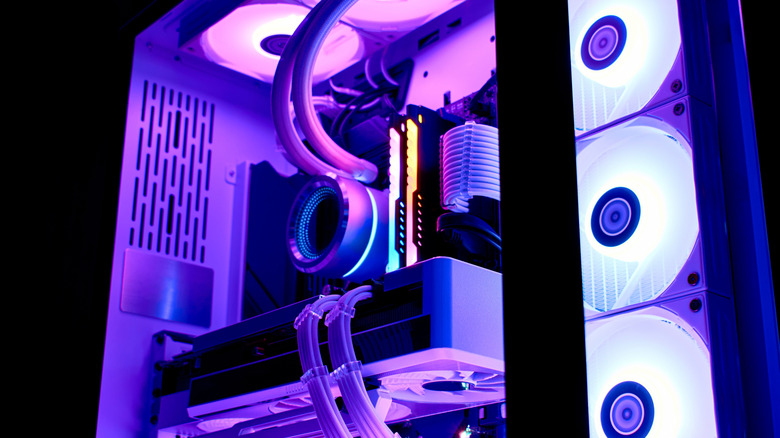
In raw figures (the noise level will vary between systems), you can expect a high-end liquid CPU cooler to stay around 20 to 35 weighted decibels dB(A) under load. To put this into perspective, a whisper is about 30 dB(A), meaning that a quality system does live up to its reputation. You can also find audio examples on sites like Reddit. For instance, even in a scenario where a user likely still had air circulating in the pump after installation (as others quickly pointed out), the attached video is still fairly quiet. In another Reddit post where users showed off their custom water-cooled build with the pump running at high capacity, the noise level is tolerable.
Most commenters advised the Redditor to keep the pump operating at around 50% to extend its lifespan and cut down on the noise. Either way, the noise level is much lower than what most people are used to with air coolers. In fact, unexplained noises like buzzing are generally an indication that there's something wrong with the cooling system. So, when you think about it, liquid cooling is really an easy sell if your main goal is to build a rig that's nearly silent.
Are some air coolers better?
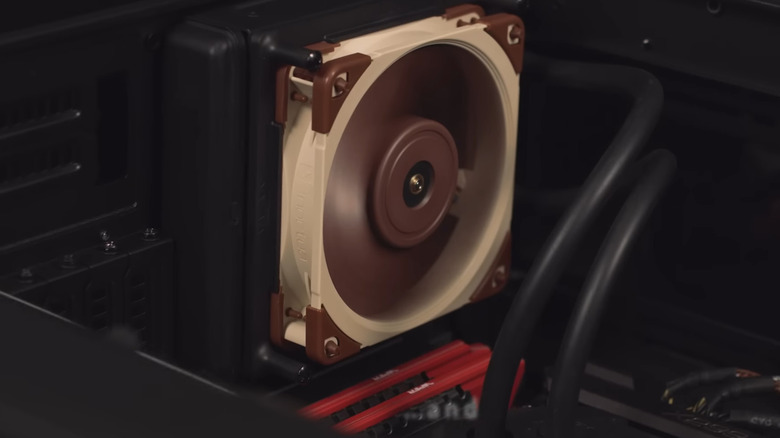
If you stack up a random set of fans against a random AIO, a liquid cooler will be quieter than an air cooler. But that's not a rule, because there are fans out there designed to be "whisper-level" silent. Case in point, Noctua NF-A12x25 G2 retails at $34 on Amazon, and reviewers point out it's perhaps the quietest air cooling option there is. The key reason for this is the design itself. The Noctua fan runs at a low RPM but also provides plenty of punch in the airflow department.
Noctua isn't the only brand out there that promises premium performance. Many on Reddit say Scythe Fuma 2 is a CPU cooler that gives Noctua a run for its money. Some experts (via Hardware Canucks) even argue that it's slightly better in terms of the overall noise-to-performance ratio. Either way, you have options that don't require you to redesign your entire PC.
It's easier to change the fans than get a liquid system. Noise levels are just one layer, though. High-performance air cooling systems that use fans like the aforementioned Noctua can help you control temperatures as well, if not better, than liquid coolers, and at a significantly lower price point. After all, if you were looking for just the silent operation, you'd go for a mineral oil-cooled PC, which is practically dead-silent, but it doesn't perform better than even a rudimentary AIO, and you don't see many machines drizzling in mineral oil out there, do you?