

Japan's Old Cargo Ships Could Soon Have An Unexpected New Job Powering AI
With the expansion of the digital world, including artificial intelligence, has come an increase in the infrastructure to power it, including data centers. Given the reality that AI data centers are harmful in more ways than one. In a world where water scarcity is a growing problem, news that Amazon's data centers used over 2.5 billion gallons of the precious liquid can sound quite grim.
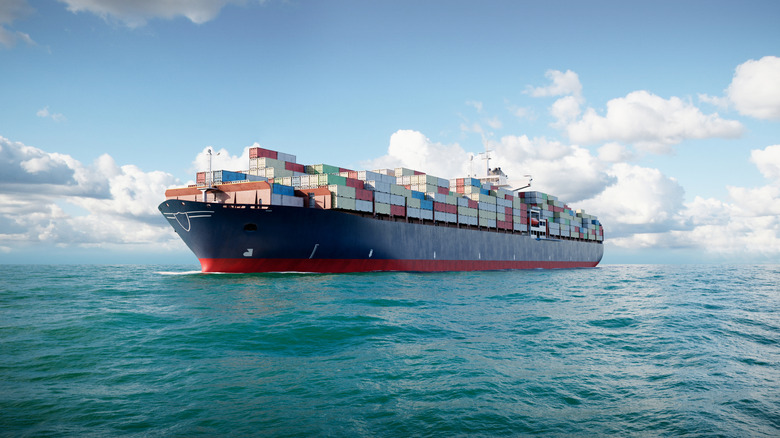
Even so, technology, including artificial intelligence. is here to stay, and efforts to support its growth will continue. Fortunately, data centers can be made more sustainable, both in terms of location and resources, helping to ensure the local ecosystem doesn't suffer from their activities. Just look to Japan for inspiration, where the repurposing of decommissioned cargo vessels as floating data centers is in development.
This solution is more environmentally friendly, as it uses seawater for cooling, which will in turn reduces power consumption. Better yet, it's faster than constructing a land-based facility. Traditional data centers can take three to six years to complete. If all goes to plan, the proposed floating data centers in Japan could begin operating in 2027.
How does a floating data center work?
The agreement between Hitachi Systems and Mitsui OSK Lines to develop floating data centers is built on a goal of meeting strict environmental guidelines while avoiding the constraints of local infrastructure. The floating data centers will use rivers or seawater for cooling. Though details are relatively sparse, Hitachi Systems handles data center management, including the design of the wider IT infrastructure. Mitsui OSK Lines, a firm that operates over 900 vessels, is responsible for maritime operations. This includes converting the vessel itself and maintaining the data center's ship-worthiness. Naturally, challenges remain, and it's still unknown how the facility will source the necessary power.
In addition, a group of four Tokyo Group companies in Japan is exploring the feasibility of building data centers under railway overpasses. The idea is to plug into the optical fiber network already established along the rail lines. It remains to be seen whether the idea will work, as there is a need for extensive testing to determine how the heat and vibration from the overhead trains will affect servers.