

This US Decoy System Tricks Enemy Radars Into Showing Fighter Jets That Don't Exist
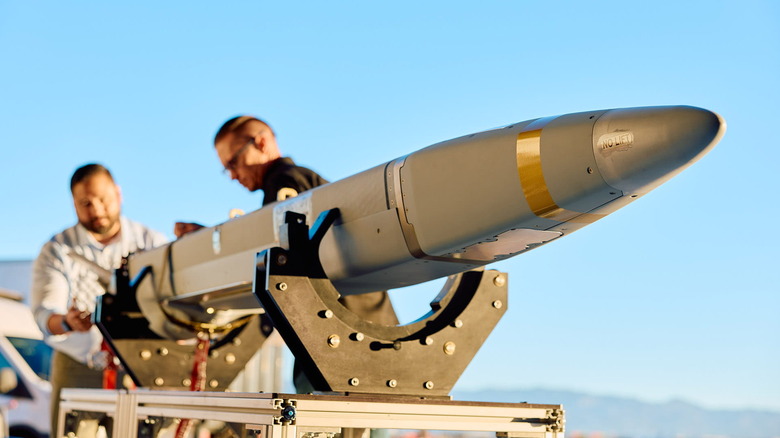
With the U.S. campaign against Iran showing no signs of letting up, and with Ukraine now in its fourth year of war with Russia, demand for novel ways of confusing enemy radars continues to increase in battle environments dominated by fighter jets, bombers, and drones. Modern ground-based and naval radars can track many threats at once, and developing decoy mechanisms to counter this technology has become strategically important. The ongoing conflicts have prompted Raytheon, which manufactures the ADM-160 Miniature Air-Launched Decoy (MALD), to bring the air-launched decoy back into production.
The MALD system works by sending signals to enemy radars that make it look like a full-sized fighter jet of practically any type. In heavily contested airspace, sending one or even groups of MALD decoys ahead of friendly aircraft can create the illusion that there are more fighter jets or bombers in the air than there actually are, causing a valuable distraction that can increase the chance of friendly aircraft reaching their targets unscathed. The system is especially effective when deployed ahead of stealthy fighter jets like the F-35A Lightning II, which can paint a highly misleading picture to enemy radars, with the MALD system appearing as a full-sized aircraft, while the F-35 appears much smaller thanks to its advanced stealth technology.
The MALD system is launched from a carrier aircraft and flies under the power of its own TJ150 turbojet engine. While Raytheon's initial production will feature traditional models of the engine, a newer 3D-printed version of the TJ150 may be included in the design at later stages.
How the MALD system fools enemy radar

The MALD system was first test-flown in 1999 under a DARPA requirement to develop a small, inexpensive decoy missile to counter enemy air defenses. The initial system was designated the ADM-160A (later developed into the more capable ADM-160C) and comes equipped with an electromagnetic system capable of simulating the radar signature of almost any aircraft type. The MALD system uses the Northrop Grumman Signature Augmentation Subsystem (SAS), and while its internal architecture remains classified, this Boeing patent details how the underlying technology behind signature augmentation systems works.
The SAS captures enemy radar signals and modifies them in three distinct ways to mimic the signatures that these radars look for when identifying aircraft. First, the system receives incoming enemy radar pulses, then splits and delays the signal using range-extent modulation. This simulates physical depth, making the small decoy appear much larger.
Second, the SAS uses Doppler jet engine modulation to simulate the radar signature of a specific size of jet engine by sending signals back that mimic the chopping effect created when radar waves bounce off a jet engine. Third, the system continuously modulates the radar signal's amplitude and polarization to simulate the apparent movement of a radar's center of reflection and match how a larger aircraft's skin reflects radar signals. When all of these factors are combined, it becomes apparent just how effective this decoy really is. When deployed in swarms, it can make a heavily defended enemy position believe it is under imminent attack before a single aircraft has arrived within range.