

A Floating Wind Farm In Portugal Is Having A Surprising Impact On Underwater Habitats
According to a UN report, approximately one million species are en route to extinction within decades. For underwater life, in particular, it's out of sight and out of mind for many, but nearly a third of all marine mammals (and over 40% of amphibian species) are under a serious threat if we as humans don't shift gears fast.
Fortunately, the report confirms there's still time to change course, meaning that all shifts toward more sustainable power sources are more than welcome. Projects such as China's floating offshore wind farm are a great answer. And while the entire endeavor seems both unorthodox and complex, it's undoubtedly an eco-friendly alternative to traditional means of generating electricity. Of course, it's only natural to assume that a floating wind farm would disrupt the underwater ecosystem, but not all human activities are inherently harmful.
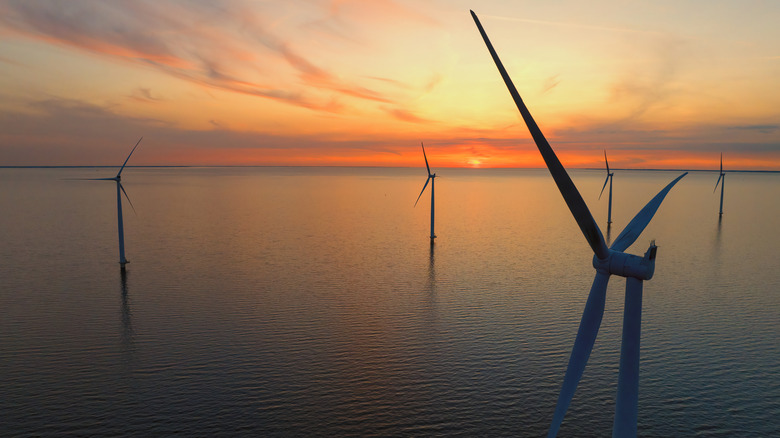
A study conducted on the WindFloat Atlantic project, an offshore wind farm located over 11 miles off the Viana do Castelo coast in Portugal, showed that the power plant had no effects on plankton communities or the wider ecosystem. While that finding was encouraging, there was more a surprising result. The WindFloat Atlantic had a positive effect on various species, with the team recording greater fish, octopus, and sole abundance in the area. In fact, the floating platforms housing the wind turbines improved the substrate of the sea bottom, creating a sort of reef effect that attracted mussels, kelp, and barnacles.
How did the wind farm help the ecosystem exactly?
Underwater life is sensitive to water quality and noise (not always a bad thing, as scientists have actually managed to restore Jamaica's coral reefs with underwater speakers). Thus, researchers kept a close eye on these metrics. After comparing the wind farm zone to other adjacent reference areas, they found that turbines didn't alter the functioning of the underwater ecosystem, particularly in terms of plankton communities.
However, since the wind farm is also a fishing exclusion zone, the locale became somewhat of a refuge for various species, with fish, octopus, and some invertebrates becoming more abundant as a result. Along with the aforementioned reef effect, researchers also noted higher dolphin activity in and around the wind farm, likely the result of reinvigorated prey availability.
A huge pitfall of wind turbines is that they can harm birds. This wasn't the case on the Portuguese wind farm. Despite researchers identifying that northern gannets and large gulls were flying at rotor height, they recorded no collisions. This is a huge victory when you consider that the plant generated 345 GWh of electricity without putting the local ecosystem at risk.