

Solar Panels Are Providing An Unexpected Benefit To This Colorado Farm
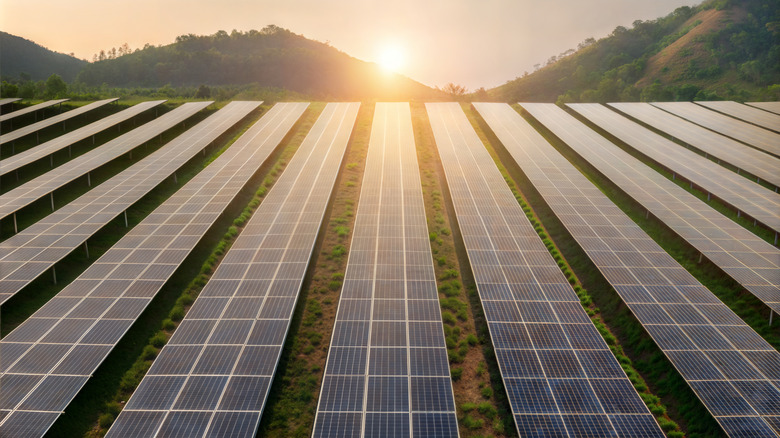
As temperatures rise and droughts become more common due to manmade climate change, farmers are having to find creative solutions to grow healthy, robust crops while staying profitable amid rising utility costs. That's why Byron Kominek added 3,276 solar panels to Jack's Solar Garden, his family's 24-acre farm located in Longmont, Colorado. He's also partnered with researchers to find the best ways to simultaneously use the land for agriculture and energy production — a practice called agrivoltaics.
As Kominek shared with The Guardian, the solar panels produce 2 gigawatt-hours of electricity each year, which he sells to a local utility company to cover the costs of the farm. On top of that, the panels create shade to keep the plants below cool. This creates microclimates where different crops can thrive, allowing plants like flax (which has an ideal germination temperature between 65 and 70 degrees Fahrenheit) and clary sage (which wilt in temperatures over 95 degrees) to grow healthily despite the increasingly brutal summer heat.
There is a learning curve for farmers, as the metal supports of the solar panels are an obstacle to work around. It will also take time for researchers like those working with Jack's Solar Garden to develop best practices that can be widely applied. On top of that, there's a high upfront cost to installing the panels in the first place, as Kominek said his 3,000+ panels cost $2 million. Regardless, agrivoltaics presents a possible solution for struggling farmers by providing an additional source of income while also improving harvests.
Solar panels are good for the environment and economy
As solar energy becomes a larger portion of overall electricity production, solar panels are proving to be more than just a source of clean power. In addition to providing shade, the solar panels block solar radiation and allow the soil below to retain more moisture. That's why China's massive Gonghe Photovoltaic Park is changing the desert around it, turning what was previously barren land into fertile ground where plants and microbes can thrive.
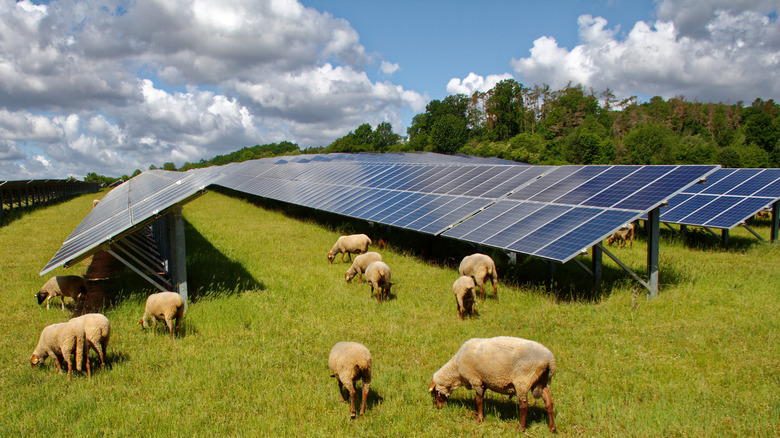
Upgrading a farm to be solar-powered isn't cheap – again, Kominek says he paid $2 million for his 3,000+ panels — but farmers don't need to spend millions installing their own panels to benefit from agrivoltaics. Solar farms frequently hire local farmers to graze animals like sheep and cattle beneath the panels, providing an efficient (and eco-friendly) landscaping team. Solar grazing gives farmers another way to boost their income, as solar shepherds often earn two to three times as much as traditional shepherds.
Agrivoltaics isn't the only way solar farms can help the surrounding environment. In the Netherlands, a floating solar farm has become a functioning ecosystem thanks to Biohuts installed beneath the panels. While opponents of solar energy expansion criticize it for the amount of space panels require, places like Jack's Solar Garden show how farmers can make the most of their land in a way that's mutually beneficial for both people and nature.