

What's The Difference Between Dual-Band And Tri-Band Mesh Wi-Fi Systems?
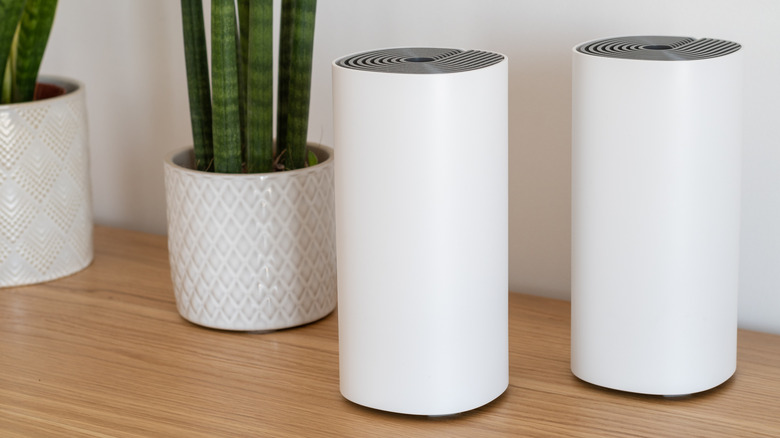
Mesh networking systems are a good choice if you are dealing with Wi-Fi dead zones and coverage issues in your relatively large home. Unlike standalone Wi-Fi routers, which function as a single access point and have to reach all corners of your property from one location, mesh systems use two or more nodes placed around your home to deliver wireless connectivity. While there are plenty of reliable mesh Wi-Fi routers on the market, picking one for your needs can sometimes become a hassle because of the jargon involved. One of the technical terms you'll come across is band support: Some mesh Wi-Fi systems are dual-band, whereas others offer tri-band support. Understanding the distinction between the two is pretty important if you want to buy something that doesn't give you trouble.
Modern Wi-Fi devices, including Wi-Fi mesh systems, rely on three bands to deliver and receive data: 2.4 GHz, 5 GHz, and 6 GHz. Dual-band support means the use of 2.4 GHz and 5 GHz, and tri-band support refers to the support for three Wi-Fi bands, which can include two 5 GHz bands and a 2.4 GHz band or one band each of 2.4 GHz, 5 GHz, and 6 GHz. With the introduction of Wi-Fi 6E and Wi-Fi 7, more and more tri-band setups favor including the 6 GHz band. However, you can still encounter Wi-Fi 6 mesh networking systems with two 5 GHz bands. There are two main ways in which the support for an additional 5 GHz or 6 GHz band in a modern mesh Wi-Fi network system impacts its performance: dedicated backhaul and data transfer speeds.
Tri-band can enable a dedicated wireless backhaul
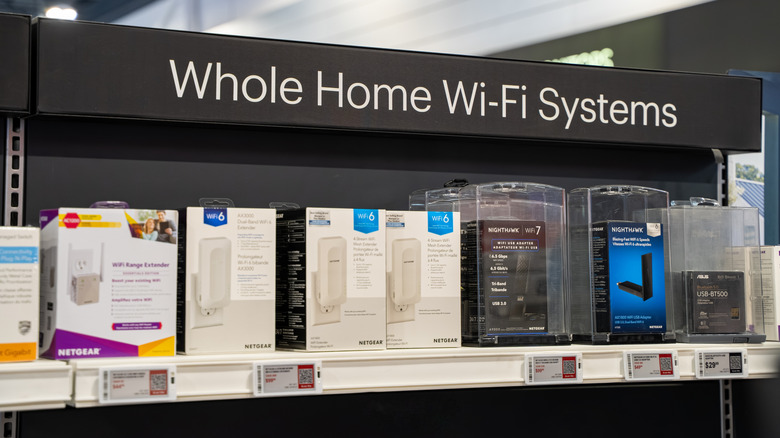
Mesh systems need a backhaul channel for communication between the router and the nodes, and most systems offer the option for a wired or wireless backhaul. While wired backhaul is typically better because it gives the nodes a direct physical connection for superfast data transfer, it's not often feasible. This is where wireless backhaul comes into play. In a dual-band mesh Wi-Fi system, wireless backhaul has to share the same space with the rest of your internet traffic, typically on the 5 GHz band, which can impact the overall performance.
However, tri-band systems can leverage the availability of the additional 5 GHz or the 6 GHz band as a dedicated backhaul for the node-to-node communication. This keeps the other bands free from this traffic, giving more room for your regular network traffic. More importantly, if there is a 6 GHz band, nodes can talk to each other more quickly, avoiding extra lag in the connection.
That said, having a dedicated wireless backhaul is not a given for all tri-band mesh routers, particularly the ones with a 6 GHz band. Some systems don't like to lock down the 6 GHz solely for node-to-node communication, and as such, use dynamic (or adaptive) shared backhaul, like dual-band systems, in which the 6 GHz band is available for regular devices as well. Still, even when the 6 GHz band is being shared between backhaul and the rest of the traffic, the tri-band mesh system is able to deliver better performance than a dual-band system because the 6 GHz band is faster, doesn't have legacy interference, and is relatively free because a limited number of devices support it.
6 GHz support adds a superfast data lane
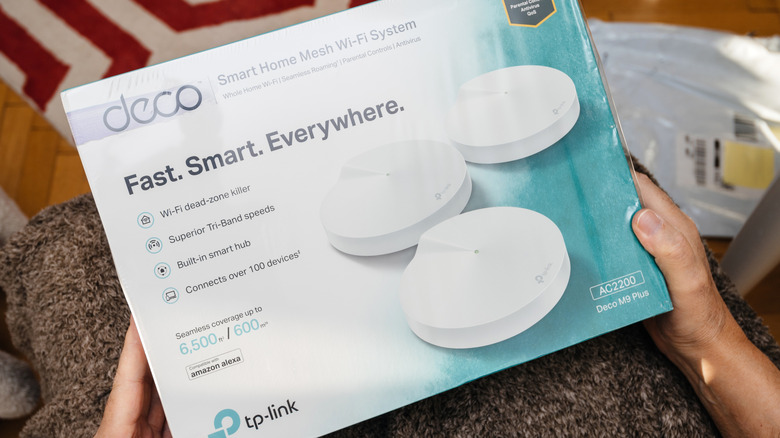
Although having a second 5 GHz band in a tri-band mesh system doesn't bring any peak speed improvements, the presence of 6 GHz can certainly help in that regard. The 6 GHz band enables even faster data transfer speeds than the 5 GHz and 2.4 GHz bands, thanks to its wider channel width, which allows for more data to be carried simultaneously. If a mesh network system supports the 6 GHz band, it's capable of delivering superfast Wi-Fi. However, both the client device and the router need 6 GHz support for you to enjoy the speed benefits. Moreover, 6 GHz has a limited range compared with the 5 GHz and 2.4 GHz bands, and has trouble penetrating obstacles because of its shorter wavelengths, which are often absorbed by dense physical materials.
The 6 GHz Wi-Fi band is only found on mesh systems with Wi-Fi 6E or Wi-Fi 7 support, the latter of which is the latest Wi-Fi generation available for public use. Keep in mind that if you enable this band for use as a dedicated backhaul, you won't be able to use it for regular devices. Besides the speed benefit, the presence of a 6 GHz band in a Wi-Fi 7 mesh system also enables Multi-Link Operation (MLO) Aggregation, which essentially allows the system to combine multiple bands together for better and more reliable performance. However, true MLO remains pretty rare to find in routers in 2026.