

How Accurately Did The Martian Depict Its Science And NASA?

NASA hopes to send humans to Mars in the near future, but can they expect a similar experience to Matt Damon's stranded astronaut in "The Martian"? Hopefully, NASA's participants enjoy a more stress-free trip, but some elements of Ridley Scott's sci-fi film are more true-to-life than you might think.
Scientists, astronauts, and NASA employees have praised "The Martian" as a scientifically accurate sci-fi movie. Let's start with the scene where Damon's hero, Mark Watney, turns carbon dioxide into oxygen during his stay on the Red Planet. In 2023, NASA's MOXIE instrument successfully extracted oxygen from Mars' atmosphere (which is 95% carbon dioxide) and proved that Watney's methods weren't far-fetched. "The Martian" also sees Watney grow his own food through a combination of Martian soil and human excrement. His methods are gross, but they beat starving to death. Be that as it may, scientists claim that it's possible to grow food on Mars due to the nitrate in the planet's soil, so real-life astronauts won't have to worry about starving if they're constipated. Feces isn't essential for growing crops in this corner of space.
The film has also been praised for its depiction of NASA and its operations, with astronauts highlighting its accurate reflection of the organization's culture and goals. What's more, some scientists noted that "The Martian" presents Mars in a similar way to how it actually looks in the real world. That said, the best sci-fi movies often abandon logical storytelling for dramatic purposes, and "The Martian" is no different.
One scene in The Martian blows scientific accuracy off the planet
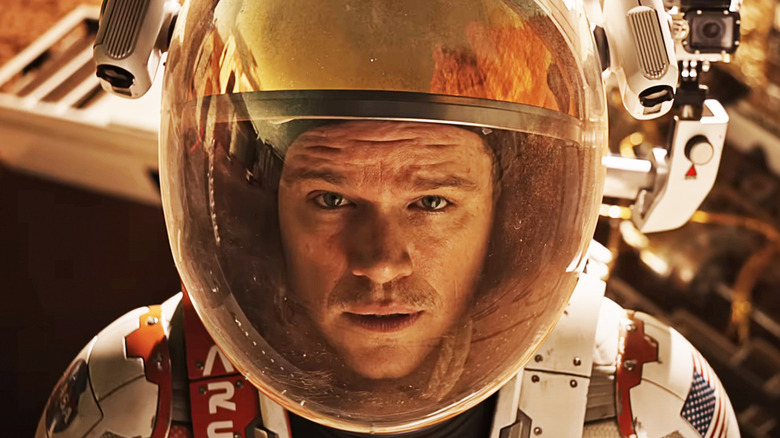
Andy Weir did a lot of scientific research before he wrote "The Martian." He wanted the story to be scientifically accurate — and it is, for the most part, from the oxygen conversion to the fact that the chance of life on Mars is not as high as we thought. Ridley Scott had a similar mindset when he adapted Weir's novel, bringing in space and science experts to consult throughout the filmmaking process. That said, Weir and Scott had to abandon their scientific principles to create one key moment in the book and movie.
The devastating wind storm that leads to Mark Watney getting stuck on Mars wouldn't happen in real life. Wind speeds can reach approximately 60 miles per hour on the Red Planet, which would cause problems on Earth. That said, Mars doesn't have enough atmosphere to turn these gusts into storms with hurricane-like intensity. However, this was included in "The Martian" because the story needed an inciting incident to keep Watney trapped in outer space.
Weir and Scott had to sacrifice scientific accuracy for an exciting set-piece, but even the folks at NASA agree it was an acceptable trade off. "The Martian" received widespread praise from experts for its realism, so everyone involved in the book and film's creation should be proud of their accomplishment.