

10 Of The World's Biggest Telescopes & Where They're Located

The first time a caveman looked up at the night sky, he dreamed of what the stars might look like up close. Alas, despite thousands of years of technological advancement, we still don't have the technology to travel to the distant stars. We've put human beings on the moon, and the Curiosity rover is still doing its thing on Mars, but those shiny white specks we call stars are still beyond our reach.
However, we might not be able to touch them, but we can still look. Telescopes are mankind's way to study the stars without venturing all the countless light-years necessary to actually see them up close. Thanks to advancements in science, telescopes aren't handheld spyglasses as you'd see on an old-timey pirate ship, or binoculars a sniper's spotter might use. Astronomers use telescopes powerful enough to capture images that are not only invisible to the naked eye but unimaginable to terrestrial sensibilities.
Let's take a look at ten of the largest telescopes in the world. For this story, we're not going to look at telescopic arrays. Those use multiple sources to create a single, composite image. We're also only sticking to earthbound tools, so we're going to skip the Hubble and the James Webb Space Telescope. With that in mind, here are 10 giant telescopes and where they are located.
Gemini South -- Cerro Pachon, Chile
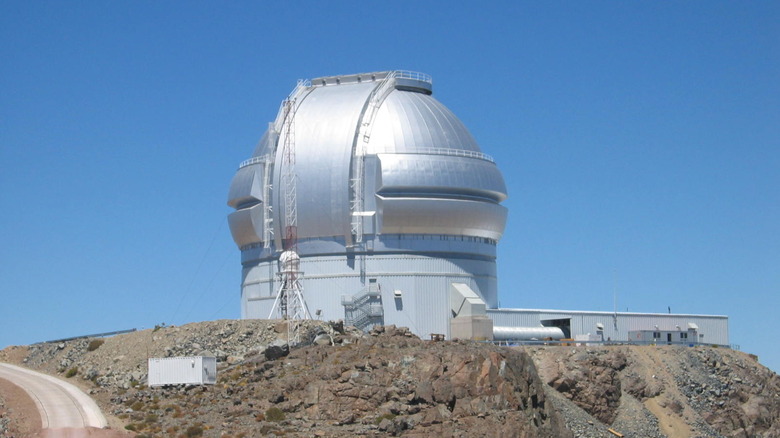
There are two Gemini telescopes. We'll get to Gemini North shortly, but first, let's discuss Gemini South, located in Cerro Pachon, Chile. The two telescopes are often referred to as a single observatory, but they're distinct entities.
Gemini South is situated nearly 9,000 feet above sea level thanks to its position in the Chilean Andes mountains. Thanks to the lack of humidity and clear skies, Gemini South has a beautiful view of the sky. Clouds and moisture, or even a single drop of water, can obscure an image like a bug crawling onto the lens of a security camera. Thanks to the unique and favorable conditions of Cerro Pachon, Gemini South has been able to capture a great many unprecedented images since first going online back in the year 2000.
The rotating dome of the telescope measures 46 meters, and the scope itself has an 8.1-m diameter Cassegrain reflector. Gemini South has taken beautiful pictures of outer space, including the Trapezium field in the Orion Nebula and the NS14 bipolar nebula. Needless to say, these images, as well as most of what these high-tech telescopes capture, are completely impossible to see with the naked eye or consumer-level equipment.
Gemini North -- Mauna Kea, Hawaii
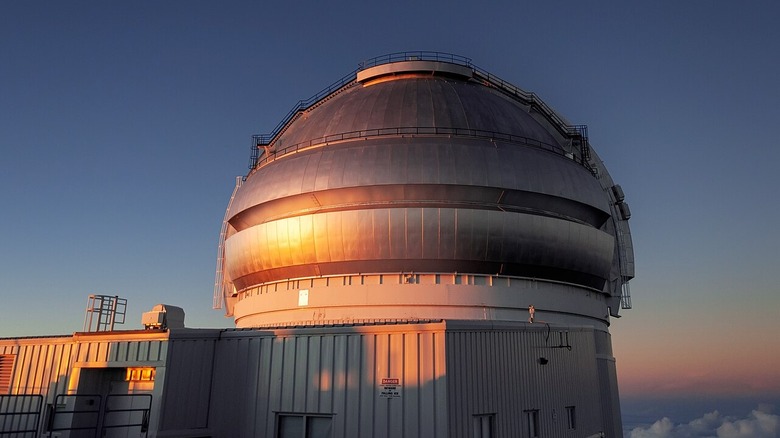
We've covered Gemini South, so now let's move on to Gemini North, the second half of the Gemini Observatory. Gemini North is located in Mauna Kea, Hawaii, roughly 14,000 feet above sea level. The telescope itself is similar to that of Gemini South, with the same 46-meter rotating dome and 8.1-meter-diameter Cassegrain reflector.
The telescope at Gemini North has captured amazing images, including shots of raging storms on Jupiter and even photos of an interstellar object, believed to be a comet, captured through exposures of the Gemini Multi-Object Spectrographs, or "GMOS." The two Gemini telescopes aren't positioned where they are by chance. They're planted where they are so they can collectively cover almost the entire sky.
Back when the system was first envisioned, it was a joint venture with funding from the United States, the United Kingdom, Australia, Chile, and neighboring nations. However, after the United Kingdom withdrew its funding in 2012, the observatory was hit hard by budget cuts. As a result, the Gemini telescopes had their functions streamlined and limited. However, in 2018, the Korean space agency, KASI, signed on to participate in the Gemini project, which helped mitigate the damage and allowed Gemini to carry on.
Subaru Telescope -- Mauna Kea, Hawaii
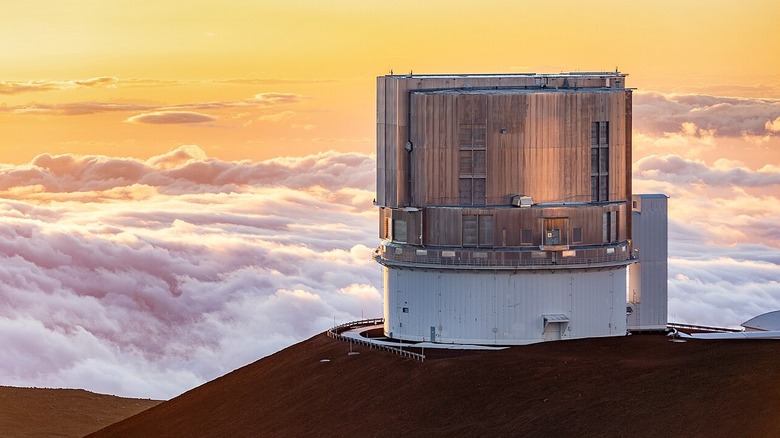
Many telescopes are located within the state of Hawaii. While seen as something of a Pacific tropical paradise, its massive mountaintops are so high above sea level that they are all but completely unaffected by the endless ocean that surrounds the islands. On the Mauna Kea mountain alone, there are no fewer than 13 telescopes, including the Subaru Telescope, owned and operated by the National Astronomical Observatory of Japan, or "NAOJ."
Mauna Kea is situated at 13,500 feet above sea level, far above the cloud coverage of the region. Mauna Kea isn't just a tall mountain, but a dormant volcano. Needless to say, the location is a bit remote, to say the least, so the telescope is operated from a control center called the Hilo Base Facility, which is much more accessible to the scientists and engineers who work there.
The Subaru Telescope was constructed across the mid-1990s and began proper work in January of 1999. The diameter of the telescope's primary mirror is 8.2 meters, a tad bigger than the Gemini telescopes, and it weighs over 25 tons, with the surrounding structure clocking in at a massive 612 tons.
Very Large Telescope -- Cerro Paranal, Chile
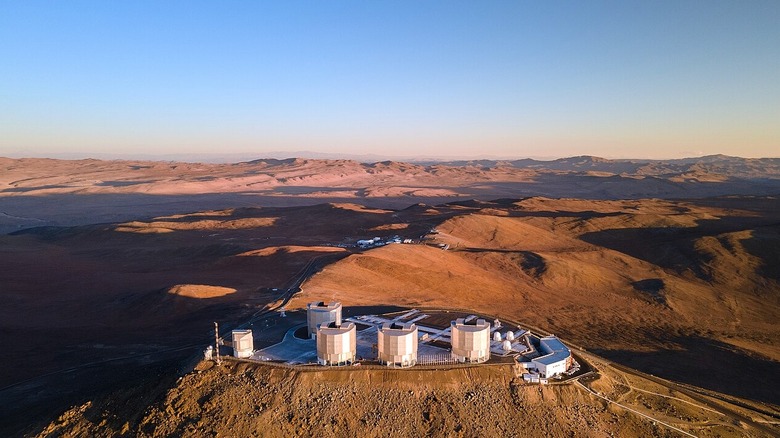
The unimaginatively named "Very Large Telescope" is, in fact, very large. First put into use in 1998, it's part of the European Southern Observatory, though it's not found in Europe but in South America. Regardless, the Very Large Telescope lives up to its name, and can potentially use observations of starlight to discover hidden alien planets.
Actually, the Very Large Telescope is four telescopes in one, though it's not an array. Each of the four Unit Telescopes has mirrors that are 8.2 meters in diameter and can all be used individually or in conjunction to capture ultra-high-detail images that would be impossible with any of the lone telescopes.
This one is located in Cerro Paranal, Chile, a mountain plateau located 8,650 feet above sea level. If the area looks familiar, you might be a James Bond fan. The people who live and work on the Very Large Telescope operate from a building called the "Residencia," which was used as the Eco Hotel in 2008's "Quantum of Solace," where it's blown to bits as part of the film's explosive finale. Thanks to movie VFX magic, they didn't actually destroy the location in real life.
Southern African Large Telescope -- Sutherland, South Africa
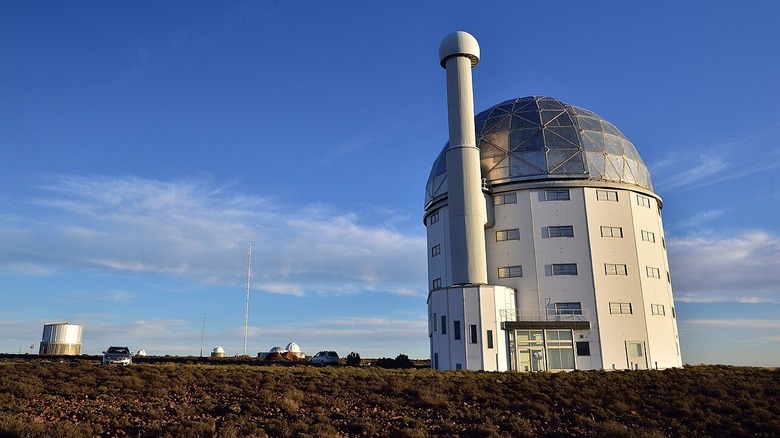
The sole African entry on this list is the Southern African Large Telescope, or "SALT," located in Sutherland, South Africa. It's sometimes referred to as "Africa's Giant Eye In The Sky," and it's easy to see why, as it is the biggest and most high-profile telescope in the region.
SALT rests at an elevation of 5,900 feet, high enough for an uninterrupted view of the sky. As a cost-saving measure, the telescope has a fixed angle of elevation and can only be adjusted on its azimuth axis. This might seem limiting, but this streamlined design makes SALT easier and cheaper to maintain, at least by the standards of multi-million-dollar telescopes funded by multiple countries around the world.
According to the South African Astronomical Observatory website, the telescope is literally a billion times more powerful than the naked eye, thanks to its primary mirror's aperture of 11.1 meters by 9.8 meters. Overall, SALT is essentially a modified version of the Hobby-Eberly Telescope in Texas, but we'll get to that one in a little while.
Keck I and Keck II -- Mauna Kea, Hawaii
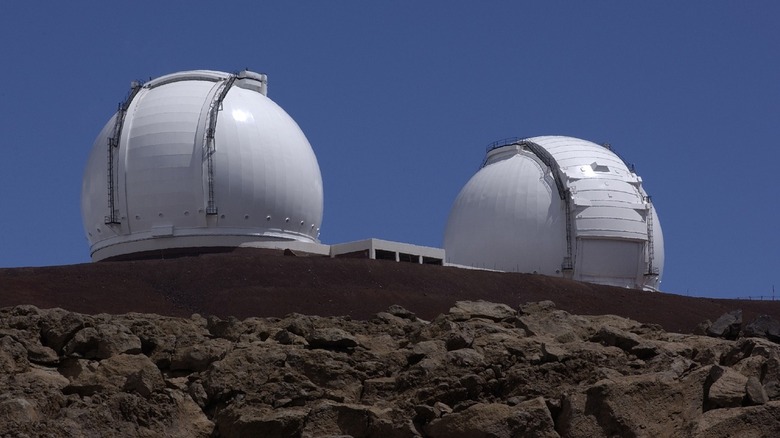
We started this story with a pair of Gemini telescopes, but they're not the only 'tele-twins' around. There are also the Keck telescopes, both of which are located in Mauna Kea, Hawaii, just like Gemini North. In fact, the Keck Observatory is less than 50 miles away from the Gemini North telescope. It's just up the road, so to speak.
Keck I and Keck II are practically identical and located right next to each other, so we're going to consolidate them in this single entry. Keck I started collecting data in 1993, with Keck II following just three years later, in 1996. Together, they've made scientific breakthroughs like observing the inside of a dying star.
The grand innovation made by the Keck telescopes came about due to the impracticality of the massive mirrors used to look out to the far reaches of space. Traditional panes of glass would bend or shatter during movement due to their massive size, so designer Jerry Nelson and his team designed a new way of assembling a telescope's mirror. Instead of one massive hunk of glass, Keck's mirror is comprised of 36 hexagonal mirrors that lock together to make one big mirror. This design was so revolutionary and successful that it was used in the Hobby-Eberly Telescope, the South African Large Telescope, and most other telescopes of significant size.
Hobby-Eberly Telescope -- Mt Fowlkes, Texas
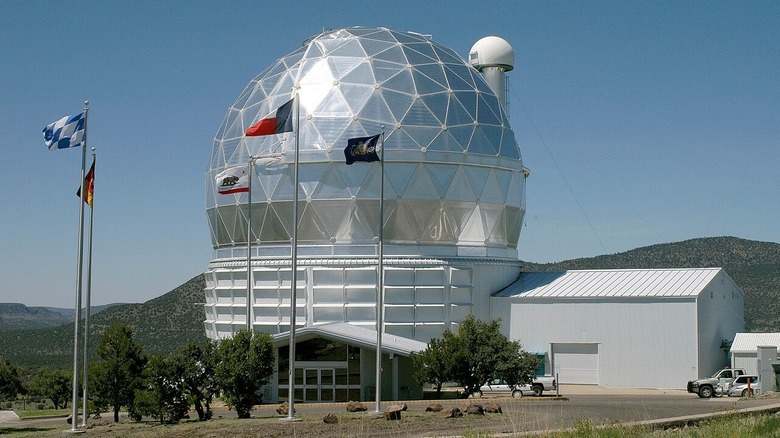
As mentioned before, the South African Large Telescope was based on the Hobby-Eberly Telescope in Fort Davis, Texas. That's mostly true, but the Hobby-Eberly Telescope is even bigger, boasting a mirror roughly the same size as its South African counterpart, but with a larger aperture of 32 feet (10 meters).
Just like SALT, Hobby-Eberly is set to a fixed angle, always locked at 55 degrees. Even with that limitation, Hobby-Eberly can still observe 70% of the sky, so it's no wonder it was copied for the SALT project. As for its Texas location, it's relatively accessible compared to most other telescopes in this story, being located 450 miles west of Austin. Thus, it's a popular tourist destination, with tickets for a guided tour going for just $10 for adults, and even less for children, students, and the elderly.
One of Hobby-Eberly's most noteworthy missions is the "Hobby-Eberly Telescope Dark Energy Experiment," more easily remembered as HETDEX, which uses advanced spectroscopy to track dark energy emissions across 11 billion years of celestial history.
Gran Telescopio Canarias -- La Palma, Canary Islands, Spain
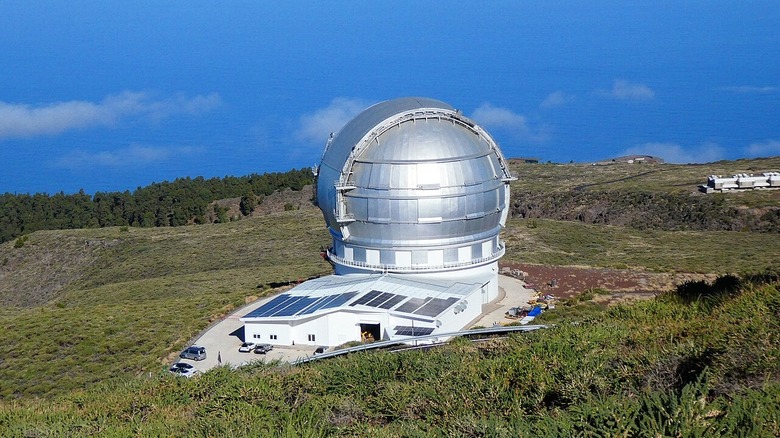
The Gran Telescopio Canarias can be found on the island of La Palma, part of the Canary Islands in Spain. It's also a relatively new telescope compared to some of the other telescopes we've covered so far, having had its "first light" ceremony in 2007. "First Light" refers to the first time a telescope is officially used to look at the stars beyond the sky. Despite this, the Gran Telescopio Canarias didn't actually start collecting data until 2009, after the Optical System for Imaging and Low-Intermediate-Resolution Integrated Spectroscopy, or OSIRIS, was installed.
The Gran Telescopio Canarias is part of the Roque de los Muchachos Observatory on La Palma, which is far away from mainland Spain and any bustling cities. It's also 7,500 feet above sea level and, as the only European entry in this story, it is the biggest telescope in all of Europe, with a diameter of 10.4 meters.
To enhance the results of the GTC and other telescopes of the La Palma observatory, a "Sky Law" was passed to minimize light pollution, which makes it harder to see the stars. Thanks to enforcement of this law, the night sky around the observatory is truly black. If you live in a major city, look up at night. You won't see many stars due to the light pollution, and it's a shame, since an unobscured night sky is an incredible wonder to behold, and that awe-inspiring wonder is multiplied a thousand times when viewed through a high-powered telescope like the Gran Telescopio Canarias.
Large Binocular Telescope -- Mt. Graham, Arizona
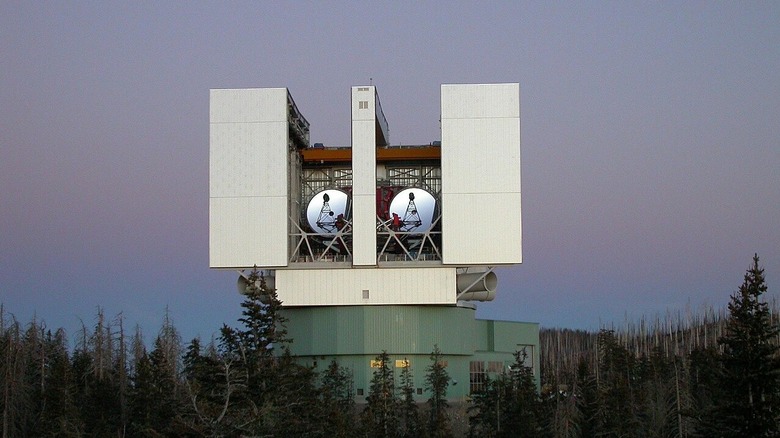
For our final entry, we push the rules a tiny bit. This is not an array of telescopes, but it is, as the name suggests, a binocular telescope. If a regular telescope is like an advanced version of a Navy seaman's spyglass, then the Large Binocular Telescope applies the same principle to binoculars like an ornithologist would use. But instead of looking for birds in the trees, you're looking for distant galaxies and other far-out phenomena.
The Large Binocular Telescope, which properly began operations in 2008, was the first of its kind, a next-generation way to look out into outer space. It makes use of two main mirrors with a diameter of 8.4 meters each, but they combine to make an effective diameter of 11.9 meters. It's a bit of a cheat, admittedly, but semantics aside, it's essentially the biggest single-mount telescope in the world. On top of that, the LBT makes use of an "adaptive optics" system that allows for sharper images than was previously thought possible.
Despite these praiseworthy achievements, the Large Binocular Telescope is not without controversy, mostly due to its location. The LBT is situated on Mt. Graham in Arizona at an elevation of over 10,500 feet. The problem is that Mt. Graham is considered sacred land by the San Carlos Apache Tribe of Native Americans. There were numerous lawsuits against the project, but they all failed, and the project was allowed to proceed.