

5 Star Trek Alien Species With Unusually Long Lifespans

"Star Trek" is all about exploring new planets and — despite Gene Roddenberry not caring about creating new civilizations — discovering new cultures. Throughout the franchise's tenure, the Enterprise and other Starfleet crews have encountered aliens of all shapes, sizes, and colors with varying lifespans. Some lived similar lengths of time as humans; others had shorter lifespans, and a few could live multiple human lifetimes. The (in)famous Q, for example, is a race of immortal, godlike beings that seemingly live indefinitely.
The Q is probably the most popular race of long-lived beings in "Star Trek," but it's far from the only one, nor is it the most fascinating. There have been characters that, without any evidence to the contrary yet, are altruistic and benevolent, like the Lanthanites. There are also those from the earliest days of the franchise that are rarely seen anymore, like the Cherons — or those who can take on any shape, like the Changelings.
None of these species are as commonly seen as the more popular Romulans, Klingons, or Vulcans, but they're just as fascinating — possibly more so since they're not as common as the others. Sure, Paramount might not have plans to green-light any new "Star Trek" shows or movies for the foreseeable future, but if and when it ever returns to the big or small screen, perhaps there will be more of the near-immortal aliens.
Changelings
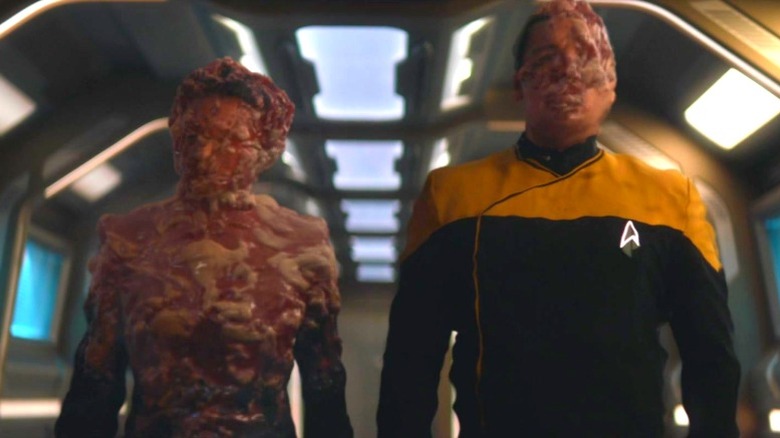
Audiences first got a glimpse of the Changelings in "Star Trek: Deep Space 9," with Odo's introduction. At that point, nobody, not even Odo himself, knew what he was. It wasn't until DS9's chief of security met the Founders from the Gamma Quadrant that anything was learned, including how long they can live. No numbers are ever explicitly said in the show — or in "Star Trek Picard" when Changelings return with a grudge — but some inferences can be made.
In season 5 episode 22 of "Deep Space 9" (entitled "Children of Time" and indeed a very timey-wimey episode), members of the Starfleet crew visit a planet settled by their descendants. It's explained to them that when they try to leave on the USS Defiant, they'll be thrown 200 years into the past and forced to make the planet their home. It's complicated. One of the settlement's residents isn't a descendant, but rather, the real Odo, who is more than 200 years old at this point and is looking mighty spry for his age.
However, in the sixth season's fourth episode, "Behind the Lines," Odo has a conversation with a female Changeling that leads to the realization that as long as the Great Link — all Changelings connected in liquid form like an ocean — exists, then the Changelings exist. It's unsaid, but it kind of insinuates that Changelings are functionally immortal.
Trill symbionts

The Trill first appeared in "Star Trek: The Next Generation's" fourth season, but they became more fleshed out in "Deep Space Nine," with a Trill — Jadzia Dax (Terry Farrell) — playing a pivotal role in the series. The Trill technically come in two parts, because there are the native humanoids of Trillius Prime, which have about the same lifespan as Earth humans, and the Trill symbionts, teardrop-looking lifeforms. As long as the symbionts have a host or reside in one of the natural pools of their planet, they can live for upwards of 550 years, and some have been known to live considerably longer.
The symbiont Bix (seen in "Star Trek: Discovery") lived for roughly 800 years. The one symbiont known to live the longest was the one who made the Trill popular with trekkies: Dax. Jadzia was Dax's eighth host just a few hundred years after its birth in 2018, with Ezri, after Jadzia's death, being its ninth host (there was a short hostile stint with Verad in "DS9" season 2 episode 4).
Thanks to the new "Starfleet Academy" series, fans learn a little about what happened to the Dax symbiont after Ezri: It was implanted in Illa. Illa Dax is a Starfleet Academy instructor in the year 3195 (the 32nd century), making Dax 1,177 years old.
El-Aurians
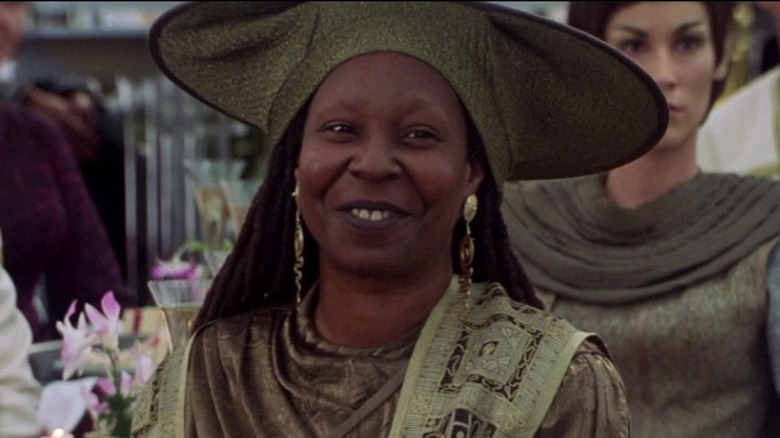
Fans of "Star Trek: The Next Generation" are likely going to fondly remember the most popular of the El-Aurians: Guinan (Whoopi Goldberg, who has a supporting role in one of the addictive Paramount+ miniseries). This humanoid species can live for several centuries, which has given them a certain appreciation for those that don't tend to live as long. It has also made them excellent listeners, and Guinan truly stood out on this front as a bartender on the Enterprise-D, listening to the woes of every patron that passed her way, including Captain Jean-Luc Picard.
However, before Guinan ever stepped foot on the Enterprise-D, she had been aboard the Enterprise-B along with 46 other El-Aurian refugees when they needed rescuing from an anomaly of energy known as the Nexus. At this time, Guinan was roughly 500 years old, and that was in 2293. Sure, by human standards, Guinan was old, but there have been El-Aurians that lived to exceed 700 years of age.
Most from this dwindling species live long, quiet lives, but there are those who have been known to get into some trouble. Most notably, there was Dr. Tolian Soran (Malcolm McDowell), who was one of the refugees rescued with Guinan, but he wanted to manipulate the Nexus in order to see his family again, and he was willing to blow up a sun to do so. Another antagonistic El-Aurian was Martus Mazur. Mazur briefly ran a club on Deep Space Nine until Odo arrested him for conning people out of their hard-earned money.
Cherons

The Cheron made their "Star Trek" debut in the original series with William Shatner and Leonard Nimoy, but have gone on to show up briefly in newer "Star Trek" projects, including "Starfleet Academy," "Lower Decks," and "Section 31," which is sadly the worst "Star Trek" movie according to Rotten Tomatoes. Their appearance in "Star Trek: The Original Series" taught fans the most about these two-tone characters. Beyond the fact that those with black on the right side of their body were horribly racist and caused a civil war that nearly wiped out their entire species, they can live to be about 50,000 years old.
Now, they might certainly live longer. The two characters — at the time believed to be the only two survivors from their planet — in the original 1969 episode ("Let That Be Your Last Battlefield") say that they had been hunting each other for 50,000 years, and they still look young-ish and spry, so they might even have another thousand years in them.
Lanthanites

The Lanthanites are a newer inclusion to the "Star Trek" franchise, with Commander Pelia (Carole Kane) being the first, so most of what fans know about this species is learned from her in "Star Trek: Strange New Worlds." In season 2's episode "Tomorrow and Tomorrow and Tomorrow," when La'an Noonien-Singh travels back in time to the 21st century, she bumps into a younger Pelia — 200 years younger — who looks exactly as she does in the 23rd century. Then there's the little fact that Pelia says she was around when Pythagoras was alive, which would make her nearly 3,000 years old by the time she's a crewmember of the Enterprise. In season 3, she admits to being 5,000 years old (born in the 28th century B.C.).
The franchise has been vague as to the exact lifespan of this newfound species, with little more than a simple "almost forever" nailing down that they're not quite as immortal as the Q. The only other Lanthanite that has received considerable screen time is Captain/Academy Chancellor Nahla Ake (Holly Hunter) of "Starfleet Academy," but in this case she's half Lanthanite and half human. She's not nearly as old as Pelia — and who knows if a hybrid could enjoy the same longevity as her Lanthanite brethren — but being over 400 years old means she remembers Starfleet's golden age.