

This Cyberpunk Sony Accessory Set The Stage For PlayStation VR Decades Ago
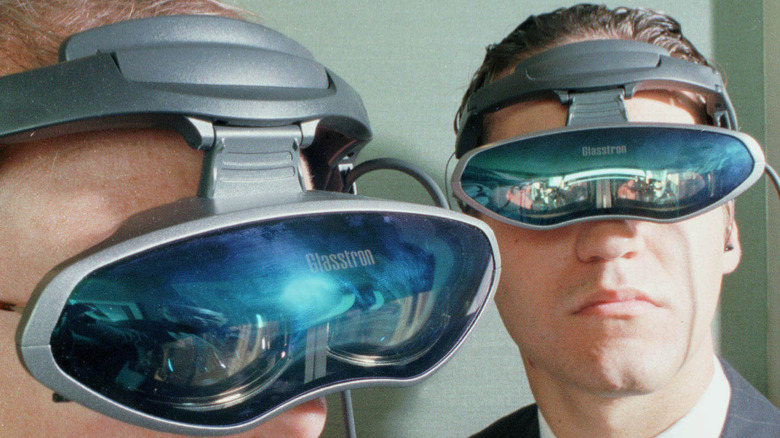
In the late 1990s, Sony released a revolutionary line of devices that allowed owners to experience television unlike any other. Before virtual reality headsets became as widespread as they are today, the company behind the PlayStation had created the Sony Glasstron Personal Viewer. Similar to how the company's PS VR headset is worn today, the Glasstron device fit on the wearer's head like a pair of glasses, and once on, it would give the experience of watching a 52-inch television from about 6 feet away.
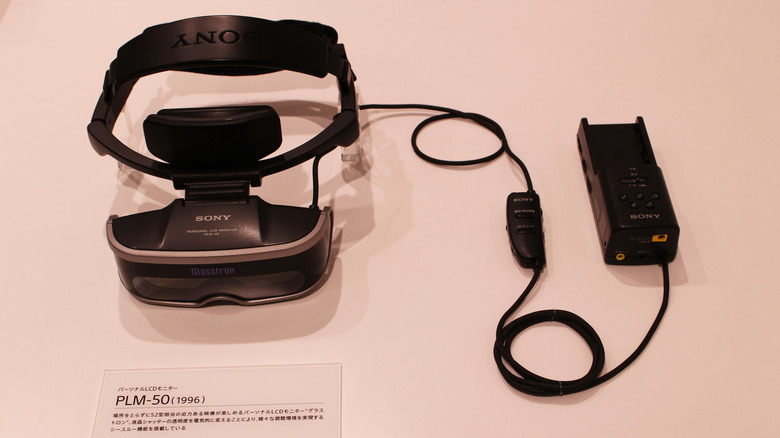
Unlike today's PS VR 2, which is powered by a PS5, the Sony Glasstron required being connected to a power supply box that also connected to a "VCR, laser disc players, DVD player, camcorder, etc." using VGA, Composite, or S-Video output. The display unit headset was equipped with two small LCD screens on the right and left that acted like glasses that even fold up when not in use. The Sony Glasstron was one of Sony's earliest examples of VR and it was a key item that led to the company making the PS VR headsets.
Details of the Sony Glasstron
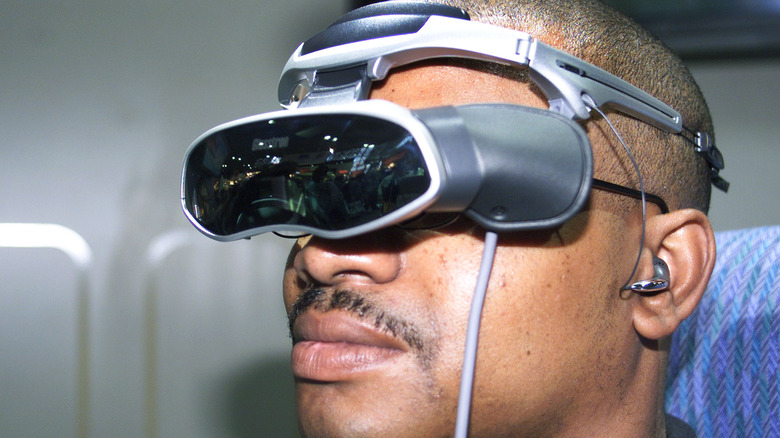
Introduced 1996, Sony sold five different versions of the Glasstron, starting with the PLM-50 (shown below). The Sony Glasstron PLM-A35 went on sale in the U.S. in 1998 with a retail price of around $500 ($1,018, adjusted for 2026 inflation), while the more advanced Glasstron PLM-S700 sold for $2,500 ($5,090, in today's money. And you thought 2026 was an expensive year for tech! Compare these prices to the $399 a modern Sony PS VR 2 headset.
Despite those prices, the Sony Glasstron received high marks in several categories, including affordability. Ergonomics were also mentioned as a strong point in an expert tech review from that era, and Sony claimed its Glasstron headsets could be worn over eyeglasses, which could account for why the device was so large. As for the components and connection cables, there were an assortment of power and video cables, making for a mess of connectors that can get tangled, twisted, and trip wearers up.
The actual headset and its two LCD screens perform some cyberpunk style optical illusions. The right and left screens act in such a way that they make the wearer's brain think they are seeing a single image, and later models had a flip-up shutter allowing the headset to be see-through. According to reviewers who testedthe device, the display looks good, but users on Reddit say it could run quite hot and strain the wearer's eyes. Fatigue and motion sickness were also problems and reasons why people ditch their VR headsets.
How it impacted current Playstation VR
The Sony Glasstron could be considered the genesis for Sony's future VR headsets released by the company. The design of the 1990s entertainment device is similar to the modern PS VR headsets, only they offer HD graphics, games made for VR, and enhanced technology not available when the Sony Glasstron was around.
The Sony PlayStation VR2 includes a larger headset than the Sony Glasstron, supports 4K HDR, and includes an OLED display with 2000 x 2040 resolution. The two headsets share a lot in common in design, look, and experience, however, the PS VR 2 is an updated and enhanced version that features motion sensing controllers as well. It also allows users the ability to play PlayStation video games in virtual reality.
The Sony Glasstron only allowed users to connect other devices to it. They could play other systems such as a Sega Dreamcast or watch a movie. The PS VR 2 features VR games such as "Resident Evil 4 VR," "Beat Saber," and "Surviving Mars: Pioneer." It took a few years for Sony to crack the VR experience, but it is clear to see that the Sony Glasstron was an early attempt and one that led to the creation of the company's PS VR headsets.