

The Unexpected Creature That Inspired A Breakthrough In 'Soft' Sensing Robots
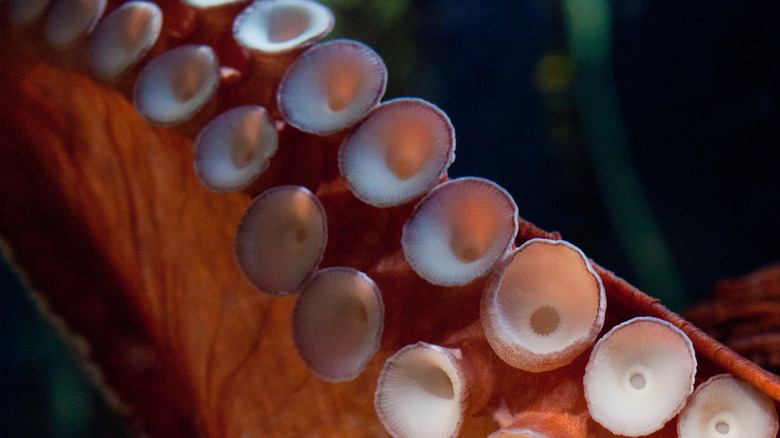
When you think of robots, you probably imagine something silver, mechanical, or some kind of humanoid android. What you probably don't picture is a long, flexible tentacle complete with suction cups. But that's essentially exactly what the robotic arm developed by researchers at the Italian Institute of Technology (IIT) looks like.
The tentacular arm uses cleverly designed artificial suction cups that can estimate force intensity and direction, autonomously grab items, and sense contact. It achieves this by mimicking key functions in octopus's nervous system. Octopuses have what's known as a distributed nervous system, where their nerve cells are spread across different parts of the body — in this case, their tentacles — instead of being focused mostly in their spine and brain like it is in humans. That's what's thought to help make their movements so dexterous, complex, and sophisticated; remarkably useful traits for creatures intelligent enough to build their own so-called underwater cities.
Much like in a real octopus' body, the robotic arm's suction cups make it possible for the tentacle to process signals in real-time without having to relay the information to another, centralized control system. In the robot arm's case, it uses miniature tactile sensors known as optoelectronic mechanosensors that allow it to move or grasp objects in response to touch. The sensors achieve this using a combination of light-emitting diodes (LEDs) and phototransistors, which interpret direction and force using light reflection, with a degree of accuracy and sensitivity that advances previous research in the field substantially.
What makes the soft sensing robotic arm special?
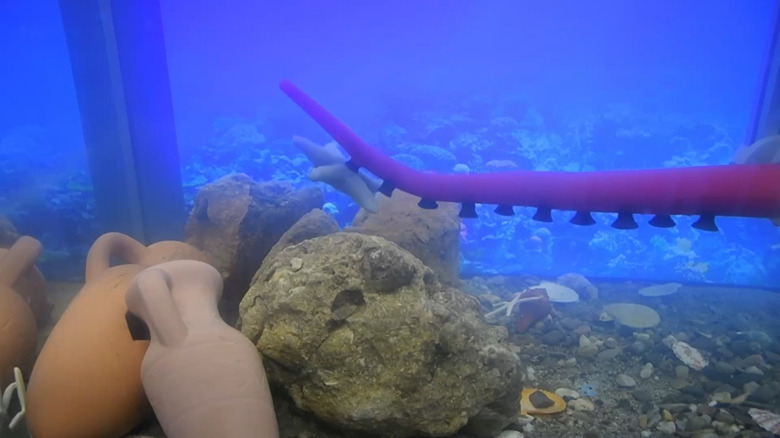
Borrowing ideas from octopus biology isn't new to soft robotics — another octopus-inspired robot arm complete with suckers was developed at the University of Bristol in 2024, for instance — but IIT's robo-octopus tentacle helps push the concept forward into new territory. There aren't many other examples of robotic arms in the field that can independently react to touch using tactile sensors and suction cups.
Branching into suction cups and all things octopus isn't only important to the field for its novelty or innovation; adaptive suction also provides exciting new avenues of development for robotics more generally. Building intelligent suction cups helps to develop the applications of soft robotics into all kinds of industrial areas and applications. While it might not be easy to immediately picture how to use a robotic tentacle, don't think that the invention is just pure experimentation or exploration.
Courtesy of the suckers' clever design, the arm's amplified sensitivity and innovative grasp mean it could be critical for moving and handling highly fragile items at a potentially lower risk of causing damage. The flexibility and shape of the arm also mean it could be useful for accessing items that could be hard to reach otherwise. And the sensors can also work in wet or dry environments, further diversifying the robot's potential applications. With all of that in mind, the arm could be useful in an assortment of applications, ranging from medical settings and manufacturing to research settings like underwater exploration or archaeology.
Soft robotics often takes inspiration from nature and biology
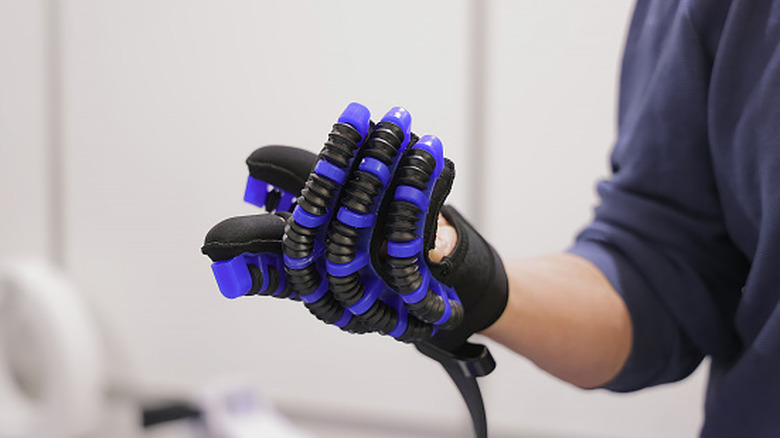
Creations in the soft robotics field are generally made out of flexible, pliable, or elastic materials that can bounce back into shape easily, and are often designed to imitate or replicate biology. This is an example of something called bioinspiration, or biomimetics. Bioinspired technology can take on all kinds of different shapes and forms, varying from robot eyes with incredible vision to remarkably emotive bionic "human" robots, and, of course, octopus tentacles.
Soft robotics has specific areas of biology that it takes inspiration from, too. According to Biomimetic Intelligence and Robotics (BIROB), a scientific journal from Shandong University, soft robotics tends to take inspiration from soft-bodied organisms (like octopuses) to develop how robots sense, begin movement, and for their wider integration and uses. Besides biology, soft robots also combine all sorts of other areas of science and technology, including computer science and materials science.
Drawing on nature as a point of inspiration for these soft and often articulated robotic inventions opens the door when it comes to how they're used. Soft robots work well where more traditional rigid or hard robotics can struggle to work, such as artificial organs, medical prosthetics, and other medical technology, specifically because of the field's focus on learning from and mimicking biological systems and processes. In fact, learning from natural systems is one of the key cornerstones that sets soft robotics apart from other areas of robotics and reflects an overall shift in technology.