

Europe's Solar Farms Are Facing An Unexpected Threat From The Sahara
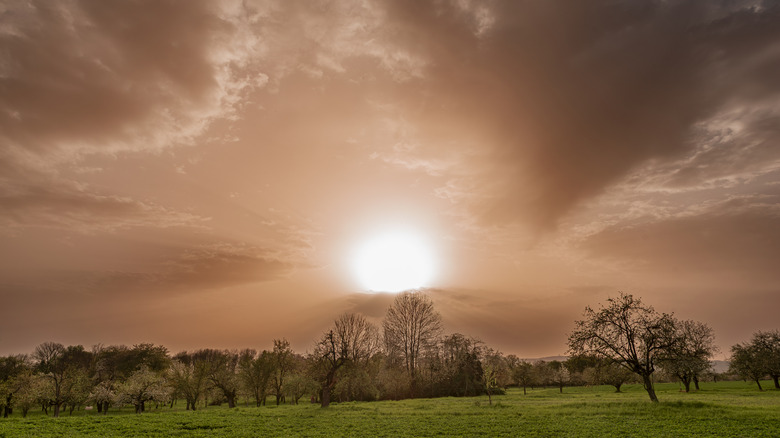
Climate change is a vicious circle. Humanity's destructive tendencies have reached a tipping point, and one could say that Mother Earth is firing back. Ironically, it's also making our efforts to reverse climate change less effective, hence the circular nature of things. Case in point, global warming is drying out Saharan desert soil at an accelerated rate, which in turn is increasing the amount of sand in the atmosphere. Experts are warning that the amount could rise anywhere from 40% to 60% by the turn of the century. Even now, the same Saharan dust is traveling toward the European continent and impeding solar farms in Mediterranean countries like Italy and Spain.
How much is Saharan dust harming Europe and its solar panels? According to one study, the growing issue of Saharan dust events is reducing solar panel efficiency and output by 25% to 40%. In Italy, the decline was logged as much as 46% in losses, with similar figures seen in Spain (between 4% and 40%). Solar energy is a net positive for the environment, and solar panels can even help plant life thrive. There's also plenty of fiscal incentives to boot. For instance, solar farms in Europe have already produced surplus power, meaning that a 40% loss in efficiency is particularly concerning.
The study clarified that Mediterranean cyclones lead to higher dust levels and cloud cover. Dust from the Saharan Desert, unfortunately, raises aerosol optical depth, which reduces transmittance in the atmosphere and, as a direct side effect, tanks the power output. These dust events will only worsen as climate change deepens, so scientists are increasingly concerned about the overall reliability of solar grids in this part of Europe.
Could putting solar farms in the Sahara reverse the damage?
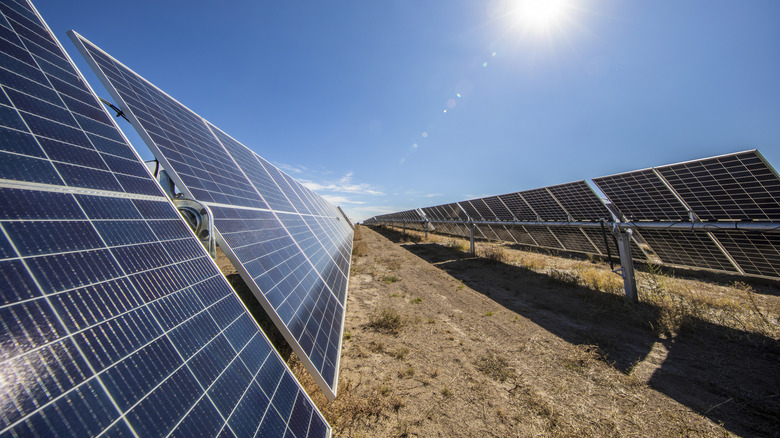
The study concluded that since these events will only become more frequent and intense, accounting for Saharan dust uncertainties should be a must during the infrastructure planning phase. However, is there a more proactive approach? Well, theoretically speaking, turning the entire Saharan territory into a solar farm would turn it green, quite literally. Both wind turbines and solar farms would increase rainfall, which could promote new vegetation growth. In other words, the entire desert would come alive, once again.
Brilliant way to get rid of dust, right? Plus, just covering 1.2% of the entire territory would generate enough juice for the whole world, so that's two birds with one stone. Sadly, the scenario sounds better in theory. In practice, panels in the Sahara would be darker than the surrounding sand, meaning they'd attract more heat and would be prone to overheating. Sand would also accumulate on the solar panels, making them less effective. Sahara turning into a rainforest seems positive, but it would be devastating. The entire ecosystem would fall out of whack, which would increase global temperatures and make climate change even worse.
In the end, Europe and its solar farms will have to find a way to tackle the dusty Saharan winds. Terraforming the desert to stop it from traveling to the continent is overkill, even if we could somehow find an effective way to transport a bunch of solar panels into the desert. Until scientists find a better solution, countries on the Old Continent will just have to plan better and hope for the best.