

Solar Farms Are Having An Unexpected Effect On The Environment
Farms are closing at alarming rates. In 2025, the number of farms in the United States shrank by 15,000, and total farmland fell by 2.51 million acres. That's nearly enough farmland to cover Hawaii's Big Island. Unused land will not naturally turn into habitat anytime soon. It takes almost a century for agricultural abandonment to see more than half of plant productivity return. With solar panels and thoughtful planning, the land may not have to remain in ecological limbo.
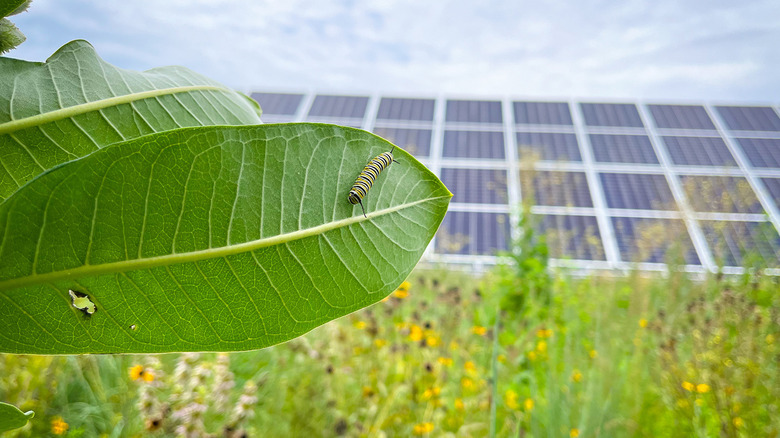
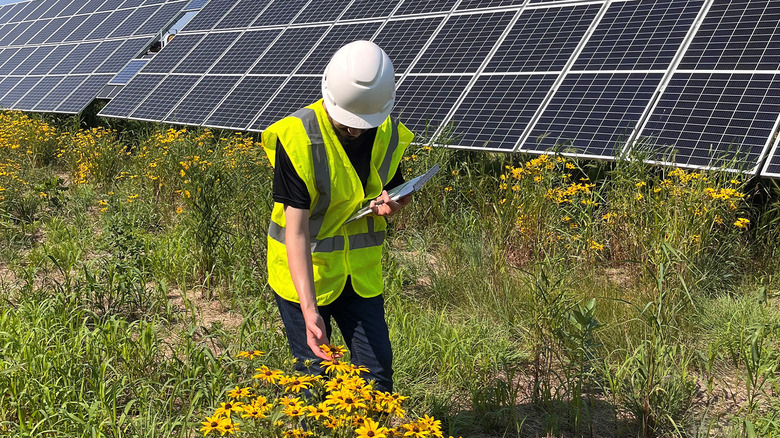
Researchers with the Argonne National Laboratory and the National Renewable Energy Laboratory (via IOPScience) tested that approach at two solar sites in Minnesota. They found that retired agricultural land can produce power while native plants thrive under and around the panels. They quickly saw an increase in the abundance and diversity of native plants and insects, especially pollinators. It's already known that solar panels are having a surprising effect on local wildlife.
This study shows just how fast the benefits can come to life. At these two sites, it took under four years for functioning habitat to return. The biggest resurgence was native bees. Around year two, plants began to mature, and that's when nature took off because hundreds of native bees returned to the land. In early surveys, scientists recorded almost no bees, but by year four, they saw them regularly. Other insects as well, including wasps, moths, flies, butterflies, and beetles. In fact, the number of insects surveyed tripled over five years.
How solar farms can be built to benefit farmland
The benefits of a solar farm built on agricultural land appear to extend beyond its borders. Researchers checked nearby soybean fields to see how the restored habitat under the solar panels affected crops and found that soybeans near the solar farm saw more bees than soybeans near roads or even inside the soybean field. In fact, the bee visits near the solar farm were similar to those found at soybean farms adjacent to Conservation Reserve Program grasslands.
A solar farm's design isn't complicated, but it is thoughtful. Solar sites often require grading, meaning the soil is compacted, the ground evened out, and pads installed for electrical gear. At the study sites, researchers didn't perform any grading except to install access roads. They then planted native grasses and flowering plants in specific test plots around the panels, including different seed types depending on how much moisture or sun the plants would see.
Since vegetation height can impact the solar equipment, the panels were mounted more than six feet off the ground. Light sensors shifted the panels to follow the sun during the day, and at their lowest point, the panels remained three feet off the ground, allowing the vegetation to grow. The study is not only important for insects, but also for struggling farmers. Solar lease offers in the Midwest, home to much of the nation's productive cropland, have reached $1,250 to $1,500 per acre. With minimal grading and thoughtful native plant management, there's an enormous benefit to installing solar panels on farms, even farms that support grazing sheep.