

Greece Is Investigating Wind Farms After Power Cables Cause Devastating Wildfire
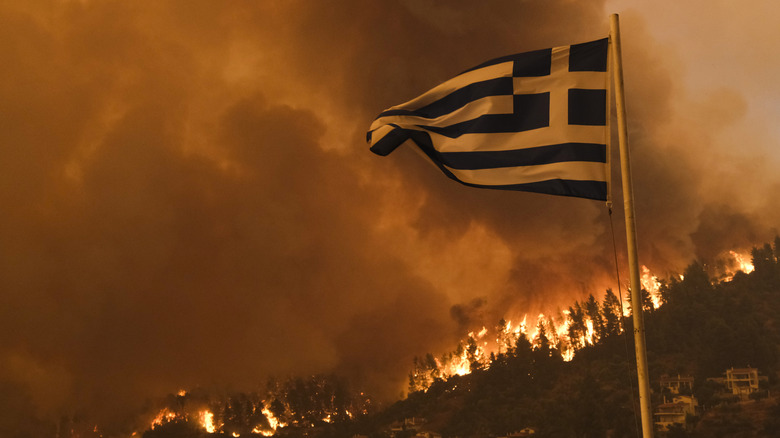
Wildfires are continuing to wreak havoc across parts of Europe during another dry summer. Greece, in southern Europe, has been dealing with multiple fires, with one of them in particular placing wind farms in the spotlight. The blaze in question started on July 31 near Mavro Spithari, about 32 miles northwest of Athens. Now under control, the huge fire destroyed about 35,000 acres and damaged or razed some 200 homes. While many wildfires are caused by careless human activity like discarded cigarettes, single-use barbecues, and even arson, some of Greece's most destructive blazes have been linked to poorly designed electricity infrastructure, including overhead power lines and private connections to renewable-energy projects. And that's exactly what appears to have happened with the Mavro Spithari wildfire.
The official investigation concluded that strong winds caused faulty overhead power lines carrying electricity from a wind farm to the public grid to spark, igniting the dry vegetation beneath it. Construction of the wind farm finished in May, and it had only just started operating when the incident occurred. Notably, a smaller fire broke out, likely due to a short circuit, along the same power line on June 27, though it was put out after burning a much smaller area of about 12 acres. A local official was among several people who said the June 27 fire indicated that there were issues with that specific network. July's huge wildfire led to the arrest of the owner of the electrical company responsible for the power lines, who also happens to be the mayor of a local town. A contractor and the wind farm owner have also been arrested, and the wind farm's operation has been suspended.
Greece and its theories about wildfires and wind farms
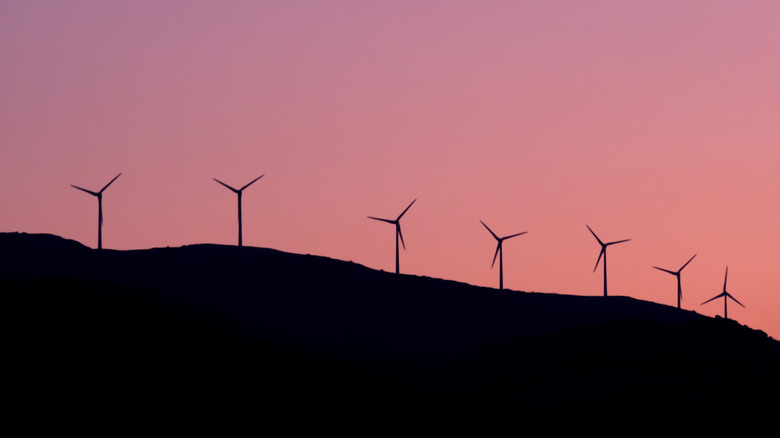
As investigators focused on a single faulty cable, the fire also became the subject of competing theories, some tied to wider conspiracy narratives about wind energy in Greece. In a country already divided over the expansion of renewable energy, the Mavro Spithari blaze tapped into a longstanding conspiracy theory that forests are being burned on purpose to ease planning rules so that developers can come along and install wind farms. The idea that forests are deliberately burned to make way for wind farms is a long-running but unsubstantiated claim held by some in Greece, according to AFP Fact Check (an arm of the Global European news agency AFP). Balkan Green Energy News calls it a "longstanding cliché," adding that wind farms are generally allowed to be built on forest land suitable for turbines, while installing them in burned areas is more difficult because the land is subject to reforestation protections and requires additional justification and approvals. In July, Greece's wind-energy association, ELTAEN, described claims that wildfires were being deliberately started to make way for wind farms as fake news.
The July 31 blaze also highlighted a more straightforward concern that wind-farm infrastructure can itself pose a wildfire risk. But legitimate concerns about such hazards can become mixed up with misinformation that can have the effect of undermining efforts to expand renewable energy.
Greece's long history with wind power
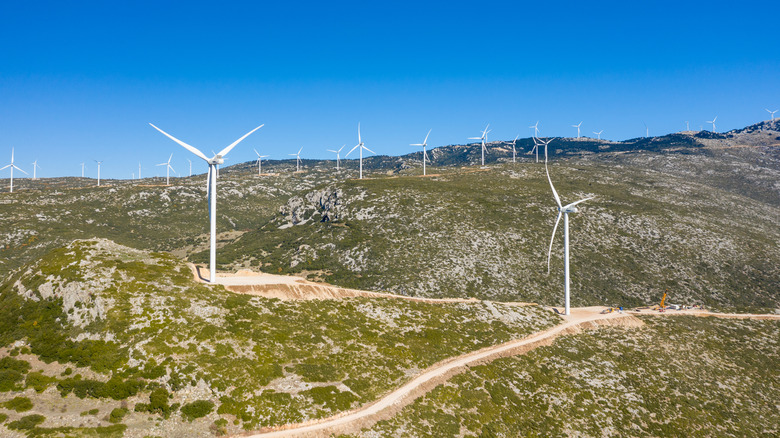
Like some U.S. states that have made wind power a major source of electricity, Greece has also long embraced the technology. In fact, it was actually an early adopter after the island of Kythnos became home to Europe's first wind farm in 1982. Comprising five wind turbines, the facility was developed by the state electricity company as Greece began exploring wind energy partly in response to the oil crises of the 1970s, which pushed up the cost of imported fuel. Many Greek islands were an ideal testing ground thanks to their windy environments and reliance on diesel generators for their energy. The country also secured funding from the European Union, helping to finance early experiments with renewable-energy technology. Kythnos eventually implemented a hybrid system, combining wind, solar, batteries, and diesel in an integrated mini-grid. Commissioned in the early 1980s, the system was remarkably advanced for the time.
While wind power technology still has a number of shortcomings and can take considerable time to recoup its costs, it's an important tool for many countries looking for ways to meet their energy needs. In 2025, wind farms in Greece generated more than 13 Terawatt-hours of electricity, almost a quarter of the country's total electricity generation. Installed wind capacity also grew by 6.4% during the year, reaching 5.7 gigawatts by the end of 2025. As Greece continues to grapple with wildfires, the public prosecutor's office has ordered a nationwide inspection of wind farms, including checks on whether other sites pose safety risks and whether licensing requirements are being followed. A current challenge for policymakers is to tighten safety rules on private grid infrastructure without letting one high-profile cable failure, and the conspiracies around it, stall Greece's ongoing push into wind energy.