

What Happens When You Cut A Photon? Physicists Found An Unexpected Answer

Common sense suggests when you break something in two, you're left with two parts. In the world of quantum physics, though, the answer isn't always that obvious. Norwegian physicists set out to answer a question that seemed so obvious it apparently hadn't been asked before. What happens when you split a photon, the smallest particle of light? They asked the question, did the math, and found something remarkable. Instead of producing two photons, splitting one can produce many.
Physicists at the University of Oslo built a mathematical model of a single photon wave packet headed toward a mirror. In the model, they removed the mirror the instant the front of the wave packet struck it. The front portion reflected back, while the back portion kept moving forward, now cut off from the rest of the wave. Sounds like it produced two separate photons, right? Wrong. When the mirror disappeared, it created a sharp edge on each wave packet. A wave packet is a bundle of wave oscillations that represents the photon in this model. The thing is, a single photon can't create a wave packet with such a sharp edge. An abrupt cutoff like that requires multiple photons.
There isn't a single answer for how many photons would appear. A physical experiment would give a clearer idea, though each could produce different numbers. Quantum field theory, the physics of particles and their underlying fields, suggests that the sharper the cutoff, the more photons required to produce it. The faster the mirror disappears, the sharper the cutoff. If the mirror could disappear instantly, the number could, in theory, rise to infinity. Because a physical mirror cannot disappear instantly, physicists expect the number to be small in a physical experiment.
How this unexpected photon discovery could change technology
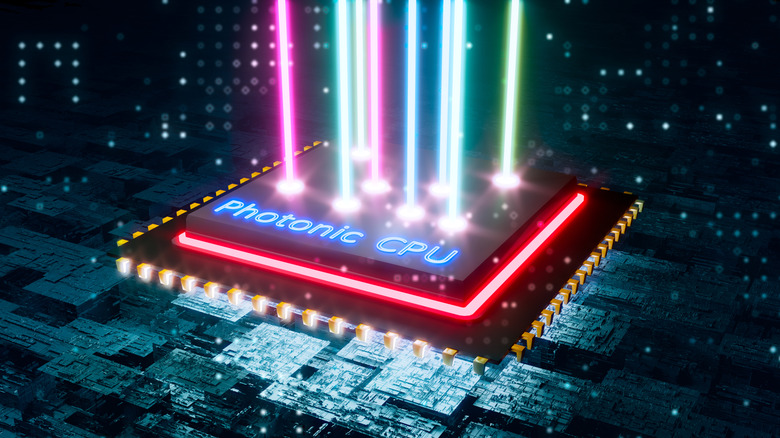
Photons are not rare. They're easy to produce. Pick up a flashlight or a laser pointer and you're armed with a photon producer. The tricky part is controlling photons because they're extremely hyperactive. Photons never rest. And they move at the speed of light. Their high-speed, restless energy is why some scientists see photons as the future of computer chips. Photons can transfer information without electrical resistance, keeping chips cooler than those powered by electrons. Multiple channels of light can travel along the same pathway, while tiny optical components control how that light moves and carries data. Scientists have also developed packaging with a durable, glasslike bond that could allow photonic chips to operate in extreme conditions, making the low-heat and low-energy chips a viable option for deep space.
NASA already relies heavily on photons to study space. Telescopes and other instruments detect photons across the electromagnetic spectrum to better understand distant planets, stars, and galaxies. Understanding photons could help improve how scientists sense and measure phenomena such as how gravitational waves let us see black holes or how they may hold the key to understanding the Big Bang. In 2019, Laser Interferometer Gravitational-Wave Observatory (LIGO) scientists began using a quantum trick that essentially squeezes light. It reduced photon-related quantum noise and improved measurement sensitivity. One LIGO researcher said scientists knew the equations worked for decades but weren't sure they could make the technology work until they did. The researcher compared it to science fiction. The Oslo research is still at the equation stage. If physicists can reproduce what happens when a photon is split, it could lead to another breakthrough that defies common sense.