

The Invention That Saved Apple And Put Its Computers Back On The Map
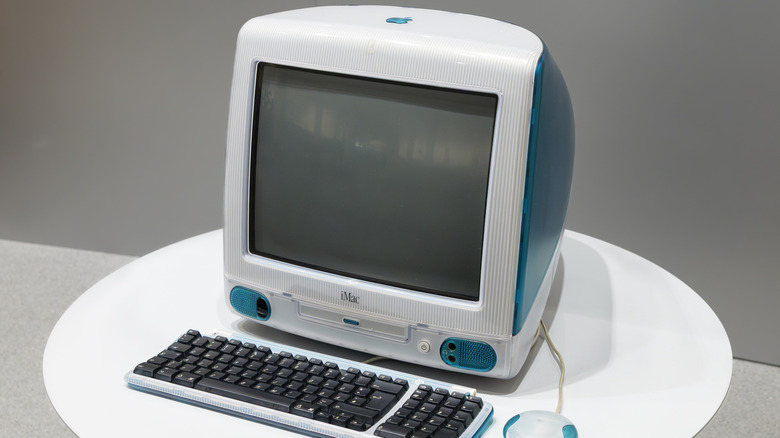
For the last two decades, it has genuinely seemed like Apple had a way to see into the future. From the iPod that helped popularize legal digital music and the iPhone that ushered in the smartphone era, to laptops like the MacBook Air that anticipated the shift to sleeker tech, Apple is somehow always at the forefront. Judging by its juggernaut status, you'd assume the company was always killing it. Yet, in 1997, it was in dire straits.
It was so bad that Apple was eerily close to repeating the steps that put the final nail in the coffin of Commodore Computers: its product line was confusing, and the company had nothing up its sleeve to challenge Microsoft's complete domination of the home computer market. Apple's annual losses? North of $1 billion. As a last-ditch effort to save the ship, Steve Jobs went back to the drawing board. With the help of designer Jony Ive, Apple upended conventions in home computing and built the innovative iMac in 1998 — a fully self-contained computer where the display and other components were housed in a single colorful box.
Wild idea, but it worked. While the rest of the market followed a modular design convention in a drab, beige look, the iMac was designed as an appliance with a translucent, plastic, and colorful package. Apple broke so many rules that the iMac didn't even include a floppy disc drive, but rather, decided to use USB as a standard, despite the USB device landscape being barren at the time. The winning move, though? Marketing the iMac as an appliance for the internet (the iconic "i" stuck) by also including the modem in the box, and the rest is history.
Apple's iMac bet paid off
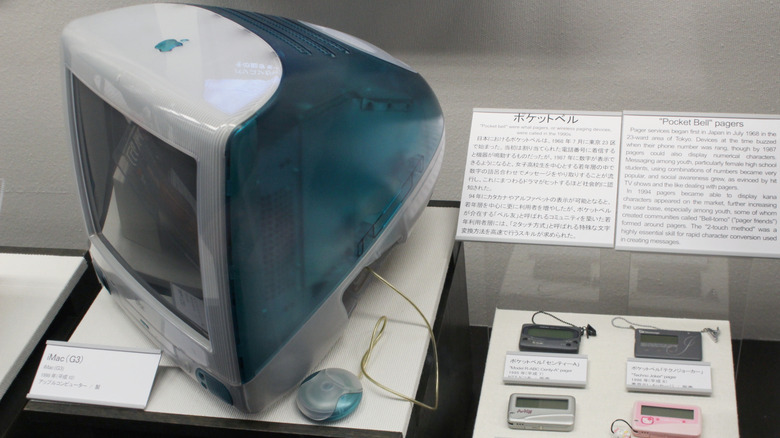
Such was the popularity that even USB peripheral manufacturers quickly ramped up production after the iMac was announced. No zip drive? No problem. The iMac came loaded with a CD-ROM tray. On top of its unique-looking design, the easy setup (you could connect to the internet just by plugging it into the phone line) turned out to be a huge selling point for many.
Within two years and eight months, five million of these machines were sold. Do a bit of math, and Apple practically sold 5,000 iMacs daily. Considering that the price tag was $1,224, Apple reversed its downward course within just a few years and finally ended up earning money. In 1999 alone, it reported $1.71 billion in total sales.
You can sense echoes of the iMac in many things today. Plug in a USB stick? You've got Apple and its translucent box to thank for it. One could argue that Apple is where it is today because of this release. The "i" in iMac became so recognizable that the company slapped it on several of its future products. For many, a self-contained computer makes the most sense. The latest version of the iMac now sports an M4 processor (the family that helped popularize the ARM architecture on desktops), and while Apple never released official sales figures, the new iMac has been getting plenty of praise.
Is the original iMac a collector's item?
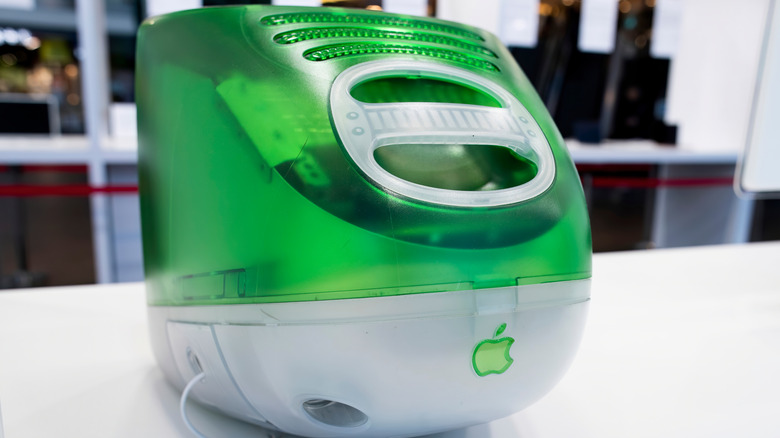
Old gadgets are back in style. There are plenty of rare vintage tech products that are now expensive collector's items. Apple stuff tends to fit the mark here, too, and it goes beyond the Apple Computer I from the '70s. People are selling the original Apple iPod for north of $2,000, and factory sealed pieces can go for even more. Though its laptops aren't that well-valued on the collector's market (you can buy the original 2006 MacBook for around $100), the original iMac from 1998 is going so strong that resale value sometimes matches its launch price.
A working iMac in Bondi Blue, on average, tends to sell for nearly $600. Got a working matching set in one of the more flashy colors like Strawberry? One is selling on eBay for nearly $2,000. Considering it was a mass-produced item (five million items sold isn't exactly rare), this is quite impressive and a testament to how groundbreaking the computer really was.
The butterfly effect is a fun thought experiment. What would the tech space look like now if Apple never released the iMac? Would smartphones look the same way they do today if the iPhone never existed? Would laptops be as sleek and thin as they are now if the MacBook Air never slid out of that envelope? Either way, if you like modern tech, so much of it exists in its current form because Apple decided to break all the rules at once back in the 1990s.