

What Happened To Commodore Computers? Why The Company Went Bust
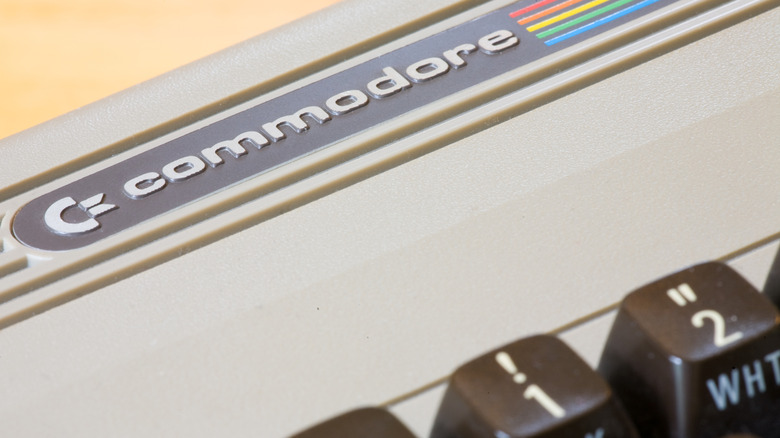
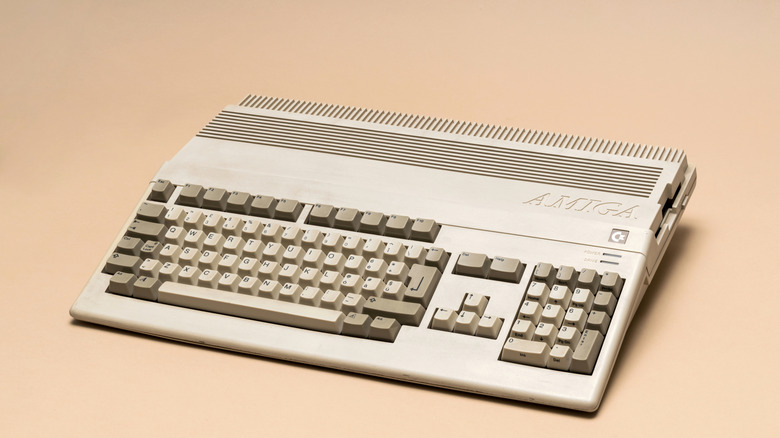
From introducing the first-ever all-in-one personal computer, the Commodore PET, to producing the highest-selling desktop model of all time, Commodore's innovative streak is nothing short of legendary. The trailblazer status is glaringly apparent when you look at some models like the Amiga. A pioneering multimedia machine, the Amiga was a window into the future, bringing together office workers, gamers, and even artists like Andy Warhol.
With such a track record, one would assume that Commodore would always be around. Yet, the company disappeared in the '90s as Microsoft and IBM completely took over the computing market. So, what happened to Commodore computers? How could a tech giant of such magnitude disappear overnight?
Unfortunately, the writing was on the wall since the mid-'80s. The company's founder, Jack Tramiel, who prided himself on democratizing home computers, left the helm in 1984, and the remaining leadership struggled to implement any long-term strategy. After coasting on the success of the Commodore 64 for a few years, the Amiga machine, despite its revolutionary status, ended up a commercial failure. By the time the '90s rolled around, Commodore was in no position to compete with Microsoft and IBM. Following a series of questionable business decisions, the company sadly filed for bankruptcy.
How Commodore rose to the top
The primary driver behind Commodore's success in the '80s was its founder, Jack Tramiel. A true visionary, he noticed that the personal computing market was falling short of its potential. Where others were okay with serving the niche, Tramiel had something else in mind: democratization. By simplifying the design and keeping the hardware affordable, he made it a mission to make personal computers accessible to the masses.
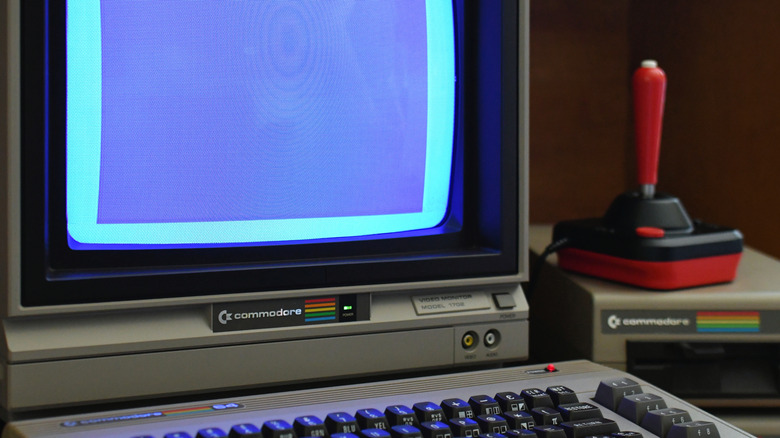
Although the PET computer, released in 1977, thrived in the workplace and education contexts, the legendary Commodore 64 brought Tramiel's vision to life. Priced at $595, the C64 offered specs that not only allowed it to compete for a slice of the professional market, but also for the consumer segment — its cost-efficient graphical capabilities made it particularly appealing to gamers. After selling around 12.5 million units and writing its name in the history books, the company became the de facto leader in the home computer industry. Commodore 64 remains beloved to this day, and along with a modern rerelease, the model was also reborn as a handheld console.
For all its successes, within two years of the Commodore 64's release, a power struggle ensued among the company's leadership. In a turn of events that could rival the melodrama of "Game of Thrones," the board forced Tramiel out. Little did they know that this move likely planted the seeds for Commodore's eventual bankruptcy.
How Commodore fell behind the curve
David John Pleasance, Commodore's MD at the time, said the company never really recovered from Tramiel's exit. Without a clear business plan, Commodore went into crisis mode, and senior management became a revolving door of leads unfamiliar with the home computer business. Prioritizing short-term profits became the name of the game, as Commodore spent years riding the coattails of the C64. By 1985, even the Amiga couldn't stop the train from derailing. While the product was a multimedia powerhouse, Commodore didn't dial in the marketing, so the computer never really hit it big with consumers.
What happened to Commodore computers in the '90s was part bad luck and part failure to innovate. Windows came to dominate the market with its architecture that set the standard for hardware-agnostic personal computers, and Commodore simply failed to notice the shifting tides. Though newer Amiga models helped the company stay afloat, Commodore lost $8.2 million in 1994. Shortly thereafter, it had nothing left to do but declare bankruptcy.
Commodore's death can be seen as a lesson. The C64 basically carried its creators for nearly a decade, and the lack of innovation and mismanagement ate away at the company from the inside. Yet, Commodore's successes greatly outweigh the gravity of its ultimate business failings. It holds a place in the collective consciousness of many computer aficionados, and new retro gadgets and rereleases prove that the legend is still alive. Commodore's appeal is so strong even today that finding the "failed" Commodore Amiga 500 in your grandparents' basement could put an extra $600 in your pocket — not too shabby for a brand that went bust over 30 years ago.