

Smart Home Gadgets Are Having An Unexpected Effect On Your Wi-Fi
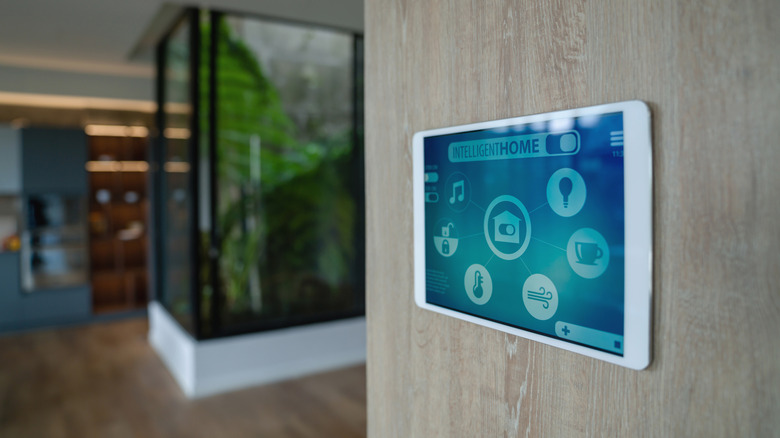
If you're experiencing spotty Wi-Fi on your home network, there are a few tweaks you can make to boost signal strength and improve the experience. In fact, the best ways to improve Wi-Fi are generally low-lift tasks, like moving your router, switching Wi-Fi bands, changing broadcast channels, or updating the device's firmware. Outside of technical issues, there may also be things around your home interfering with the signal, from appliances and other electronics to smart home gadgets.
Yes, smart home gadgets can jam up your Wi-Fi network. It's usually not caused by one or two devices — or even a dozen — but rather a large group of gadgets all communicating at the same time. The reason why probably isn't what you'd expect. It has little to do with bandwidth, because a lot of those devices, like smart plugs, switches, light bulbs, and sensors, really don't use much. We're talking under 1 Mbps per device. The real issue is either signal crowding or interference. Interference is a more intuitive concept — it's when other wireless signals disrupt your Wi-Fi signal — so let's take a closer look at signal crowding.
Imagine the Wi-Fi channel as a highway, with each connected device acting as a vehicle traveling on it. Phones, tablets, smart devices, smart appliances — everything is effectively coasting on that highway and communicating openly. When you have too many devices doing that at once, they create a traffic jam and slow things down. This has more to do with network airtime than bandwidth. Only one device at a time can communicate with the router over a given channel, forcing others to wait their turn. So, the more devices you have connected, the more likely you'll run into performance issues.
Split Wi-Fi bands (and devices between them) or go with a mesh system
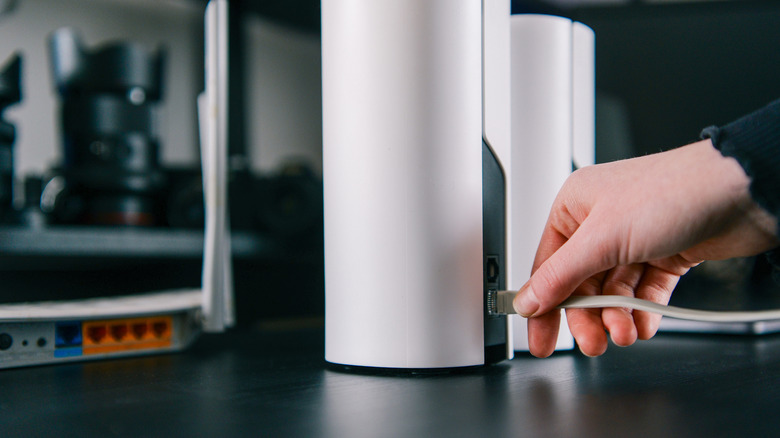
The only real solutions for those airtime "traffic jams" are to either reduce or remove some of the devices with active connections or improve the capabilities of the source so it can handle more. If you don't have the budget to upgrade your router, the next best option is to split the load of your network across bands or access points.
Most modern routers broadcast on two bands, 2.4 GHz and 5 GHz, and some newer models even toss in a 6 GHz band. Smart home gadgets, often considered to be low-priority, tend to operate on the 2.4 GHz band, and many don't even support the higher options. So a good first step here would be to move as many of your smart home devices to the 2.4 GHz band as possible, leaving the 5 GHz band for things like your phone, smart TV, and gaming console. Alternatively, you could set up a guest network for smart home devices only, but there's always the chance that will reduce performance for your main network.
As for the issue of interference, your best option might be to upgrade your router. You could opt for a more powerful single-unit router, or, the ultimate option, go with a mesh system. Mesh systems are usually better than traditional routers because they offer improved coverage and are better at handling lots of devices. This is because mesh networks spread communications across multiple nodes so that individual nodes don't get overwhelmed. In theory, you could even free up your most commonly used node — for instance, the node in your living room — by assigning smart home devices to lesser-used nodes in the router's settings, which could help solve the "traffic jam" problem, too.