

Apple Reveals The Next-Gen M6 And M5 Ultra Chips - Here's What You Need To Know
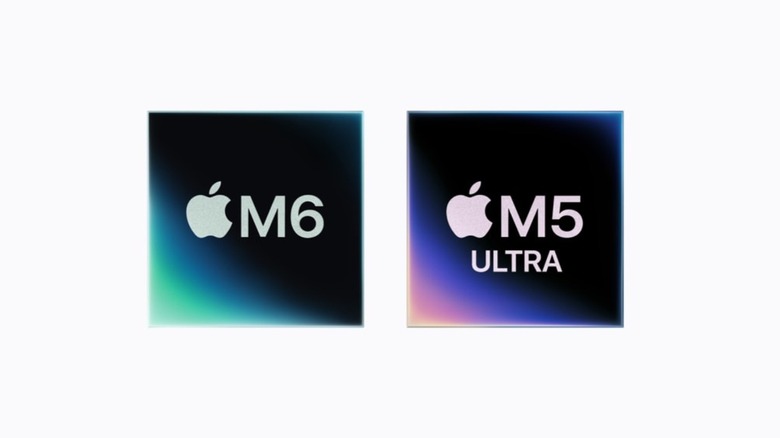
Ahead of the iPhone 18 Pro event announcement, Apple surprised customers by introducing not only its most powerful Mac processor yet, the M5 Ultra, but also the next generation of the M6 chip, with a base-model version for the Mac mini. Both of these processors are unique in their own way, with the M6 variant powering the Mac mini, and the M5 Ultra being available exclusively on the Mac Studio. Still, they have a big focus on AI and improved performance, making them not only better them their immediate predecessors, but a huge leap when compared to the M1 family.
While Apple continues its strategy of cross-generation between its chips — with the previous Mac Studio the company offered an M4 Max and M3 Ultra variants— rumors point to a short M6 family. Besides a few other Mac refreshes, Apple might completely skip the Pro, Max, and Ultra variants, as it's already working on the M7 models, with an ever-increasing focus on handling AI workloads.
According to Bloomberg, this will make Apple introduce the long-rumored MacBook Pro with OLED with the M5 Pro and M5 Max chips, instead of M6 Pro and M6 Max variants. Still, even if the rumors are true and Apple quickly moves on from the M6 generation, there's a lot to look forward to, as this processor marks the first Apple chip with 2 nanometers, making it more powerful and also efficient.
Getting to know Apple's M6 chip

Apple says the M6 processor, the first built with a 2nm process technology, is perfect for students, developers, and everyday users' workflows, as it combines great performance with on-device AI. With an all-new 12-core CPU, offering two more kernels than the M5 counterpart, it features two super cores, four performance cores, and six efficiency cores. The company says that single-threaded performance is up to 1.2x faster than M5, while up to 2.4x faster than M1, which is perfect for really demanding tasks, while also handling everything else in the background smoothly.
The M6 GPU also features 12 cores, which is again two more than the previous generation, with Neural Accelerator in every core. While the jump between M4 and M5 was already impressive, Apple's new chip can be almost 30 percent better in GPU compute for AI than the M5. The company also says it's improving shader core architecture, Dynamic Caching, and hardware-accelerated ray tracing, even though they haven't been rebranded as a new generation. Still, the company expects everything to run a lot more smoothly, including games like Cyberpunk 2077.
For the M6 chip, Apple supports up to 32GB of unified RAM, with up to 170GB/s of unified memory bandwidth, which is a 10 percent improvement over the M5, but a 2.5x increase over the first Apple Silicon. For everyday customers, it means that even more data can be read at once.
Inside Apple's most powerful processor yet

Exclusive to the Mac Studio, the M5 Ultra is Apple's most powerful processor to date. While it still uses a 3nm manufacturing process, it takes advantage of UltraFusion, an Apple technology that connects two M5 Max chips together to offer up to 4.4TB/s of bandwidth, and crazy high specs for the most demanding users. According to Apple, the M5 Ultra can get up to 36-core CPU, with 12 super cores and 24 performance cores, making the single-threaded performance 1.25x faster and a multithreaded performance 1.3 higher than the M3 UltraApple's last best chip — and 32-core Neural Engine.
With a massive 80-core GPU, the biggest on an Apple Silicon Mac so far, it includes Neural Accelerators to each of them, making the peak GPU 4.5x faster than the M3 Ultra, which still didn't feature that technology. This also means that this chip provides second-generation Dynamic Caching, hardware-accelerated mesh shading, and third-generation ray tracing, which makes graphics performance 40 percent faster, a massive bump for more demanding users.
The M5 Ultra also has up to 512GB of unified RAM, which is only able to be ordered in October. That said, right now, users can only pre-order for an extra $4,000 for a 256GB unified memory. Still, once this option becomes available, users will have 50 percent more memory bandwidth to run huge LLMs on this device. In addition, the processor also features dedicated hardware-enabled H.264, HEVC, and ProRes encode and decode engines, and other solutions for high-end video editing.