

4 Useful Accessories Every Amateur Podcaster Should Have
We may receive a commission on purchases made from links.
Over half the U.S. population listens to podcasts every single month, with over 4.5 million podcasts live around the world. While growing an audience and keeping them engaged are certainly the biggest challenges for most podcasters, 44% of them say the costs of running a podcast and production challenges are their biggest hurdles, according to the Independent Podcast Report. Creating original, interesting content should take most of your time, as the technical side is something you can iron out and streamline from the very beginning. Doing so will give you a head start and immediately separate you from other amateur podcasters.
There are several accessories you can get for your podcasting setup that will immediately make you look more professional and improve the quality of both the video and audio you put out. Oh, and you don't need to splurge on complex products that you don't know how to use fully. To help you out, we've identified not only the most important accessories you should get, but also specific products under those categories that you can consider getting for the ultimate podcasting starter pack.
These include a microphone, a pair of budget-friendly headphones, a pop filter, and LED lights. The first three will help you capture clear audio, while LED lights can help you make the most of your smartphone or camera, giving you an affordable way to improve your video quality without spending on a professional-grade camera. Better yet, all of the products showcased in this guide are available on Amazon for easy and fast shipping.
Microphone
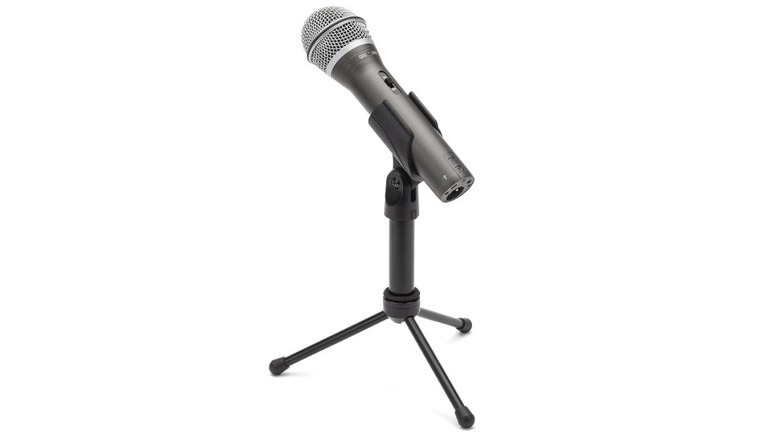
One of the best ways to separate yourself from podcasts that are noticeably undercooked and amateurish is to get a high-quality microphone that clearly records everything you say. Podcast viewers can compromise with slightly grainy video but not audio. If there are frequent voice drops or screeches, they won't stay, no matter how compelling your content is. Luckily, you don't have to spend a fortune on a studio-grade mic. The Samson Q2U microphone is priced at $79.99 on Amazon, where it has a 4.5-star rating after more than 5,600 reviews.
One reviewer was "absolutely blown away by the quality for [the] price." The Q2U mic is a good choice because it comes with both USB and XLR connection options, with the former being better for newbies, as there's no need for an audio interface. All you have to do is plug it into your laptop, and it's good to go. It doesn't even require any driver installation. According to Samson, it also comes with built-in analog-to-digital converters, providing "excellent audio reproduction" when using USB with a computer. Most importantly, the mic offers high-quality sound.
It's "clear, warm, and does a good job of minimizing background noise," according to one reviewer. In fact, Buzzsprout, which has recorded over 500 podcast episodes and tested several podcasting microphones with great audio, recommends the Samson Q2U, saying that it offers "high-quality recording at home, in a hotel, or in your closet." It also highlighted its incredible durability, saying that they bought one in 2014 and it never broke. In addition to the mic, your purchase also includes a short-height mic stand so you can keep it on your desk, a windscreen, a mic clip, and both USB and XLR cables.
Headphones
Having headphones instead of speakers avoids your mic from recording your voice twice — once when you speak and the other time from the speakers — giving a clear, professional-grade listening experience for your viewers. They also help you monitor your recording in real time, allowing you to identify audio issues. Moreover, you can curate the listening experience in a much better way. That's because listening to yourself as you record helps you quickly analyze and make changes to your pitch, pacing, and overall energy, which can't be fine-tuned after recording.
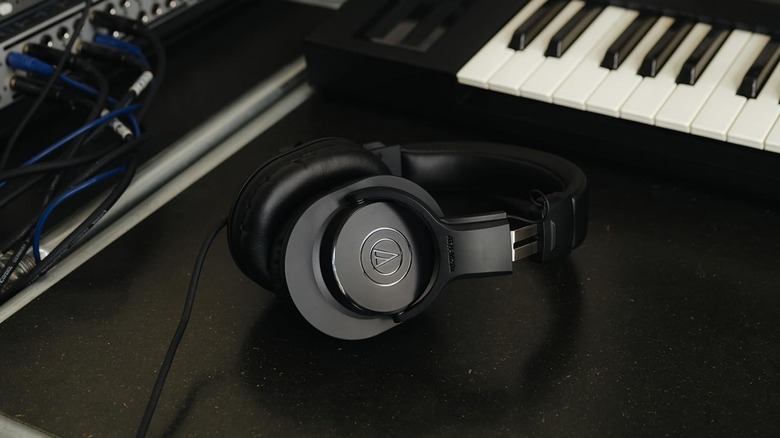
One good pair of budget podcasting headphones is the Audio-Technica ATH-M20X. It goes for $58 on Amazon and is, in fact, one of the best budget headphones you can buy, as evident from its 4.6-star rating after more than 27,000 reviews. It's also a pair of wired headphones, which is even better for podcasting, as it will help you keep latency and lag to a minimum. The company claims to offer "unmatched sound isolation with minimal bleed," and that has been backed up by both experts and real-world users.
Rtings, for instance, concluded that they provide a "balanced sound that delivers pleasing warmth and bass," while one reviewer said that the "sound is very well balanced [and the] bass is not overwhelming at all." This neutrality is exactly what podcasters tracking a recording need. That said, comfort during prolonged periods can be a slight issue, so you might need a short break after a couple of hours. However, it's not a major gripe when you consider the value. "You will not find another pair of headphones this well-balanced and built for the price," as one user put it.
LED lights
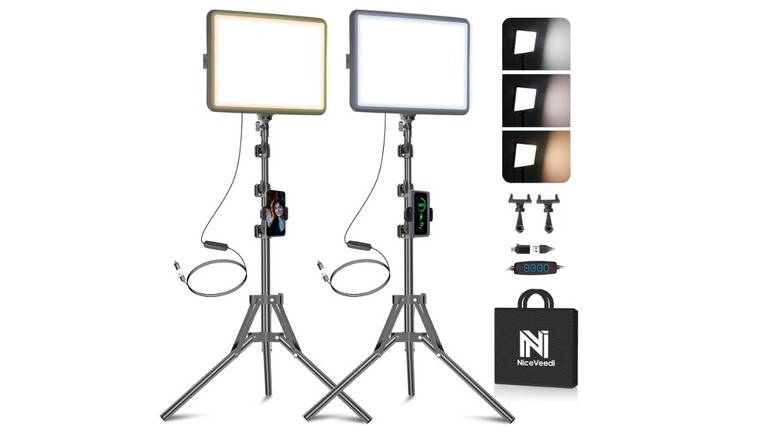
LED lighting is an affordable way to instantly improve your podcast quality, whether you're doing in-person recordings or capturing over a webcam. It's a particularly great addition for amateur podcasters who don't have the luxury of a brightly lit room or a high-quality camera. The NiceVeedi 2-Pack LED Video Light Kit might be an ideal option for entry-level podcasters. It costs just $49.99 on Amazon, where it enjoys a solid 4.4-star rating after more than 6,600 reviews.
You get two LED lights, each complete with its own tripod, an integrated remote that sits around midway through a 6.7-foot-long cable, and a phone holder. According to one reviewer, the phone holders are "convenient for filming content, livestreaming, video calls, gaming, and YouTube videos." The remote lets you change the light mode, brightness level, and power the lights on and off. The lights run on a USB-A connection, but they come with a USB-A-to-USB-C adapter, so you can connect them to any power source, whether that's a typical wall charger, your laptop, or a power bank.
You can also adjust the height of the tripods from 38 inches to 73 inches, and they "are sturdy [and] fold up easily," according to another reviewer. The two light panels measure 12 inches diagonally and include 356 LED light pieces in each of them. Users particularly like that they allow switching between three different warm and cool color temperatures: 2800K, 4800K, and 6500K, letting you to "get the perfect lighting for any situation," as one reviewer put it. Another reviewer, whose room doesn't get any natural light, concluded that these LED lights "lit up the whole room without giving that skin burning feeling."
Pop filter
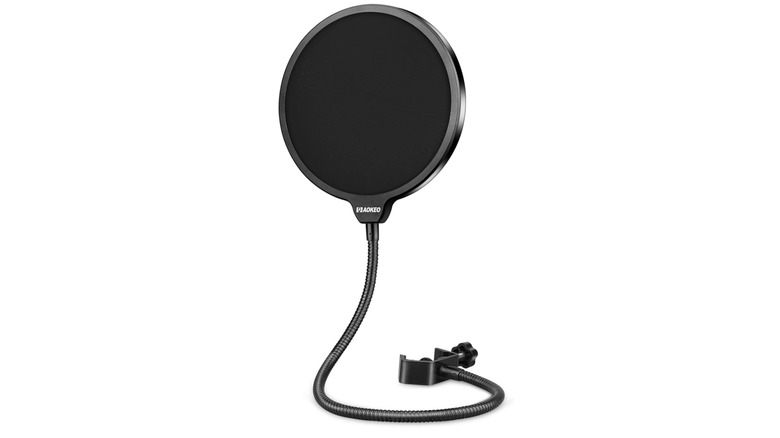
A pop filter, like LED lights, is a cheap but effective way to immediately improve your podcast quality. It sits in front of your mic and blocks out the air that comes out with plosive words, like P and B, as well as the hissing sound that comes out with the letter S, polishing your audio to give it a professional, studio-like clarity. The Aokeo Professional Microphone Pop Filter, priced at just $9.99, is one of the most popular pop filters on Amazon right now, with a 4.5-star rating after more than 12,000 reviews. It has a double metal mesh layer that reviewers say "does an excellent job of reducing pops and hisses that can occur during recording."
Moreover, it has a metal tube body that's 6.26 inches long and can be rotated 360 degrees, so you have a lot of freedom when it comes to the angle and distance you want to place the pop filter at, without repeatedly loosening it from the mic stand. Speaking of which, the screw you use to fasten the filter to your mic has soft silicone padding at its end, so it doesn't damage the mic stand or the wooden surface of the desk you place it on. It's also incredibly durable.
One reviewer said that it "feels much more durable than many fabric-style pop filters." It also helps that it comes with a one-year warranty. Just note that the maximum diameter of the mic stand or desk surface you're placing it on cannot be more than 1.57 inches, as that's the widest the pop filter's clip can spread. Users have also praised just how simple it is to set up. It also comes with clear instructions in case you need any help.
How we selected these podcasting accessories
When looking for accessories for podcasters who've just started or want to start, we prioritized products that didn't require a lot of investment but offered a huge upside when it came to improving an amateur podcaster's quality. As such, we narrowed down four product categories we wanted to include. Next, it was time to pick individual products that we could recommend under each of these categories.
LED lights and a pop filter are generally inexpensive, so we simply picked the very best ones on offer. For products such as microphones and headphones, which have so many options at different price points, we ensured that we only picked budget-friendly items. Despite their affordability, though, you can rest assured that they're both tailored for podcasters. While we also considered other product categories, namely cameras and audio interfaces, they didn't make the cut because we believe amateur podcasters can do without them.
A dedicated podcasting camera, for instance, can cost upwards of $500 and is easily substitutable by a smartphone camera with good lighting. An audio interface, meanwhile, can be complex, which is why we picked a microphone with a USB connection. Lastly, all of the products we picked were found after carefully researching what expert podcasters recommend, as well as the reviews and ratings they receive on online stores such as Amazon.