

This European Town Found A Clever New Use For Old Wind Turbine Blades
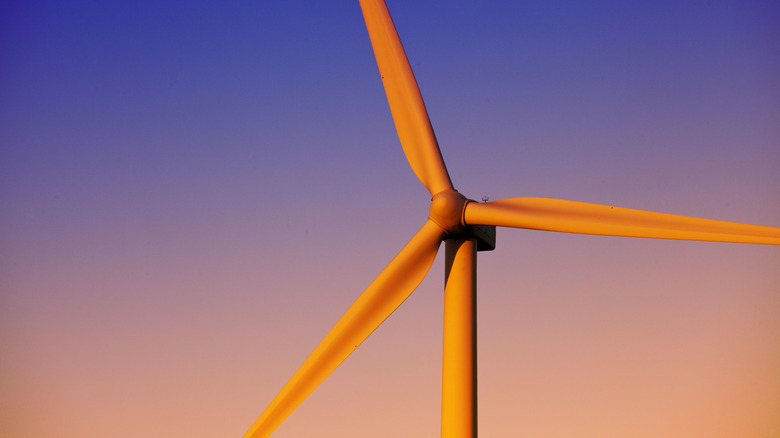
Wind turbines are becoming an increasingly common sight in the U.S. and beyond as governments implement alternatives to fossil fuels, even though the wind units take a long time to pay off. There are hundreds of thousands of wind turbines in operation around the world, and with most turbines using three blades, that means well over a million blades turning steadily in the wind to generate electricity. While the turbines themselves are typically designed for a service life of around 20-25 years, the blades are experiencing near-constant stress and weathering and so may need to be repaired or replaced during the turbine's lifetime. Consequently, as the number of wind turbines continues to grow, so too will the number of blades reaching the end of their useful lives, along with the challenge of what to do with them. Most decommissioned blades end up in landfills, though the issue is also inspiring new ideas for giving them a second life.
In Denmark, a nation that has embraced wind power for decades and is even home to one of the world's leading makers of wind turbines, the government wanted to see if there were any creative ways to reuse old blades. After being asked by the government there to see how it could repurpose a used blade, wind turbine manufacturer and renewable energy company Siemens Gamesa was brought in to help create a rather striking bicycle shelter in the Danish port city of Aalborg. The concept came from Brian Rasmussen, a local engineer and environmental coordinator. Rather than breaking the blade down, much of its curved shell was left intact and turned into the roof of the shelter. Rasmussen says that turbine blades are well-suited for projects like this one because of their structural strength and aesthetic beauty.
Recycling wind turbine blades still isn't easy
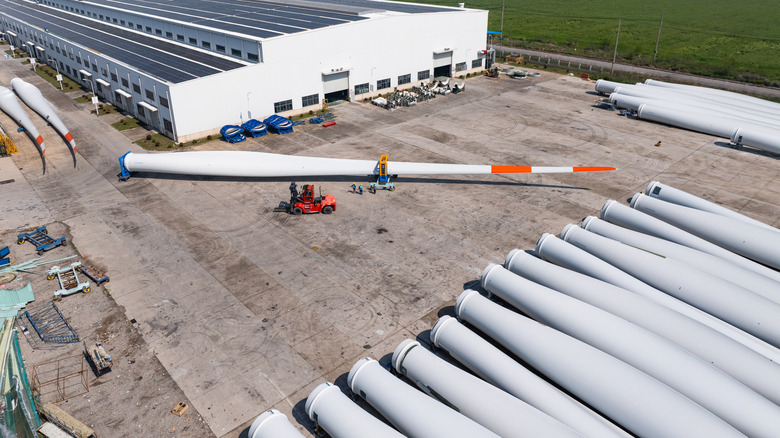
The idea of creating a bicycle shelter from a single wind-turbine blade is certainly a novel one, but what happens to the tens of thousands of other blades reaching the end of their useful lives is a much bigger question. The blades pose a problem because they're made from glass and carbon fibers bound in tough thermoset resins, making them much harder to recycle than steel and other turbine components. Unlike metals, the resin cannot simply be melted down and separated from the fibers, meaning the blades require more complex processes if their materials are to be recovered. While most old blades end up in a landfill, some are shredded and processed into materials for new products, while others are repurposed whole or in sections for items like urban furniture. The blades can also be used in cement production, while newer methods can break them down to recover some of their constituent materials, though these newer approaches remain difficult to scale.
With a simple, high-volume recycling solution still seemingly out of reach, researchers and companies are increasingly looking for more creative ways to put old blades to work rather than simply breaking them down or sending them to the dump. The Danish bicycle shelter is a great example, and other projects are taking a similar approach. Let's take a look at a few of them.
Creative ideas to give used blades new life
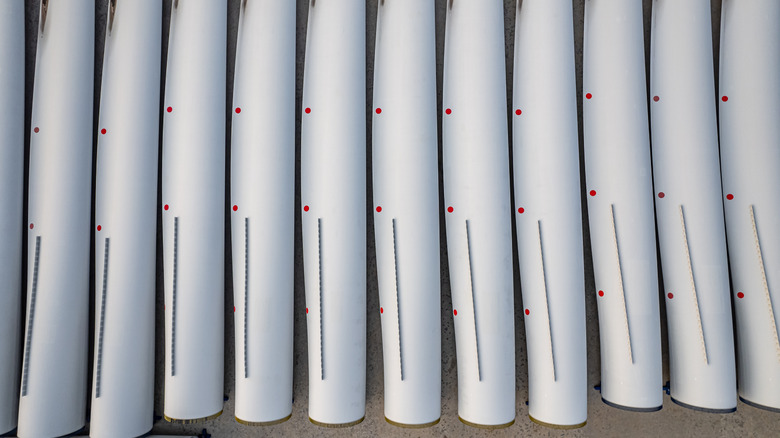
Wikado playground in Rotterdam, the Netherlands, is a prime example of getting creative with retired turbine blades. Completed in 2008, the children's playground uses five decommissioned blades for towers, tunnels, climbing areas, and other play features, with the distinctive shape of the original blades still clearly recognizable. The idea came about when Kinderparadijs Meidoorn, a local children's and community center, decided to renovate its aging playground and commissioned Rotterdam-based Superuse Studios to come up with a new design. The park has since become a popular neighborhood facility where families can enjoy time together.
Across the pond, in Beaverbrook Park, Atlanta, people are walking over a 15-meter wind-turbine blade that's been repurposed as a pedestrian bridge. While working to improve the park, Georgia Tech researcher Jud Ready noticed that a creek reduced access to some of the grounds. There weren't enough funds for a conventional bridge, but Ready knew that reusing turbine blades as bridges was a possibility. He and Georgia Tech professor Russell Gentry then set about assembling a team to adapt the idea for the park, and the bridge was installed in March 2025.
In the Mexican state of Yucatan, researchers developed a housing concept to demonstrate how decommissioned wind-turbine blades could be put to use beyond things like bridges and playgrounds. The idea is that sections of blade can be cut into structural components, including for platforms to raise homes above floodwaters, while other pieces can be used for parts involving doors, windows, and shutters. The innovative approach was designed for coastal communities where low-quality masonry homes are vulnerable to hurricanes and flooding. The concept remains a paper vision, but it nevertheless shows how turbine blades might one day be put to good use for housing projects.