

93% Of America's Wind Turbines Come From Just Two Companies
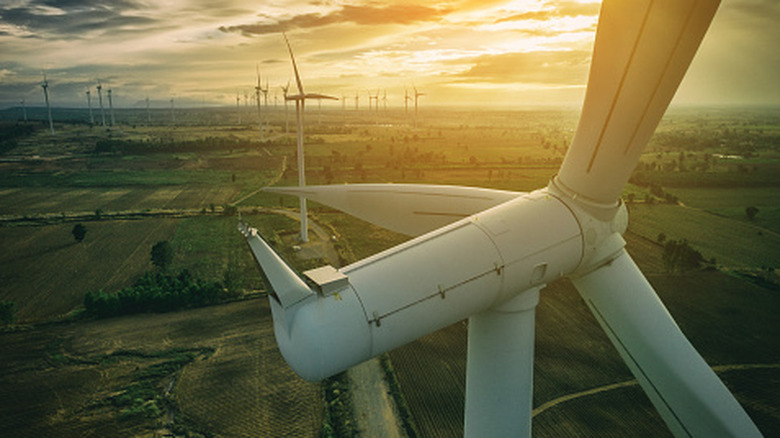
Upon its completion in 2026, the SunZia Wind Farm became the largest project of its kind in the Western Hemisphere, capable of 3.5-gigawatts. Located in New Mexico, SunZia marks a huge milestone for the United States in the world of renewable energy with a peak capacity that can power roughly one million homes per year. The majority of the turbines — 674 out of 916, to be exact — were supplied by GE Vernova. Based in Cambridge, Massachusetts, GE Vernova is a top manufacturer of wind turbines in the U.S. representing 56% of this market as of 2024, and, in 2025, GE Vernova along with Danish rival, Vestas, accounted for 93% of America's onshore wind turbines installations.
Moreover, GE Vernova alone is responsible for about 59,000 wind turbine installations globally, including 35,000 in the U.S., allowing the company to boast that its technology helps generate almost a quarter of the world's electricity. GE Vernova may be the biggest names in this field, but there are a handful of other turbine manufacturers contributing to the global renewable energy supply, and they're all making waves.
GE Vernova may dominate, but it's not the only one hitting milestones
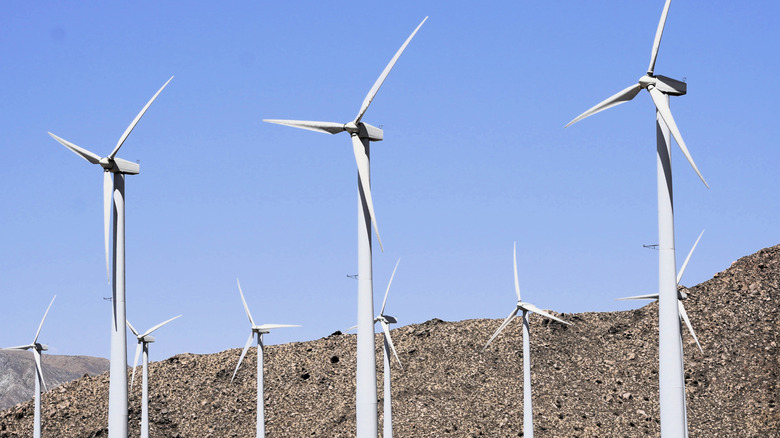
While GE Vernova might dominate the U.S. supply, rivals such as Vestas, Siemens Gamesa, and Goldwind are all hitting international milestones. In 2025, Vestas was the first manufacturer to pass the 200-gigawatt cumulatively supplied threshold, not GE Vernova. In fact, two of the five companies have a higher cumulative supply alongside Vestas, including Goldwind with 163 gigawatts and Siemens Gamesa with 148 gigawatts. GE Vernova came in fourth with 125 gigawatts. In addition, these names represent four of the five companies that have passed the milestone of over 100-gigawatts of renewable wind power installed, which is "enough electricity to power many of the world's largest economies."
Globally, renewable wind energy satisfies about 9.5% of electricity demand, with a record 178-gigawatts of wind power coming online in 2025, a 40% increase over years prior. Upwards trend or not, none of these companies have anything on China's new flying wind turbine, which is designed to float in the air, like a balloon, and help unlock power that conventional options could never reach.
Are wind turbines even viable sources of power?
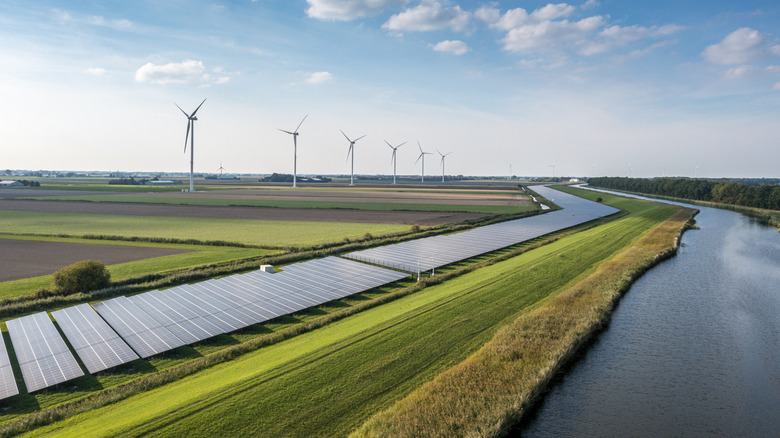
With global energy demand growing for several reasons, and nuclear energy serving as a viable alternative to conventional power, it begs the question how many wind turbines equal a single nuclear reactor? The short answer is that it would take a farm with about 800 turbines – with each turbine producing about 3 megawatts – to equal a single nuclear reactor.
It does take a lot more wind turbines and a lot more space to match the capacity of nuclear power, but turbines are more recyclable when they reach end of their life. Wind turbines last about 20 to 30 years, compared to nuclear reactors, which have a tentative lifespan about 40 years, but to date, about 94% of a wind turbine's parts can be recycled, including the foundation, tower, gear box, generator, and even more recently, the rotor blades.
When you compare wind versus solar, though, wind energy is technically more efficient and more readily available, believe it or not. Even a light breeze can generate energy with a proper wind turbine installation.