

Trump's New US Space Academy Is Coming - Here's What You Need To Know
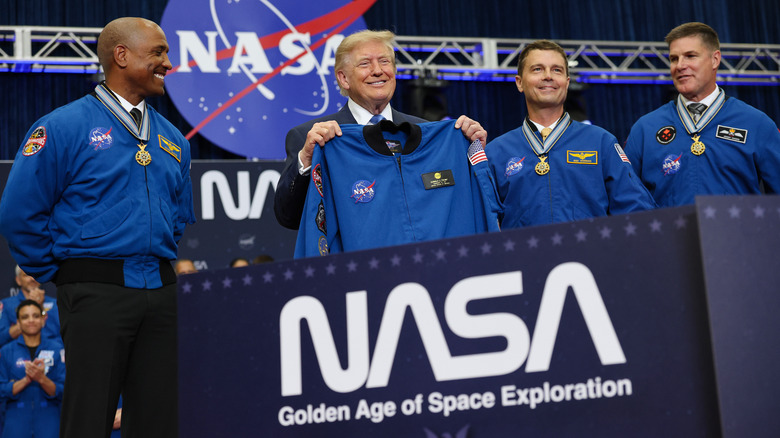
President Donald J. Trump signed an Executive Order on August 28, 2026, that officially establishes the first-ever U.S. Space Academy. As stated by the President in his Executive Order (via the White House), "it is my Administration's policy to strengthen the Nation's space workforce by expanding opportunities to educate and develop the next generation of leaders across the space domain."
An opening date for the academy has not been set yet, but the newly formed Presidential Commission on the United States Space Academy will report to President Trump within 120 days to provide recommendations on the location of the academy, governance, and other foundational policies. The Commission is chaired by NASA Administrator Jared Isaacman, and NASA Deputy Administrator Matt Anderson will serve as the executive director.
The signing of the Executive Order took place at NASA's Johnson Space Center, where President Trump also presented the Congressional Space Medal of Honor to the crew of the Artemis II mission, which took place back in April 2026. There have now been 34 recipients of this award since the beginning of the U.S. space program, which just goes to show that NASA's Artemis II mission is special from a historical standpoint. The bestowal of this award, along with the establishment of the U.S. Space Academy, demonstrates a newfound glorification of space exploration by the current Administration.
The US Space Academy is a new direction for NASA
NASA notoriously has strict hiring requirements for astronauts and other skilled staff. An "Astronaut Requirements" page published by NASA states that applicants must possess a master's degree in a STEM field and have at least two years of related professional experience obtained after degree completion, among other requirements. The opening of a dedicated U.S. Space Academy could help more people cultivate the skills needed to become a spacefaring pioneer.
The founding of this academy is also a new direction for the Trump Administration. Back in 2025, Trump wanted to kill one of the biggest space missions of our lifetime. There was genuine concern that Trump's budget cuts could halt decades of progress in space science. Even as recently as this year — shortly after the success of the Artemis II mission — new NASA budget cuts were proposed that would slice science programs' funding nearly in half. What changed all of a sudden?
In a NASA news release regarding the recent Executive Order, NASA Administrator Jared Isaacman said, "In the years ahead, we will return NASA astronauts to the lunar surface, build the Moon Base, get underway on nuclear power, ignite the orbital economy and launch more missions of science and discovery." The new direction the Administration is taking may very much be inspired by the competitive advantage that comes from pulling ahead in space.