

Which Music Streaming Service Has The Best Audio Quality?
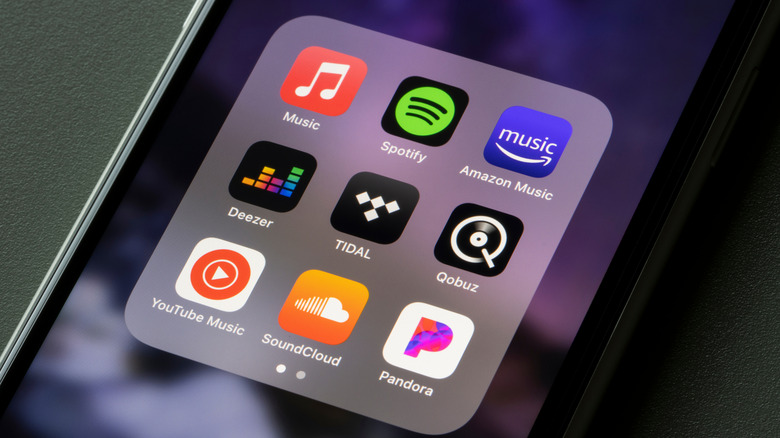
We all have access to the world's music at the tip of our fingers these days, but, sadly, not all music streaming services are created equal. Signal reliability — especially when driving through a tunnel — and content availability are obvious weak points, but hey, the highs can be just as peaky. Take high-fidelity streaming, for example: of seven major services which we've ranked from worst to best, four of them offer the absolute top quality most consumers can get from their tunes.
If audio quality is the leading concern in your next big streaming move, you should consider Amazon Music Unlimited, Apple Music, Qobuz, or Tidal. All of them offer lossless formats to varying degrees at up to 24-bit depth and 192kHz. Spotify and Deezer also offer Hi-Fi streaming, but with a lower cap of 16-bit or 24-bit/44.1kHz streaming, which nails them at about CD quality. YouTube Music only maxes out at a mediocre 256kbps using a lossy codec. Also, sorry Amazon Prime subscribers, but your complementary Amazon Music Prime does not net you those so-called HD streaming tiers.
What's the best quality for value I can get with a music streaming service?
On a purely theoretical bitrate-for-dollar comparison, Qobuz offers the best value with a basic individual plan costing just under $11 per month. Apple Music and Tidal share the runner-up spot at $12 per month, while Amazon takes fourth $13. Spotify and Deezer both offer 44.1kHz bandwidths, but the former can output 24-bit tracks while the latter is limited to 16 bits. This means even as Spotify charges $13 per month to Deezer's $12 that they end up in fifth and sixth, respectively. YouTube Music Premium brings up the rear — it costs $12 a month. Keep in mind that you can take advantage of discounted rates on student plans, family plans, and YouTube Music users can even access special rates when bundling in a YouTube Premium subscription or that plus a Google One cloud storage plan.
If you're curious about the musical math, you can calculate the maximum bandwidth of high-fidelity rates by multiplying the listed bit depth figure by the sample frequency in Hertz, and then again by the number of active channels in a song — most tracks are stereo, so in this case, it's two. As to waffling about other considerations like whether your wireless headphones' Bluetooth codec can support some of these streaming tiers, well, we'll leave that to another article.