

How Apple's iPhone Prices Evolved Over The Years
Apple is planning to hold a special media event on September 9, where the company is expected to introduce a brand new iPhone lineup. While new iPhone unveilings are always interesting, this year is going to be especially exciting in light of rumors that Apple will, at long last, introduce a foldable iPhone that may be dubbed the iPhone Ultra. Alongside it, Apple will also introduce an iPhone 18 Pro. It's a safe assumption that both devices will be markedly expensive. The foldable iPhone will be pricey because it represents an entirely new product category for Apple. And the iPhone 18 Pro may be pricier than the iPhone 17 Pro due to rising memory costs.
As a frame of reference, the iPhone 17 Pro debuted with a sticker price of $1,099. Meanwhile, the iPhone Ultra may retail for as much as $2,399. Of course, the actual cost is never a sure thing until Apple officially announces it. Still, the four-figure pricing on Apple's premium iPhones raises an interesting question: How has the price of an iPhone evolved over the past 19 years?
The original iPhone made a huge splash when first introduced in 2007. There was nothing else like it on the market, and the device proved to be revolutionary in many respects. It's fair to say that the original iPhone not only changed how we use mobile devices, but also created the blueprint that still defines smartphones today. Let's take a look at how that blueprint has evolved with the times.
2007-2020: The original iPhone and carrier subsidies
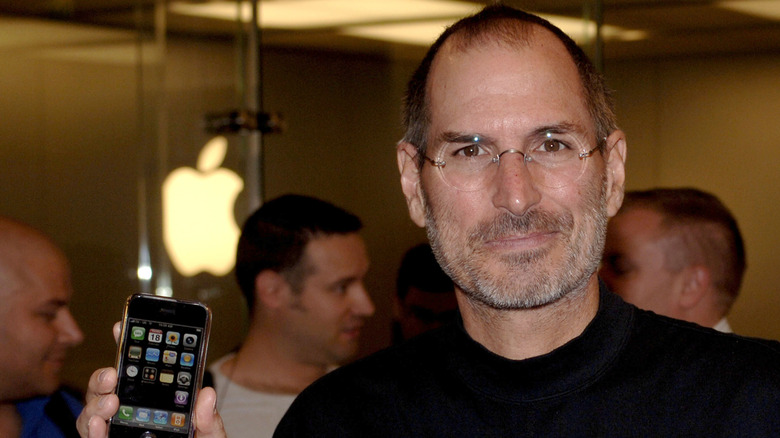
When first unveiled, the original iPhone was priced at $499. That may seem surprisingly cheap given how pricey iPhones are today, but bear in mind that $499 in 2007 is equivalent to about $800 in today's dollars. As a point of comparison, Apple's entry-level iPhone 17 costs about $799.
After the initial iPhone release, Apple and AT&T (which was the exclusive iPhone carrier at the time) made a concerted effort to make the device more affordable. When Apple released the iPhone 3G in 2008, the entry-level price dropped down to just $199. If we take inflation into account, a $199 iPhone 3G in 2008 is equivalent to $302 in today's dollars. The caveat to the $199 price tag is that customers looking to take advantage of that price point had to sign up for an exclusive two-year contract with AT&T. Customers were more than happy to do so, and iPhone sales continued to boom.
Notably, the entry-level price for a carrier-subsidized iPhone remained at $199 for several years. Consequently, there were some years where a new iPhone was available for an astonishingly low price. For example, a $199 iPhone 6 in 2014 is equivalent to $279 in today's dollars. Suffice it to say, Apple's iPhone pricing matrix in the 2010-2015 era provided users with a lot of bang for the buck.
By the time Apple released the iPhone 7 in 2016, carrier subsidies had started to go away and iPhone prices began to increase. With the release of the iPhone 8, the entry-level price for a new iPhone jumped to $699. When Apple released the iPhone 12 in 2020, the entry-level price for a standard iPhone model jumped to $799. Incidentally, $799 in 2020 dollars is equivalent to $1,025 in today's dollars.
2020-present: Keeping the base-model iPhone priced to sell
To its credit, Apple kept the $799 entry-level price unchanged for five years. At the same time, the value proposition for a new iPhone increased as Apple added features like bigger displays, Face ID, and more impressive hardware. For example, the iPhone 17 ships with 256 GB of storage. In contrast, the base iPhone 12 also launched for $799 but only came with 64 GB of storage. In 2022, meanwhile, entry-level storage on the iPhone 14 was 128 GB.
While Apple managed to keep entry-level pricing steady, the company started raking in money when it began offering Pro models. As a point of interest, the iPhone 11 Pro debuted at $999. Apple managed to keep the starting price on its Pro models at $999 for years, all the way until the iPhone 17 Pro debuted at $1,099.
The Android equivalent to an entry-level iPhone is probably Samsung's Galaxy S series, which debuted in 2010. Interestingly, the unsubsidized price of Samsung's Galaxy S series over the years lines up very closely to Apple's iPhone pricing. For instance, an unsubsidized iPhone 5 retailed for $649 in 2012, while the 2012 Galaxy S III was $599. The Galaxy S6 in 2015 ranged from $650 to $685, while the iPhone 6s retailed for $649.
These days, iPhone and Galaxy S pricing mirror each other closely, especially when looking at the pro models. Over the last six years, iPhone Pro pricing remained steady at $999 up until last year's iPhone 17 Pro. In that same timeframe, Samsung's Galaxy S+ models stayed steady at $1,000. Put differently, if you're in the market for a new smartphone, you won't find much of a price difference between an iPhone or iPhone Pro and an equivalent device from Samsung.