

The 5 Best Humanoid Robots Of IFA 2026
IFA 2026 has three big focuses: wearables, AI, and robotics. While these have been hot topics for the past few trade shows, it's interesting to see a general growth in the amount of humanoid robots being promoted. More interestingly, while a few years ago, these products were just a glimpse of the future, most of the robots exhibited are already real-life devices that, if they haven't been out for a while, are just around the corner of being introduced in the Chinese, European, and/or American markets. Among the several brands exhibiting at IFA, BGR got excited about PrimeBOT's Q1 robot, a mini humanoid-like option that's made for AI research, classrooms, and home companionship, Zero's W1, which resembles Disney's Wall-E, and even the scary EngineAI T800 — the robot known for kicking its own CEO's ass.
During the trade show, BGR saw these robots demonstrating their kung-fu capabilities, latest K-pop movements, and even sports skills by scoring goals and celebrating like famous soccer players. While we still think these robots look mainly funny and they're a way of generating brand awareness, what intrigues us the most is the fact that these companies have been really serious about already deploying them for factories, B2B customers, and now tackling the B2C market.
While 2026 might not be the year you'll get a humanoid robot for Christmas, it's impressive that you could — and even IFA's CEO agrees: "This year, we're seeing more humanoid robots at IFA than ever before. It shows that robotics, AI and new interfaces are becoming an increasingly integral part of people's everyday lives," said Leif Lindner.
PrimeBOT Q1
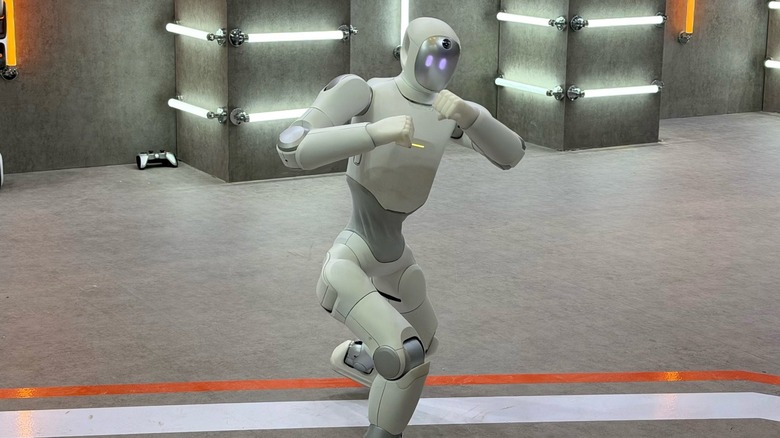
BGR's first stop was visiting the PrimeBOT Q1 robot. Unveiled at CES 2026 early this year, the company says the device will become available in China starting later this September, with a price tag still to be announced and a focus in academic studies for global research laboratories and interactive home companionship. Being 88 centimeters tall, this short king robot is designed with a focus on portability and domestic safety. It has 22 degrees of freedom powered by quasi-direct drive joints and full-body force control, allowing it to navigate environments with ease. During the trade show, BGR saw this robot kicking, defending itself, and even dancing. PrimeBOT says is features more than 10 martial arts movements.
PrimeBOT also showcased how simple it is to customize, as customers could 3D print parts to make the robot resemble a famous movie character, a proper futuristic robot, and more. With up to three hours of battery life, this robot can be a fun companion for families, run 3.2 meters per second in open air, and even work as emotional support for family members. Users can control it by voice, app, or a remote control.
During the show, the executives present would also often take the robot by hand to walk it around, take some pictures, and then make it go back to kung-fu training — it felt like Goku was being trained in front of me.
Booster K1
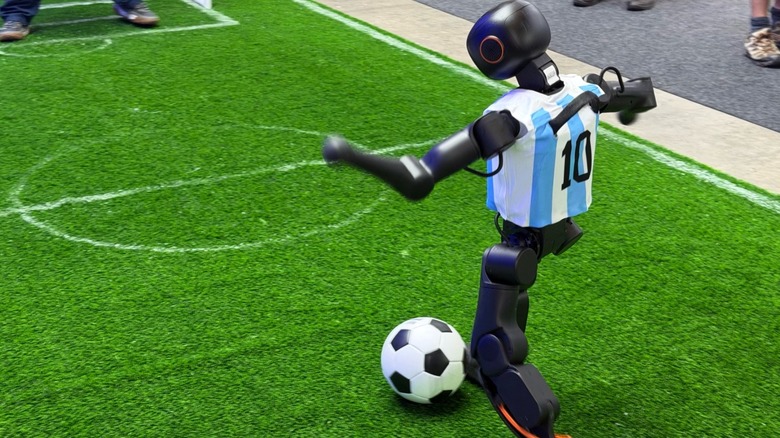
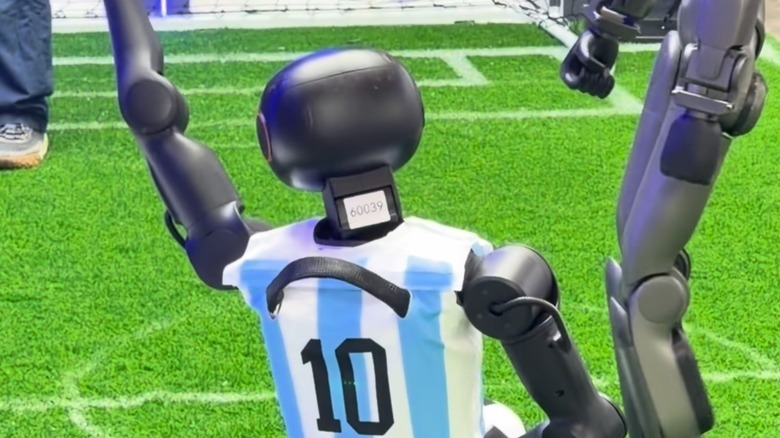
Possibly the funniest robot BGR saw so far, the K1 model is made by the Beijing-based Booster Robotics company. Already available in China, the U.S., and Europe, this robot starts at $5,999 but can go over $10,000 depending on the compute tier, and it can be key for university engineering programs, AI laboratories, trade exhibitions, and even international robotic competitions.
At 95 centimeters and 19.5 kilograms, the K1 robot looks like a kid ready to go to soccer practice — and having it wear Lionel Messi's Argentina jersey helped set the mood. At the trade show, we saw the robot dancing, fighting, and even kicking a ball to the goal — with surprisingly a lot of strength and accuracy for most of the time. Still, it was interesting to see the robot celebrating like Cristiano Ronaldo and other players even when it kicked the ball further away from the goal, or getting too close to attendants just to "make fun."
Jokes aside, the K1 can scale from a 48 TOPS base module up to an NVIDIA Jetson Orin NX or AGX Orin options with up to 200 TOPS of onboard AI processing. It features a binocular 3D depth camera, a 9-axis IMU, and an omnidirectional microphone and speaker array. This product supports Python, ROS, and ROS 2, and it's powered by a swappable battery delivering 50 to 80 minutes of runtime, with sub-one-hour rapid charging.
EngineAI T800
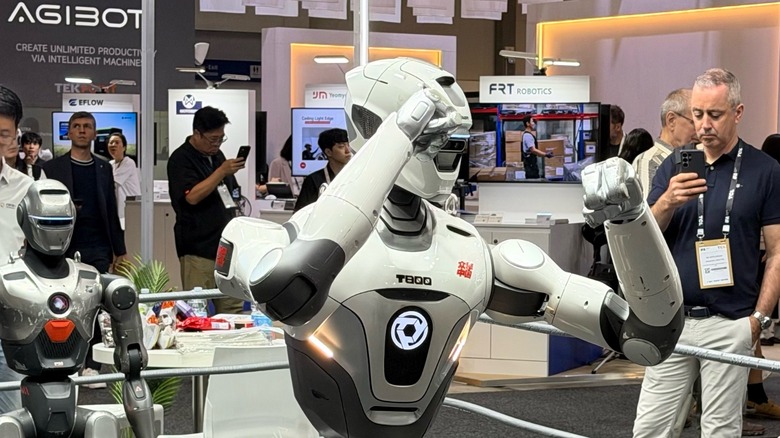
Walking away from cute, short king robots, BGR also once again featured EngineAI's T800 humanoid robot and, trust us, you wouldn't like to meet this robot in a dark alley. Known for its force and even working as police patrol in China, this robot focuses on heavy-duty, and high-mobility. Available in Asia, the T800 model is 173 centimeters tall and is made of aviation-grade aluminum alloy panels with hollow internal wiring. With 29 degrees of freedom, it delivers up to 450 N·m of peak torque. This robot can exceed speeds of 3 meters per second, alongside high-impact movements, such as martial arts techniques. Its kick, for example, can throw a person two meters away — not that we tested, fortunately.
With a somewhat terrifying look, this humanoid robot was inside a fight ring distributing punches and kicks in the air. From the looks of some German kids around, they were probably only expecting cute robots. Still, what continues to impress the most in one of the best-known robots on the market is how well built it is.
The T800 features multi-modal 7-DoF dexterous hands capable of lifting 5 kilograms per arm with built-in tactile feedback. Its perception and computation hardware consist of 360-degree LiDAR, Intel RealSense depth cameras, an Intel host processor, and an onboard NVIDIA Jetson Orin NX computing unit, which delivers millisecond obstacle detection. This robot also features a standard ternary lithium pack or an option 74.8V 40Ah modular solid-state battery that powers it up to 5 hours of continuous usage.
Agibot A3
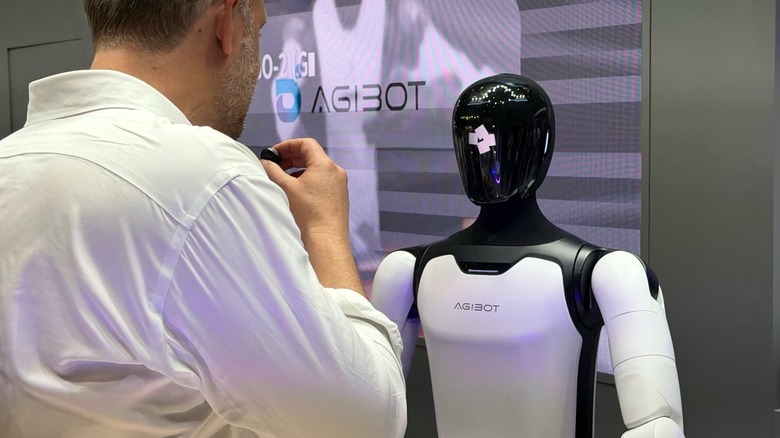
Recently introduced, Agibot continues to make the headlines by developing cutting edge robots on a large scale. With the latest A3 model, this robot is also 173 centimeters tall, weighs 55 kilograms, but its far from being scary. Even though the company also highlights how it could fight, Agibot showcased a more interesting approach at the trade show — the robot's writing capabilities. With a modular OmniHand, it features up to 12 active degrees of freedom, tactile force arrays, and sub-millimeter positioning repeatability to let the robot grip a pen or stylus and write in traditional Chinese calligraphy.
With an ultra-lightweight exoskeleton framework constructed from magnesium-titanium alloys and thermoplastic polyurethane, it delivers 12 kilowatts of peak power, and can achieve an impressive power-to-weight ratio of 0.218 kW/kg, allowing this robot to perform fluid choreographies, high-speed walking, and traditional martial arts practices. It features a dual-battery pack with up to 10 hours of continuous operating time, besides a 10-second hot-swap mechanism for non-stop stage performance. This robot integrates UWB radio to deliver centimeter-level spatial awareness, which means several of these products could be synchronized to perform simultaneous routines.
Agibot's A3 robot features a 360-degree multi-array microphone system, dual-module 5G connectivity, and shoulder touch sensors for responsive physical engagement. At the trade show, BGR attendees focused on talking to the robot and understanding its latest advancements in comprehension, speech, and more.
Zero W1
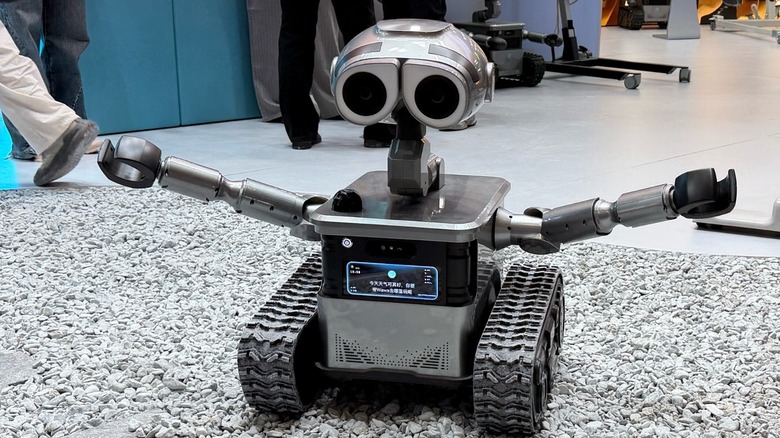
Last but not least, BGR saw the Zero W1, which is also known as the Zeroth W1. Available in the U.S. and China, it costs $7,999 and resembles Disney's Wall-E. In a bipedal form factor, this robot can navigate through any terrain for everyday physical chores, like carrying things or monitoring your home, and also entertain families by playing games, offering a video display, and more.
This robot is 68 centimeters tall, measures 578 mm by 520 mm across its base and weighs 28 kilograms. It features an eight-core Horizon Sunrise processor running an onboard perception and navigation stack. The robot can tilt both its head and big eyebrows, and has up to 25 hours of battery life, requiring four hours to completely recharge. The company says it can operate at speeds up to 1 meter per second on flat ground and 0.5 meters per second on slopes, which means it can handle rough terrain without issues. The W1 supports a 20-kilogram cargo carrying payload and up to 50 kilograms of pulling traction, making it great to carry outdoor gear, tools, or supplies.
The robot features a LiDAR scanner, a 13MP camera for shooting, and a 2MP option for monitoring, in addition to a RGBD depth camera. It features a built-in GPS, human infrared sensor, works with 4G and offers a dual-band Wi-Fi 6 connectivity, making it ready for indoor and outdoor tasks.