

This Startup's Unique Turbine Design Could Solve A Big Problem With Wind Energy
There's no denying that renewable energy will play an important role in the future, but critics often argue that initial costs make it less viable. There are valid disadvantages of wind energy that scientists are trying to overcome by using some alternative methods, such as experimenting with using wood for wind turbines because the material is easier to recycle. Surprisingly, that's still not as radical as the idea that Wyoming-based Airloom Energy has developed.
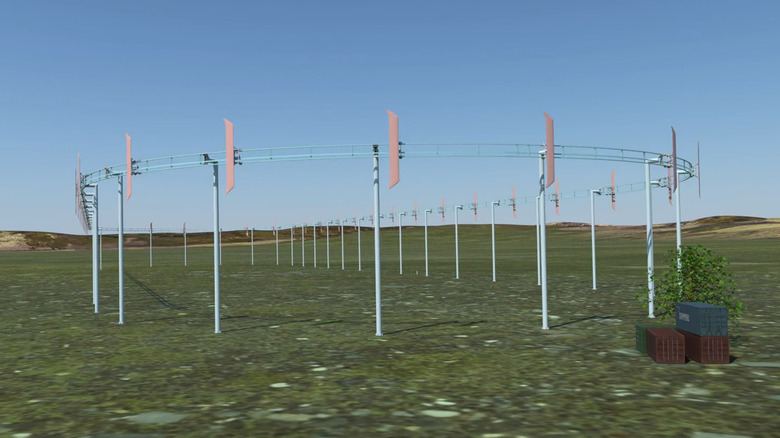
In addition to high noise and lower output, wind turbines aren't as popular as solar because an average turbine has specific requirements for elevation, wind speed, and land. Airloom's design, while experimental in nature, has redesigned the concept of wind turbines from the ground up. How does Airloom work? The design uses a group of poles (up to 100-feet tall) arranged in an oval and attached to these poles is a cable system connected to numerous vertical airfoil wings. As wind hits the vertical wings, the cable moves around the track to generate electricity.
Per Airloom, the unit can be installed anywhere, and it's being developed with disaster relief and military defense scenarios in mind. All this combined, results in a product that is 50% cheaper to operate per square meter than a regular turbine, which would make the system more affordable and accessible. And that's exactly what renewable energy will need to convert the naysayers.
Is Airloom design better than traditional wind turbines?
Airloom claims that its system has 42% fewer parts and 40% less mass than a traditional wind turbine. This means the parts are smaller, which allows them to be easily mass-produced and, more importantly, the system can be transported with regular shipping trucks — one such example is the airfoil wings, which are 30-feet tall compared to wind turbine blades that are 180-feet long. Whether the new design can be deployed at scale remains to be seen as the commercial demonstration is not expected until 2027.
Yet, Airloom made significant strides in recent years. After a prototype stage in 2023, the team put together a pilot design that was presented at CES 2026 and was voted the 2026 Honoree in Sustainability & Energy Transition. Major players are already backing the project, which may indicate that there is huge potential if the design delivers on its promises. Bill Gates' Breakthrough Energy is on board, for instance, and so are other climate-conscious organizations like Crosscut and MSJ, to name just a few.
If successful, regions will have a way to scale wind energy much faster and with fewer restrictions. Airloom's wind energy system can reportedly stay operational for at least 20 years in harsh environments, which is around the same lifespan as a regular wind turbine. This is a big deal, especially when you consider this system promises to produce "more energy per square kilometer" than today's wind turbines.