

Scientists Turned Antarctic Ice Into The First Of Its Kind Particle 'Telescope'
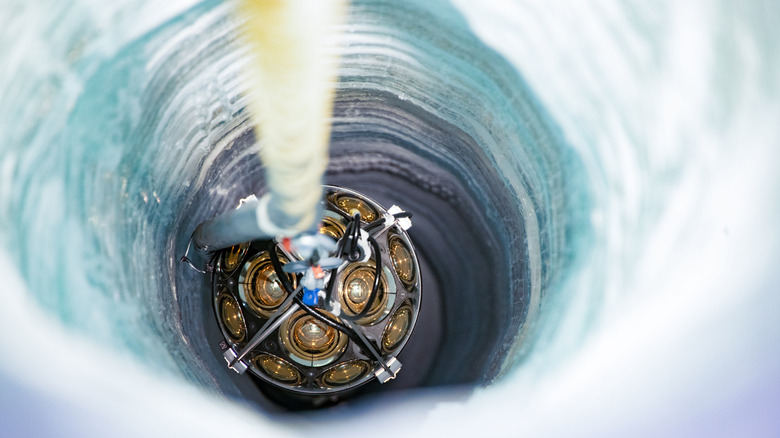
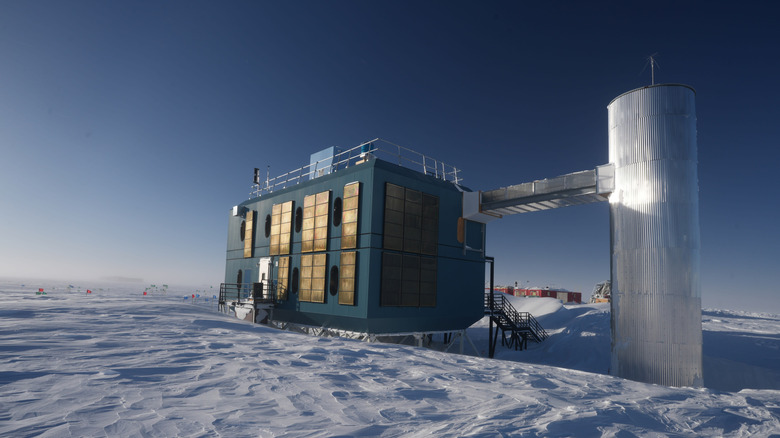
Deep beneath the ice of Antarctica there's a telescope, embedded in the ice, ready to spot the world's most elusive particle: the neutrino. The traces neutrinos leave behind when interacting with matter can tell us about how the universe evolved and how its most violent environments work. IceCube Neutrino Observatory is a special kind of telescope – a particle detector — buried up to 8,000 feet beneath the South Pole. It stretches through an enormous section of Antarctic ice about 3,300 feet tall and about 3,300 feet wide. More than 5,000 light sensors are frozen inside for the rare detection.
Neutrinos are subatomic particles produced by nuclear reactions and the decay of other particles throughout the universe. They have little mass, carry no electrical charge, and rarely interact with matter. Detecting neutrinos can reveal details of extreme cosmic events like matter falling into black holes, neutron-star mergers, and supernovae that ordinary light cannot explain. IceCube doesn't spot neutrinos directly. On rare occasions, a neutrino will interact with the ice. It creates charged secondary particles that travel through the ice, emitting blue Cherenkov light, which is recorded by IceCube's optical sensors. The ice at the South Pole is well-suited for detection. It's clear, stable, and mostly free of air bubbles that scatter light.
Natural ice is not perfect. It contains dust that also scatters light and ice crystals that deflect light. These factors are why scientists just upgraded IceCube for the first time since its completion in 2010. They added hundreds of new, enhanced light sensors that are two-to-three times more sensitive than the older sensors. There are also new calibration instruments that allow them to measure the ice around IceCube more precisely, helping them better analyze 15 years of archived data.
What scientists hope this Antarctic particle telescope can discover
Neutrinos race toward Earth after violent explosions and collisions from across the universe. Reading their direction, energy, and timing is like doing forensics on a splash of blood at a crime scene. Scientists can work backward from the particle to the cosmic event, helping them understand physics that cannot be reproduced on Earth. A neutrino blasted toward Earth during a neutron-star or black-hole merger could reveal where particles are being accelerated. By pairing a neutrino with gravitational waves from the same merger, scientists could learn how the collision accelerates particles and affects matter.
A burst from a galactic supernova could expose what happens deep inside a collapsing star. Neutrinos escape from its dense interior almost immediately. Light gets trapped in gas and dust released by the explosion. Detecting the neutrinos would give astronomers tn early warningime that a supernova is underway, allowing them to aim telescopes at the event before its visible light arrives. Physicists could study the gap between the neutrino burst and the first visible light to learn how it collapsed and how the explosion traveled through the star. It would help make clearer what the inside of a dying star looks like.
Gamma-ray bursts can erupt billions of light-years away. Scientists know these bursts can launch extremely powerful jets that may help explain how nature accelerates particles to energies no machine on Earth can reach. However, they don't know exactly how those jets accelerate particles or whether gamma-ray bursts help produce ultra-high-energy cosmic rays. Finding neutrinos from a gamma-ray burst would give scientists the first direct evidence that these explosions can produce them. Scientists at IceCube will have time to keep looking. The National Science Foundation approved $53 million to keep the project going through 2031.