

Who Owns MapQuest, The Google Maps Alternative?
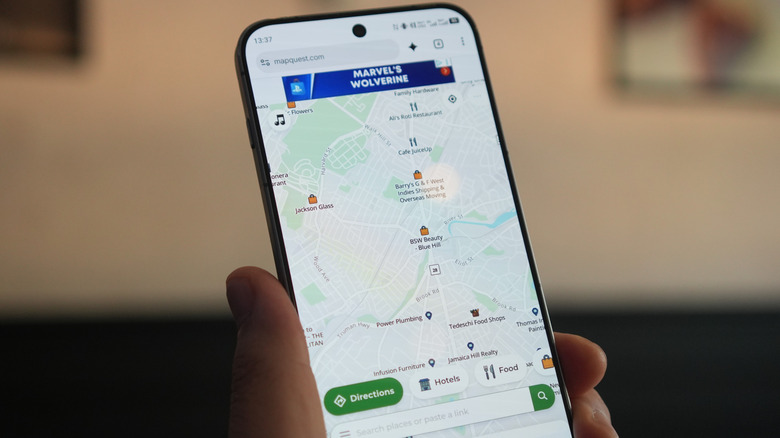
Cartography service MapQuest made waves on social media for its stance against the United States changing official designations of geographic features, including the conversion of Lake Ontario to Lake America. The company's refusal to recognize the new name has helped it dethrone Google Maps from the app store leaderboards. But before there were mobile app stores and before there was even a Google Maps, millennials and Gen Xers fondly remember gathering and printing out turn-by-turn directions from MapQuest, one of those new-fangled internet websites.
The company is a subsidiary of advertising tech firm System1, which owns other brands including Answers.com, a competitor to Q&A site Quora that centers its primary experience around AI chatbots, and search engine StartPage, among others. MapQuest's ad-forward experience pushes local businesses as the first pins you see, linking to Yelp for reviews or Booking.com for hotel reservations, and so on.
Under System1's tenure, MapQuest has also started up a new subscription service called Lighthouse where families and people on one shared account can track the location of each member as well as the battery levels of their phones. At $6.66 per month, however, it's a steep ask when you put it up against free real-time location sharing methods. Given how Systems1 was incorporated in 2013, though, you might be curious about how MapsQuest actually started out.
A condensed history of MapQuest
MapQuest's origins came with the convergence of R.R. Donnelley & Sons, a 19th-century Chicago-area print shop that grew into an international marketing powerhouse over the decades, and Spatial Data Services, a late '80s startup focused on digital mapping. SDS was working on a digital trip planner product and successfully pitched RRD on a joint venture, which eventually led to GeoSystems Global in 1994. Two years later, MapQuest hit the ground running.
GeoSystems renamed itself MapQuest upon its IPO on the Nasdaq exchange in 1999 and was actively seeking a buyer. It would get one in America Online by the end of the year, though at a significant undervaluation. Infamously, AOL would then proceed to merge with Time Warner shortly thereafter. James Killick, a veteran of MapQuest and the Apple Maps team, characterized AOL-Time Warner's tenure as chaos. In a lengthy post about MapQuest's history in the Map Happenings blog, Killick described layoffs of MapQuest's entire home base office, including the legacy map-printing operations that were responsible for most of the company's income, and a lack of mission besides milking advertising inventory. And if your ad revenue as a dot-com company isn't doubling every year, then what's the point, right?
MapQuest would remain in AOL's portfolio through the years, even when the Time Warner merger was undone in 2009, and AOL was building out its media business, acquiring TechCrunch and The Huffington Post. Verizon acquired AOL in 2015. It wasn't until 2019 that System1 picked up MapQuest from Verizon, ending two decades of association with AOL.