

These Two Upgrades Made Filming The Odyssey Entirely In IMAX Possible

The gods might've been against Odysseus on his mission home, but one person they weren't going to stop was the filmmaker daring to bring the journey to life in the biggest way possible. After reaching this point in his career, some parts of Christopher Nolan's to-do list were easy. Assembling one of the biggest star-studded casts in movie history outside of a Marvel movie was small-potatoes-level stuff. It was getting them all on camera in his favored filming format, which proved to be the real undertaking.
Having tinkered with IMAX since his second bout with Batman, Nolan's "The Odyssey" needed to be groundbreaking on so many fronts. Not only was it the director's first movie shot entirely in the format, it was also the first movie to do so, period. That task might sound simple, given that the Oscar-winning filmmaker has given audiences massive sequences in some of his great science fiction movies and used one of the best sci-fi movie motorcycles in a chase scene in "The Dark Knight." But an IMAX camera is a beast. Larger than normal cameras, they can be so loud that any scenes involving cast members having lengthy conversations can get completely drowned out by the sound of the machine at work.
This, along with a few other hitches, was something Nolan needed to overcome to deliver the epic he was aiming for. It seems fitting, then, that in an effort to get a hold of this new and elusive kind of movie magic, he resorted to good old-fashioned mirror tricks to get the job done. And a blimp.
Silence was golden when filming The Odyssey
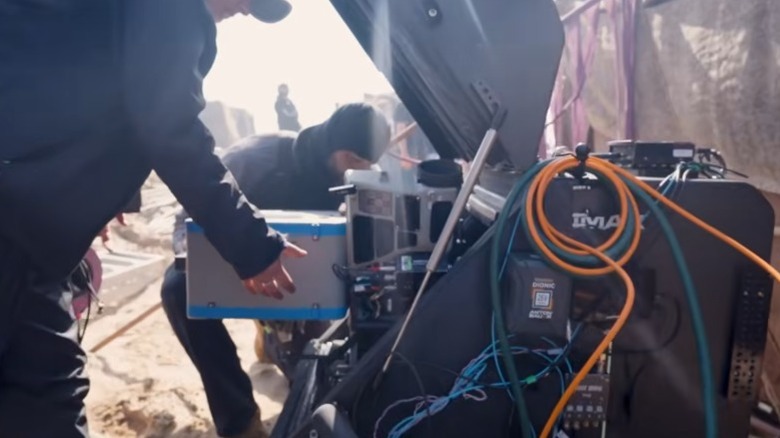
It's nothing new to be asked for quiet on set, but with an IMAX camera, that's a lot harder to come by. To kill the noise of Nolan's most beloved bit of kit, a special kind of casing was created. Nicknamed "the blimp," the contraption encased the camera in a box to absorb the sound it made, picking up even the most hushed conversations. "The blimp system is a game-changer," Nolan told Empire. "You can be shooting a foot from [an actor's] face while they're whispering and get usable sound. What that opens up are intimate moments of performance on the world's most beautiful format."
Problem solved, then? Well, not quite. With the cameras now wearing an extra bit of soundproof armor, the issue was getting the actors to work around them. Just because a now 400-pound camera stopped sounding like an industrial air conditioner, it didn't mean it was smaller than one. A simple camera setup that could be placed between Nolan's stars now needed to be reworked, so that their performances weren't hindered in the heat of the moment. For that, the director applied a pretty ingenious method to get the job done that even its star agreed eventually became barely noticeable upon reflection.
Mirrors helped The Odyssey in its most emotional moments
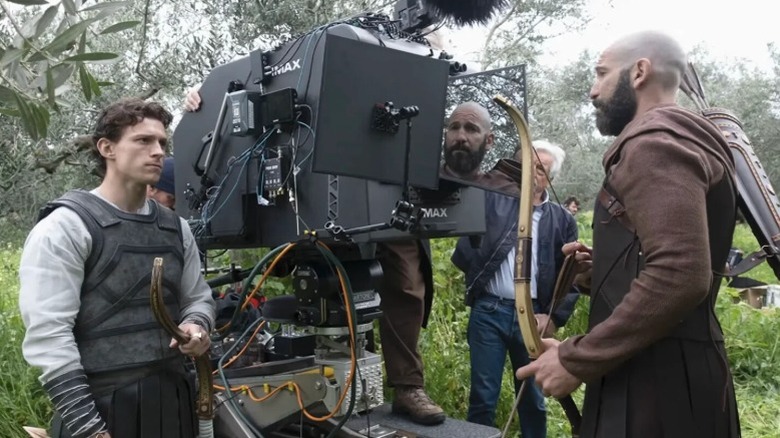
Any self-respecting actor would agree that a scene can really soar if they can react to their screen partner. To make sure Nolan's big-screen team could do this, even with a camera built like a Transformer, they used a clever mirror-placement technique to get the job done. Lining them up just so around the camera units let Matt Damon, Tom Holland, Anne Hathaway, and company avoid losing eye contact and stay in the emotional moments being mapped out for them.
It might sound like a struggle, but the cast took to the process with ease, with even the movie's leading man confessing that he quickly forgot he was looking at reflections of his co-stars, rather than doing so directly. "The effect worked seamlessly. And in fact, I was talking to Anne about this yesterday because I realized that, in my memory of doing that very intimate scene with her at the end of the movie, I don't remember it being a mirror," Damon told Collider. "I remember I was so dialed into Annie's eyes that I just remember Annie being right there, and she was, she was right there, but I was doing it to the mirror. But it worked. It worked really well."
Now, following "The Odyssey's" booming success (especially in IMAX) and Herculean efforts to get the job done, it's a wonder if Nolan will reapply these techniques in any of his future projects, or more importantly, whether any other directors will give it a go and deliver movies as epic as this one. Well, they can try, at least.