

What's The Difference Between Data Centers And Crypto Mining?
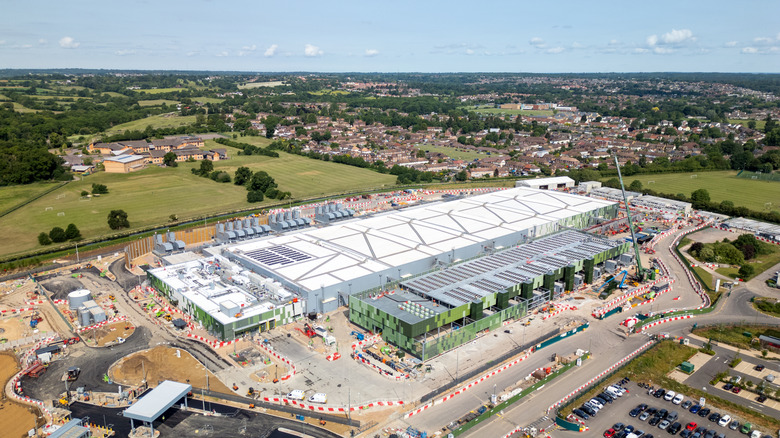
Almost everybody has a personal computer, but it's the servers that keep their modern services running. You pay a subscription for a streaming app? Servers house all the shows and movies you watch. You play games like "Final Fantasy XIV" and "Fortnite"? All your progress and ability to communicate with other players relies on servers. However, not all servers are built the same, and the differences are best illustrated by comparing data centers and crypto mining operations.
The differences start with the purposes. Crypto mines produce currency (depending on your definition) by solving complicated math problems. The more problems a mining program solves, the more "money" it generates. Meanwhile, data centers support AI models, from their computations to their learning. Furthermore, while multiple users can access data centers and the AI models they house, each crypto mining operation is reserved for one user. The differences branch out from there.
All data centers and crypto mines rely on components operating in parallel, with countless operations carried out at the same time. The more components an installation uses, the more calculations it can handle. Crypto miners primarily rely on GPUs (what few there are after the crypto market sank). These rigs still need CPUs and RAM — only enough to maintain multitasking — but the graphics cards are the main draw. Data centers, meanwhile, use the same components, and while GPUs still do most of the heavy computational lifting, data centers need way more RAM than crypto miners to provide a near-constant stream of data and then send the results to users.
The price of doing business
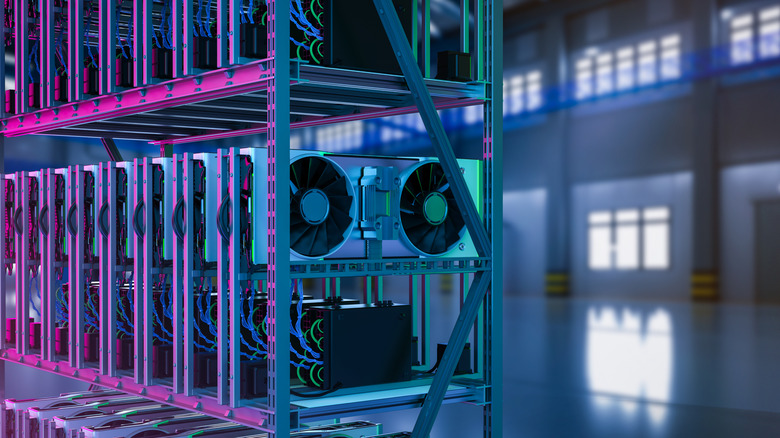
At the end of the day, both data centers and crypto mining rigs perform innumerable computations in parallel, but the same could also be said of modern computers. What truly sets them apart is the requirements needed to maintain their performance.
While both data centers and crypto mines are energy intensive, AI models require way more power than crypto. For example, two crypto facilities in Sandersville, Georgia consumed enough energy to power around 110,000 households, whereas two similar data center facilities in Atlanta gorged themselves on enough electricity to keep about 458,000 houses lit. And yet despite that electricity going to large corporations, the average citizen is still paying ever-increasing power bills.
An exponential power drain isn't the only side effect of running data centers and crypto mining facilities. People complain about the harm these locations cause, from noise pollution to water contamination, but again, data centers cause more harm than crypto mines. AI servers require more effort to stay cool — mostly because they are more sensitive to temperature changes — and thus require more water and electricity to achieve that goal. Somewhat ironically, data centers generally use more sophisticated cooling solutions than crypto mining buildings, which can rely on cheap fans yet still function. But this design makes crypto miners generate more noise, which is saying something since data centers often produce noises up to 96 decibels — well beyond the threshold of sounds harmful to human hearing.